Blog
The Ultimate Guide to Fixing a Garage Door That Won't Close
Door Serv Pro
Reviewed by the Door Serv Pro service team · Trained, professional garage door technicians
Last updated June 24, 2026
Why a Non-Closing Garage Door is More Than Just an Inconvenience
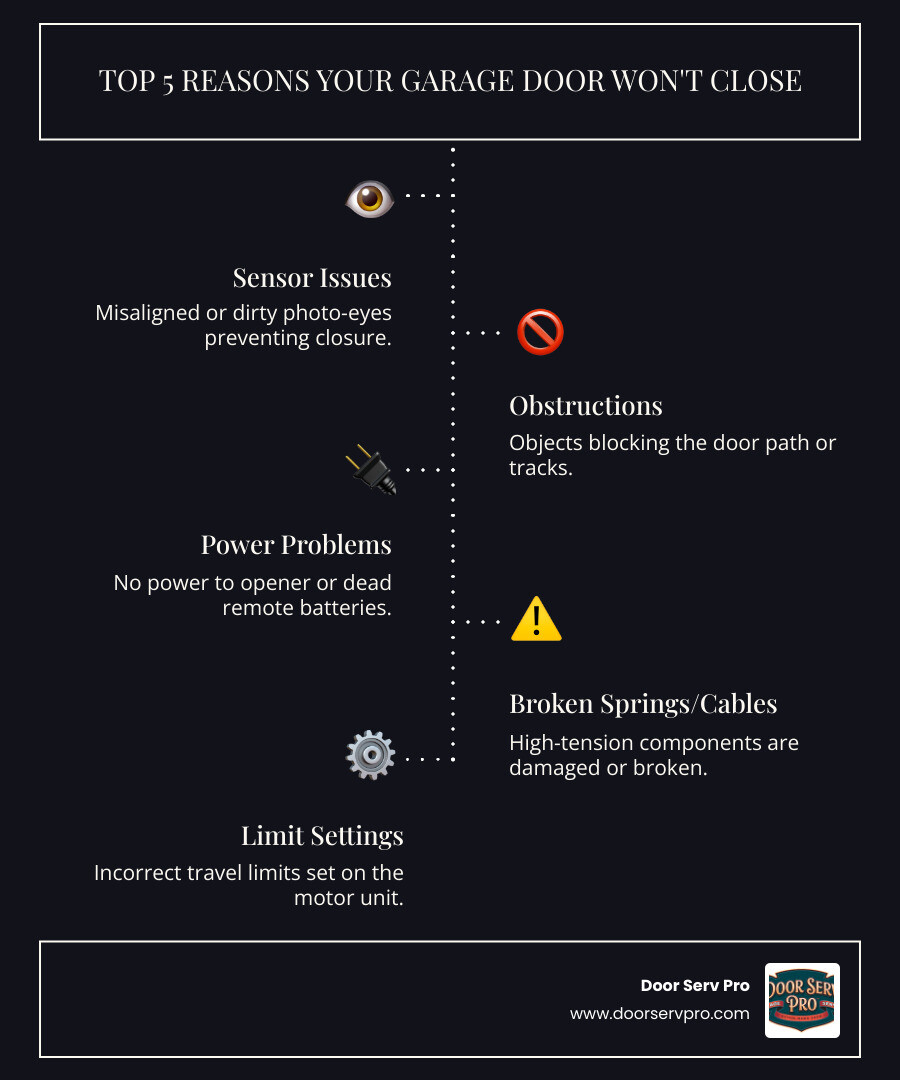
Garage door not closing properly is one of the most frustrating problems homeowners face. Nothing is worse than coming home and finding that your garage door won't close, leaving your car and belongings exposed to the elements and potential theft.
Quick Fix Checklist for a Garage Door That Won't Close:
- Check the power - Ensure the opener is plugged in and circuit breaker is on
- Test the remote - Replace batteries and try the wall button
- Inspect safety sensors - Clean lenses and check for obstructions or misalignment
- Clear the tracks - Remove debris and check for bent rails
- Adjust limit screws - Fine-tune the down-limit setting on the opener motor
- Call a professional - For broken springs, cables, or persistent issues
A garage door that refuses to close creates serious security risks for your home. Modern garage doors have multiple safety features that can prevent closing, including photo-eye sensors that detect obstructions and limit switches that control travel distance.
The good news? Most garage door closing problems have simple solutions you can handle yourself. From dead remote batteries to misaligned sensors, many issues take just minutes to fix once you know what to look for.
However, some problems - like broken springs or damaged cables - require professional expertise due to safety concerns. Garage door springs are under extreme tension and can cause serious injury if handled improperly.
This guide walks you through a systematic approach to diagnose and fix your garage door closing issues, starting with the simplest solutions first. We'll cover everything from basic power checks to when it's time to call Door Serv Pro for professional help.
Step 1: Quick & Easy DIY Checks
When your garage door not closing issue strikes, don't assume the worst. Often, the simplest solutions solve the problem. Before worrying about expensive repairs, walk through these quick checks that might have you back in business in minutes.
Checking the Power and Controls
Start with the basics: power. Many service calls are due to an unplugged opener or a tripped circuit breaker.
Check your power cord and outlet first. Walk over to your garage door opener and make sure it's plugged in securely; vibrations can work the plug loose. If your opener is connected to a GFCI outlet (with "test" and "reset" buttons), press the "reset" button.
Head to your electrical panel if the outlet is fine. Find the garage's circuit breaker and flip it completely off, then back on. Power surges can trip breakers.
Don't forget about the manual lock. Many garage doors have a manual slide bolt or T-handle lock on the inside. If this was accidentally engaged, the opener will run but the door won't move. Ensure this lock is disengaged.
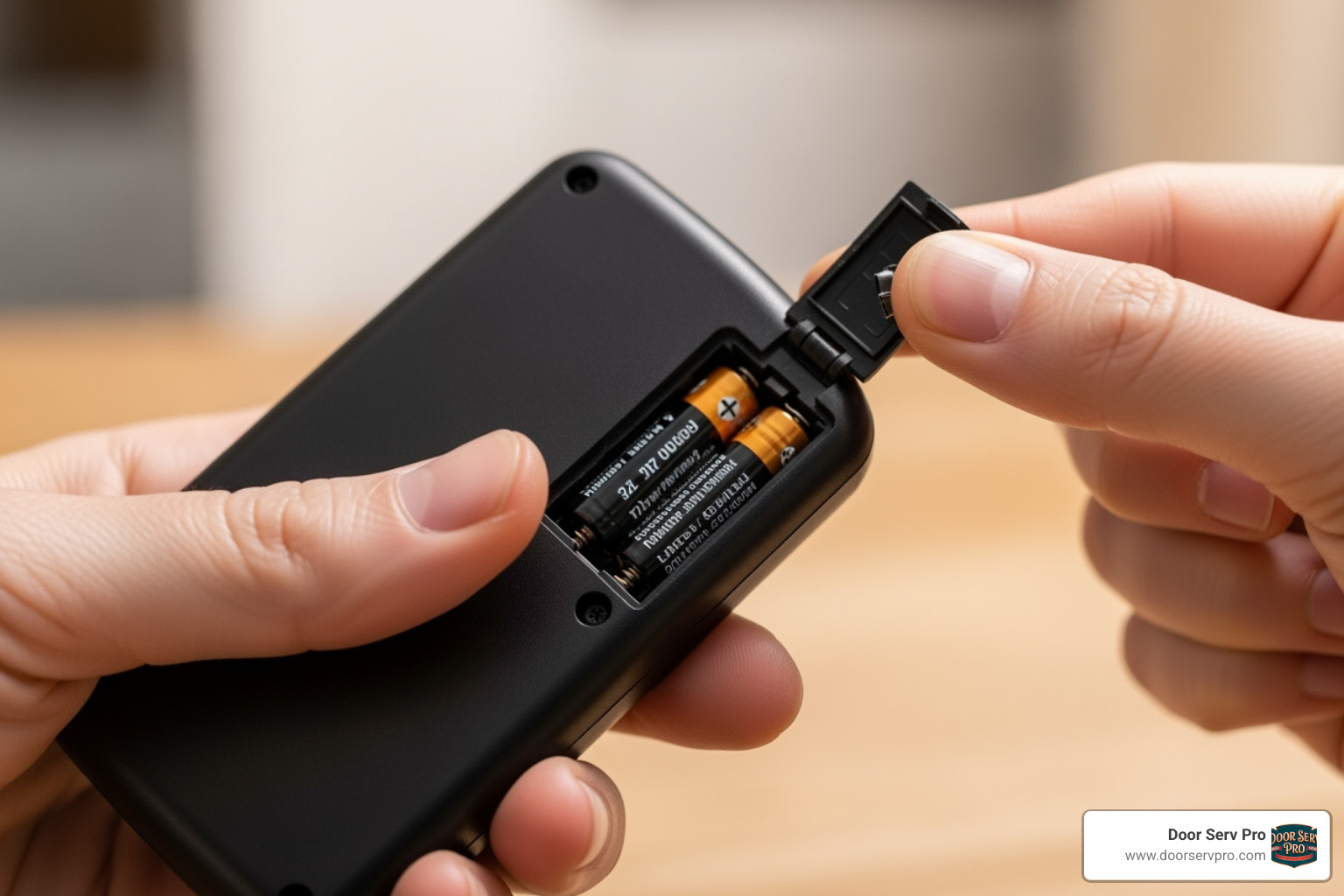
Test your remote control batteries next. If the wall button works but the remote doesn't, try replacing the batteries. If that fails, you may need to reprogram it. Press the "learn" button on the opener motor, then press a button on your remote to sync them.
Pay attention to how the wall button behaves. If the door closes perfectly with the wall button but ignores your remote, you have a remote issue. An important clue: if you must hold down the wall button to close the door, it indicates a safety sensor problem, which we'll cover next.
Watch for blinking lights on your opener's motor unit. These are diagnostic codes. Count the blinks and consult your owner's manual to understand the error.
These simple checks solve more garage door not closing problems than you might expect. If none of these steps get your door working, don't worry - we're just getting started with our troubleshooting journey.
Step 2: Inspecting and Aligning the Safety Sensors
If your garage door not closing issues persist after checking the power and controls, it's time to check the safety sensors. These small devices near the bottom of the door frame are the most common culprit when a garage door refuses to cooperate.
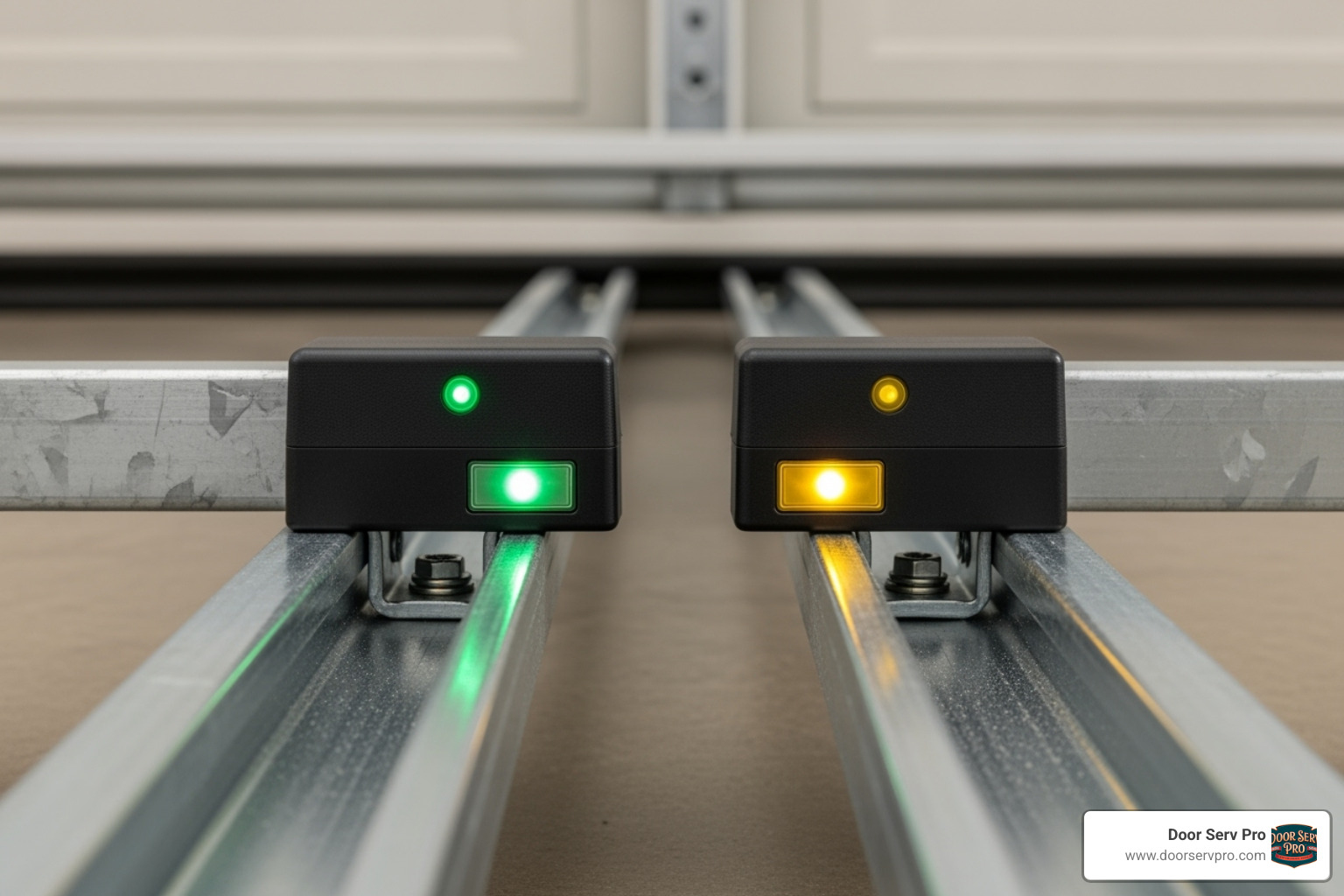
Positioned on either side of the opening about 4-6 inches from the floor, these photo-eyes work by sending an invisible infrared beam from one to the other. This creates a safety net across the opening. If anything breaks this beam while the door is closing, it will immediately reverse, preventing accidents and keeping your family safe.
Photo-Eye Function and Legal Requirement
Since 1993, federal law requires all automatic garage doors to have these safety sensors. This is a legal requirement that has prevented countless injuries. While the technology is sophisticated, the sensors themselves can be finicky.
Each sensor has a small LED indicator light. One sensor acts as the sender (usually showing an orange or yellow light) while the other is the receiver (typically displaying a green light). These lights communicate the sensor status.
How to Fix a Garage Door Not Closing Due to Sensor Issues
Sensor issues typically cause the door to not close at all, reverse after starting, or only close when you hold the wall button down.
Solid lights on both sensors indicate they are working. Blinking lights signal a problem with alignment or an obstruction. No lights could mean a power issue, bad wiring, or a failed sensor.
Most sensor problems are easy to fix. Start by cleaning the sensor lenses. A spider web, dust, or a smudge can be enough to block the beam. Use a soft, dry cloth to wipe both lenses. Avoid harsh cleaners. While you're at it, check for any obvious obstructions in the door's path or in front of the sensors, like a broom or a toy.
Aligning the sensors can be tricky but is very doable. The sensors must be aimed directly at each other. They can be knocked out of alignment by accidental bumps, vibrations, or the house settling.
Inspect the sensor brackets for bends or looseness. You can often realign them by hand or by tightening screws. To fine-tune, loosen the wing nut on one sensor and adjust its angle until both indicator lights are solid.
For precision, tie a string between the two sensors at lens height. This visual guide helps ensure they are level and aimed correctly. Adjust until the string is straight, then tighten them.
Finally, check the sensor wiring for cuts, frays, or loose connections. Damaged wiring can stop the sensors from working. If you find damaged wires, it's best to call a professional like Door Serv Pro.
After each adjustment, test your garage door. If sensors were the problem, your door should now close smoothly.
Step 3: Troubleshooting Mechanical Issues When Your Garage Door Won't Close
If your garage door not closing issue isn't related to power or sensors, it's time to inspect the mechanical components. Every part must work in harmony for a smooth closing performance.
Clearing Tracks and Checking Rollers
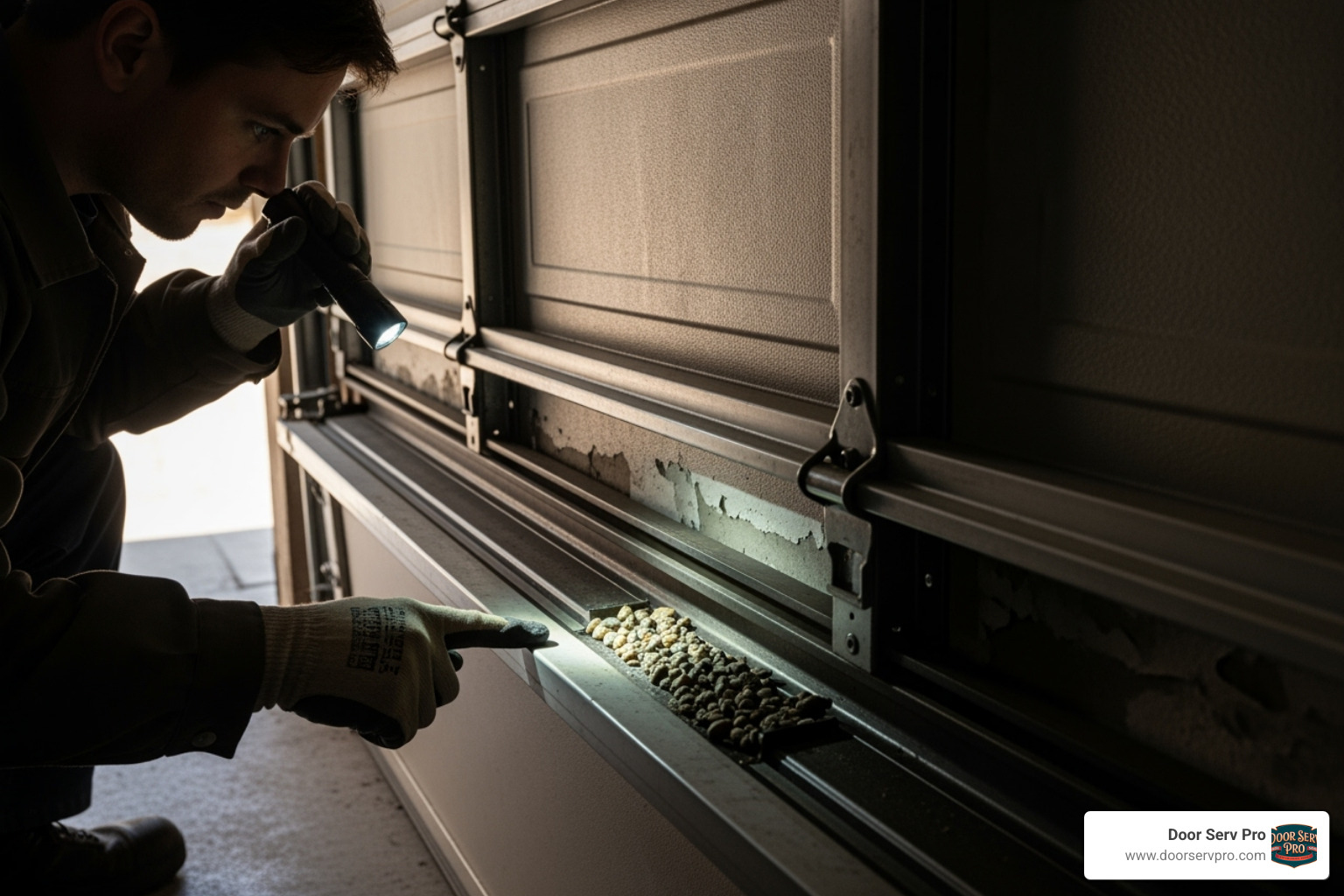
Your garage door tracks guide the door's movement and can collect debris or become misaligned over time.
Debris removal is an easy fix. Leaves, dirt, and small stones can get stuck in the tracks and stop the door. Clean them out with a stiff brush or shop vacuum.
Track alignment issues are trickier. Inspect your tracks; they should be parallel and straight. If you see bent sections or dents, this could be the problem. You can try to fix minor dings with a rubber mallet, but for significant damage, it's best to call a professional to avoid making it worse.
Check your rollers for cracks, chips, or wear. Clean grimy metal rollers with a brush. Nylon rollers are quieter but may wear out faster.
Proper lubrication is key. Use a white lithium grease or silicone-based lubricant every six months. Avoid WD-40, as it attracts dirt and can gum up the parts. For nylon rollers, only lubricate the metal bearings, not the nylon wheel itself.
Don't forget the trolley system—the part that rides along the opener rail. If the motor runs but nothing happens, the trolley might be disengaged from someone pulling the red emergency release cord.
How to Adjust the Travel Limit Screws
Your garage door opener uses limit screws to know exactly when to stop.
Finding the limit screws is your first mission. Find the two adjustment screws on your opener's motor unit, usually labeled "Up" and "Down." Newer models may have digital displays, but the principle is the same.
The down-limit screw controls the closing point. If it's set incorrectly, the door might stop before the floor or reverse upon closing because it thinks it hit an obstruction.
Making adjustments requires patience. Always unplug your opener first for safety. Use a screwdriver to make small, quarter-turn adjustments. Large adjustments can cause issues. Plug the opener back in and test the door after each small change.
If your garage door not closing completely, turn the down-limit screw counter-clockwise to increase travel. If it reverses upon closing, turn it clockwise to reduce travel. The goal is a full close where the weather seal gently compresses against the floor.
Testing is crucial after each adjustment. It might take a few tries to get it just right, but once you do, you'll have a door that closes properly every time.
Step 4: When to Call a Professional for a Garage Door Not Closing
While DIY repairs can be satisfying, some garage door not closing issues require a professional for safety reasons. Your safety is more important than a DIY fix.
If you've tried all the troubleshooting steps without success, or if you see any of the following warning signs, it's time to put down the tools and call us at Door Serv Pro.
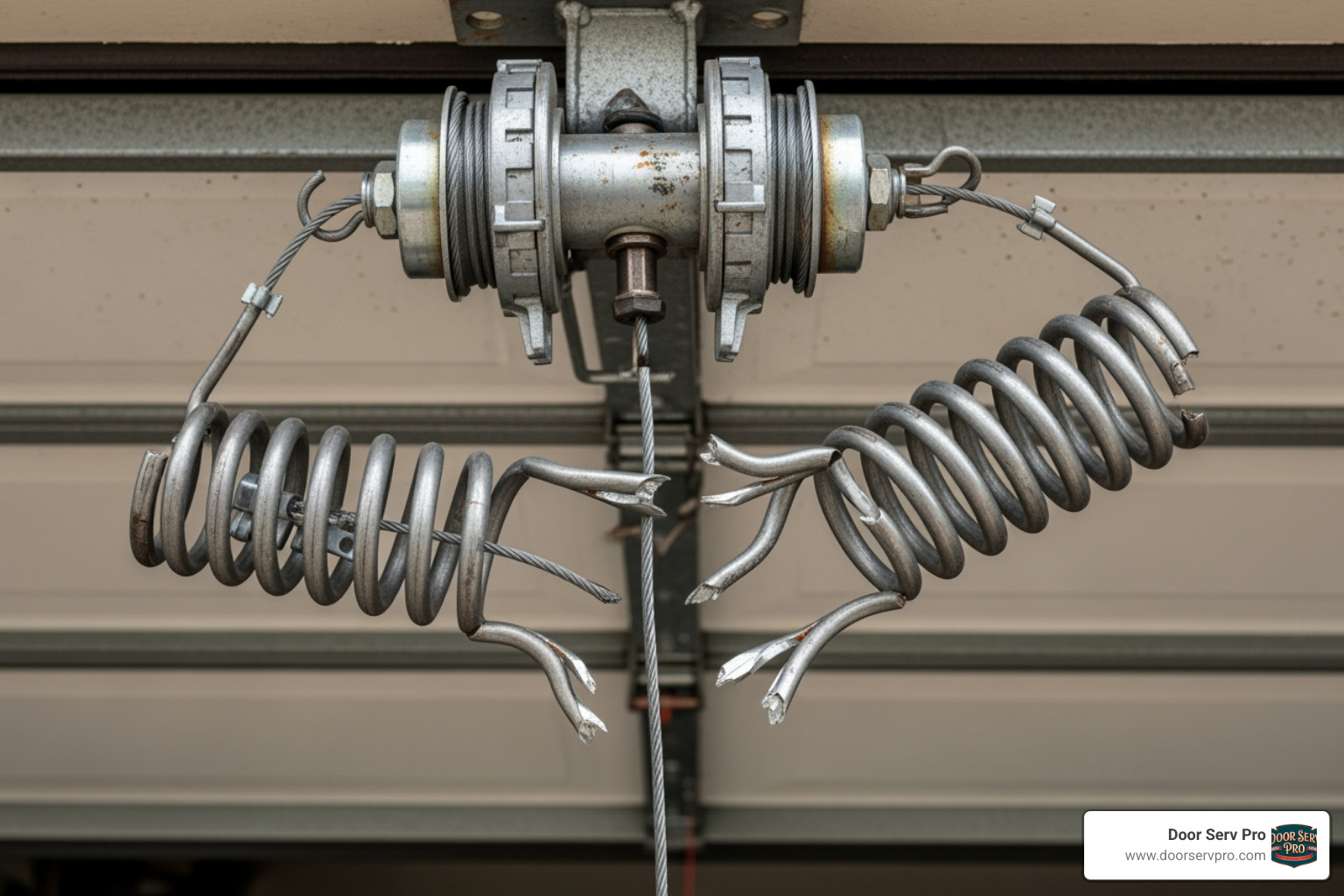
The Dangers of Broken Springs and Cables
Garage door springs are under tremendous tension—enough to support a door weighing 300-400 pounds. They are extremely dangerous and require professional handling.
Attempting to repair springs yourself can lead to serious injury. Our technicians use specialized tools and have the experience to handle these repairs safely.
A broken spring often makes a loud noise, like a gunshot. You may see a visible gap in a torsion spring (above the door) or a stretched-out extension spring (along the tracks).
The most obvious sign is that the door becomes extremely heavy and difficult or impossible to lift manually. The opener motor may run, but the door won't move or will struggle significantly.
Frayed or broken cables are also dangerous. They work with the springs, and if they fail, the door can become unbalanced and crash down.
The bottom line? Never, ever attempt to repair or replace broken springs or cables yourself. Our NATE-certified technicians have the specialized winding bars, safety equipment, and years of training to handle these repairs safely. It's not worth risking serious injury or making the problem worse.
Other situations that call for professional help include a running opener motor that doesn't move the door (often a stripped gear), severely bent tracks, persistent electrical issues, or concerning grinding or screeching noises.
After 25 years serving families across WV, VA, PA, and MD, we've seen it all. Our team brings the right tools, experience, and safety protocols to get your garage door back to working perfectly – without putting anyone at risk.
Step 5: How to Manually Close and Secure Your Garage Door
If you can't fix your garage door not closing issue immediately, you'll need to close it manually while you wait for professional help. Knowing how to do this is an essential skill for homeowners.

Emergency Release Cord
Every automatic opener has an emergency release cord, a red rope with a handle hanging from the trolley on the opener rail. This cord disconnects the door from the opener, allowing for manual control.
Before you pull that cord, a safety warning: If the door is stuck open and you suspect a broken spring, do not attempt to disengage the opener. A door without functioning springs is extremely heavy and will crash down with dangerous force. In this situation, call Door Serv Pro immediately.
If your door is closed or only partially open, and you're confident your springs are intact, you can safely proceed. Firmly pull the red emergency release cord straight down until it clicks, disengaging the trolley from the opener.
Lowering the door by hand requires care. Be prepared for the door's weight. Guide it down slowly to prevent it from jumping the tracks or damaging the rollers.
A critical step: manually closing the door does not lock it. You must take an extra step to secure it.
To secure your door from the inside, engage the manual slide bolts or T-handle locks to prevent it from being opened from the outside.
If your door lacks manual locks, you can secure it by placing a C-clamp on the vertical track just above a roller, or by wedging a piece of wood in the track.
Manually operating your garage door is a temporary solution. If you find yourself repeatedly needing to close your door manually, it's a clear signal that professional attention is overdue. At Door Serv Pro, we're available 24/7 to help restore your garage door to full, safe operation.
Frequently Asked Questions about Closing Issues
Over our 25 years serving families across WV, VA, PA, and MD, we've heard just about every garage door not closing question you can imagine! Here are the ones that come up most often.
Why does my garage door reverse after hitting the floor?
Your door is being overly cautious. The opener thinks it's hitting an obstruction and reverses as a safety measure. The most common cause is the down-limit switch being set too far. The opener hits the floor, senses an "obstruction," and reverses. A small adjustment to the down-limit screw on the opener motor will usually fix this.
Sometimes, the force settings might also be too sensitive. If your opener is set to reverse with very little resistance, the normal pressure of the door meeting the floor can trigger the reversal.
Why do I have to hold the wall button down to close the door?
This is a classic sign of a sensor issue. When you hold down the wall button, you're overriding the safety sensor system, which means the sensors are detecting a problem. This is a clear sign of photo-eye sensor issues. The sensors think something is obstructing the door's path. The fix is usually to clean the lenses, clear any debris, and ensure the sensors are aligned with solid indicator lights.
We always tell our customers: if you have to hold the button down, don't ignore it! Those sensors are there for your safety.
Can cold weather stop my garage door from closing?
Yes, it can. Winter is tough on garage doors, and cold weather can affect them in several ways. Metal components like tracks and rollers contract in the cold, which can hinder smooth operation. Lubricants also thicken, slowing the door's movement.
We recommend using white lithium grease for the trolley carriage rail in colder months as it stays more flexible. Also, be sure to clear any ice or snow buildup, as this can block the sensors and prevent the door from closing completely.
If your garage door not closing issues seem to coincide with cold snaps, a little extra lubrication and clearing away ice buildup usually gets things moving again.
Get Your Garage Door Back on Track
We know a garage door not closing is frustrating and leaves you feeling vulnerable. We've walked you through the most common causes and solutions, many of which are manageable with patience.
Regular maintenance is your best defense. A few minutes every few months cleaning sensors, lubricating parts, and checking for debris can prevent major problems. Think of it as a small effort that prevents much bigger problems down the road.
The key takeaway is to start with the simplest solutions first. Dead remote batteries, tripped breakers, and dirty sensors cause most closing issues and are often quick fixes.
However, we cannot stress this enough: safety must always come first. When you encounter broken springs, frayed cables, or serious track damage, it's time to step back and call in the professionals. These high-tension components are incredibly dangerous, and attempting repairs yourself can lead to serious injury or costly damage.
At Door Serv Pro, we've been helping families across WV, VA, PA, and MD solve their garage door problems for over 25 years. Founded by industry veteran Paul Wiese, our family-owned company combines best craftsmanship with innovative designs and a genuine passion for changing houses into homes. Our NATE-certified technicians bring both technical excellence and a personal touch to every job, whether it's a simple sensor alignment or a complete door installation.
We deliver round-the-clock service with a 100% satisfaction guarantee because we understand that garage door problems don't wait for convenient times. From custom garage doors to expert repairs, maintenance, and installations, we're here to ensure every project reflects quality, reliability, and style.
At Door Serv Pro, we don't just fix doors—we create lasting impressions, one entryway at a time. If your garage door is still giving you trouble after trying our troubleshooting steps, or if you've finded any of those serious issues we've discussed, don't hesitate to reach out. We're here to help get your garage door back on track, safely and efficiently.
Schedule your professional garage door repair in Frederick, MD
Need Help?
Contact us today to discuss your needs. Our team is ready to help.
About the author
Door Serv Pro
More articles
View all postsKeep reading
Related articles
Ready to Get Started?
Whether you need a repair, maintenance, or a new installation, our expert team is here to help.