Blog
Why your bike chain is cheaper than a belt but might cost you more later
Door Serv Pro
Reviewed by the Door Serv Pro service team · Trained, professional garage door technicians
Last updated June 24, 2026
Why the Belt Drive vs Chain Drive Cost Comparison Matters for Virginia Homeowners
The belt drive vs chain drive cost comparison is one of the most practical questions a homeowner faces when choosing or replacing a garage door opener. And the short answer? The cheaper option upfront can quietly become the more expensive choice over time.
Here's a quick breakdown to help you decide fast:
| Factor | Chain Drive | Belt Drive |
|---|---|---|
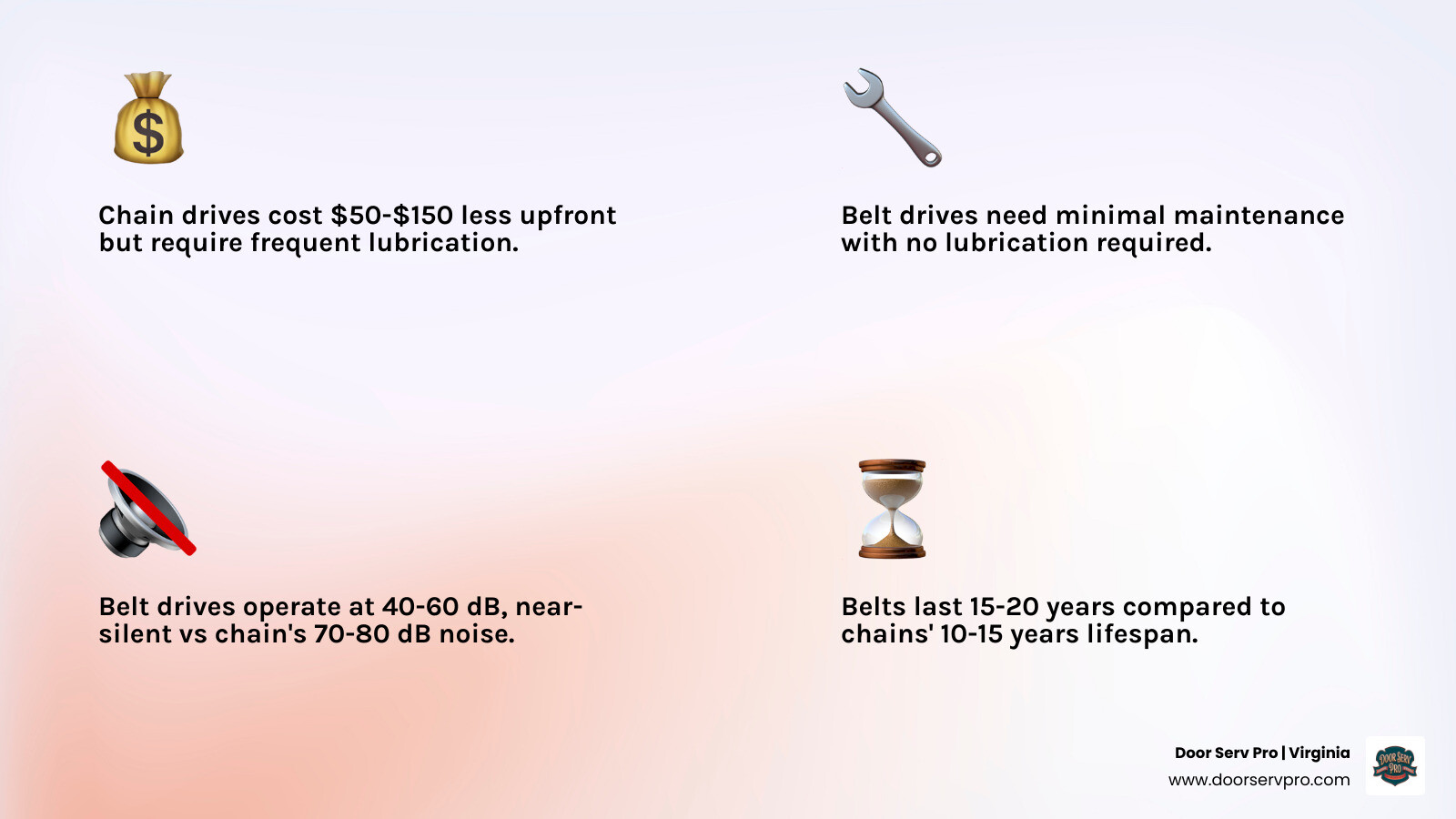
| Upfront cost | Lower | Higher ($50-$150 more) |
| Maintenance | Semi-annual lubrication + tension checks | Minimal, no lubrication needed |
| Noise level | 70-80 dB (loud) | 40-60 dB (near-silent) |
| Lifespan | 10-15 years | 15-20 years |
| Best for | Heavy doors, detached garages, tight budgets | Attached garages, light sleepers, low-maintenance preference |
| Repair cost | Chain replacement $50-$100 | Belt replacement $60-$120 |
So while a chain drive saves you money at the register, a belt drive often wins on total cost of ownership — thanks to a longer lifespan and far less maintenance.
Picture this: you pull into your driveway late at night, the baby is finally asleep, and your garage door opener rattles to life like a freight train. That's the chain drive experience for many homeowners. Belt drives, on the other hand, operate closer to the quiet hum of a refrigerator. The difference in daily quality of life is real — and so is the difference in what you'll spend over 15 to 20 years of ownership.
As a Virginia homeowner, your choice isn't just about noise or price. Local humidity, temperature swings, and your specific door type all play a role in which system delivers the best value for your home.
Analyzing the belt drive vs chain drive cost comparison for Virginia homeowners
When we sit down with homeowners in Ashburn or Leesburg to discuss a new installation, the conversation almost always starts with the initial investment. It is true that chain drives have been the industry’s "workhorse" for decades primarily because they are more accessible for those on a strict budget. However, looking only at the sticker price is like buying a car based solely on the down payment without checking the fuel efficiency.
The belt drive vs chain drive cost comparison involves looking at the materials used. Chain drives utilize a metal chain—much like a bicycle—to pull the trolley along the rail. This metal-on-metal contact is durable but creates friction. Belt drives use a reinforced rubber, fiberglass, or Kevlar-belt. While the belt itself is a more premium material, leading to a higher upfront price, it requires no lubrication and experiences significantly less friction.
For those considering a swap, you can find more info about opener services to see how these units integrate with your existing door. Installation complexity is virtually identical for both systems, meaning labor remains consistent, but the long-term value shifts toward the belt drive because it simply has fewer moving parts that grind against one another.
Long-term durability and the belt drive vs chain drive cost comparison
Durability isn't just about how "strong" a material feels; it’s about how it handles the "fatigue" of opening and closing four times a day, 365 days a year. Steel links in a chain drive are incredibly strong, but they are prone to stretching over time. As the links stretch, the chain begins to sag, requiring manual tension adjustments to prevent it from hitting the rail or slipping off the sprocket.
Conversely, modern reinforced rubber belts are designed not to stretch. They offer a "soft start and stop" feature, especially when paired with DC motors, which reduces the jarring vibration that can wear out other garage door components like rollers and springs. We often see belt drives operating reliably for 15 to 20 years, whereas a chain drive might start showing significant wear after year 10. For a deeper dive into how these hold up in specific local climates, check out our post on Belt Vs Chain Drive Openers In Cresaptown.
Repair frequency and the belt drive vs chain drive cost comparison
In our 30+ years of craftsmanship, we’ve noticed a pattern in repair calls. Chain drives are more likely to suffer from sprocket alignment issues or trolley wear because of the constant vibration. If a chain isn't lubricated, it can rust, leading to a snapped link that requires a full chain replacement.
Belt drives are generally more "set it and forget it," but they aren't invincible. In extreme Virginia heat, an older belt might become brittle, or a poorly calibrated system could cause the belt to slip. However, because belt drives have fewer components, the troubleshooting process is often faster. Regardless of the drive type, professional calibration is the best way to ensure you aren't paying for avoidable repairs three years down the line.
Maintenance requirements and their impact on total ownership value
If you choose a chain drive, you are essentially signing up for a semi-annual "date" with a can of lithium grease. Because it is metal-on-metal, the system must be lubricated every six months to prevent the "symphony of grinding" and to protect the metal from the elements.
When we look at the belt drive vs chain drive cost comparison, maintenance time is a hidden "tax" on the chain drive. Here is what a typical maintenance schedule looks like:
- Chain Drive Tasks:
- Lubricate the entire length of the chain (twice a year).
- Check for chain sag and adjust the tension screw (annually).
- Clean metal shavings/debris from the rail (annually).
- Inspect sprockets for tooth wear.
- Belt Drive Tasks:
- Visual inspection for cracks or fraying (annually).
- Wipe the rail clean of dust.
- No lubrication required.
Neglected maintenance is the number one cause of premature opener failure. If you know you aren't the type to climb a ladder twice a year with grease, the belt drive’s higher upfront price is actually a preventative investment. You can learn more about how we handle these tasks for our neighbors in Reston and McLean by viewing our maintenance plans.
How environmental factors in Virginia influence your drive choice
Virginia’s climate is unique. We deal with high humidity in the summer and freezing temperatures in the winter. These fluctuations play a massive role in the belt drive vs chain drive cost comparison.
In high-humidity areas like Vienna or Alexandria, moisture in the air is the enemy of the chain drive. Without consistent lubrication, a steel chain will develop surface rust. This rust increases friction, which makes the motor work harder, eventually leading to a burnt-out capacitor or motor.
Belt drives are generally more resistant to humidity since rubber doesn't rust. However, extreme temperature swings can cause older rubber compounds to expand or contract. While modern belts are rated for temperatures as low as -20°F, an aging belt might lose some flexibility in a harsh Middletown winter. Generally, for a standard residential garage, the belt drive wins the "weather-proof" award because it avoids the corrosion issues that plague metal chains in our humid East Coast climate.
Performance factors: Noise, strength, and efficiency
Performance is where the "value" part of the cost comparison really shines. If your garage is detached and sits 50 feet away from your house, the noise of a chain drive doesn't matter. But if you live in a home in Stephens City where the primary bedroom is directly above the garage, a chain drive's 80-decibel rattle will eventually feel like an expensive mistake.
| Feature | Chain Drive Performance | Belt Drive Performance |
|---|---|---|
| Noise Level | 70-80 dB (Like a vacuum) | 40-60 dB (Like a refrigerator) |
| Vibration | High - can shake the walls | Minimal - very smooth |
| Lifting Power | Excellent for heavy wood/steel | Great for most residential doors |
| Speed | Standard | Slightly faster due to less friction |
When comparing Liftmaster Vs Genie Garage Door Openers, you'll find that both brands offer high-tier versions of both drive types. Modern belt drives have challenged the old myth that they are "weak." Today’s steel-reinforced belts can easily lift doors weighing up to 500 lbs. However, for massive, industrial-sized carriage doors or solid oak custom doors, we still often recommend a heavy-duty chain drive for its raw mechanical "bite."
Frequently Asked Questions about garage door drive systems
Which drive is better for attached garages with bedrooms nearby?
The belt drive is the undisputed champion for attached garages. Because the belt is made of a flexible material, it absorbs the vibration that would otherwise travel through the steel tracks and into the framing of your home. It can be up to 30% quieter than a chain drive, ensuring that early morning departures don't wake up the whole household.
Can a belt drive handle a heavy carriage-style wooden door?
Yes, most modern belt drives are reinforced with internal steel or fiberglass cords. If you have a standard double-car insulated door, a 3/4 HP belt drive is more than sufficient. However, if your door is an oversized custom wood door weighing over 500 lbs, a chain drive provides the positive mechanical engagement needed for that level of weight.
How does Virginia's humidity affect chain drive longevity?
Humidity accelerates oxidation (rust). In Virginia, an unlubricated chain can begin to show signs of rust within a single season. This rust creates "stiff links," which put uneven pressure on the opener's gears. If you live in a high-humidity area, you must commit to a strict lubrication schedule or opt for a belt drive to avoid premature replacement costs.
Conclusion
Choosing between a belt and a chain drive isn't just about what you pay today—it's about how much you want to think about your garage door over the next 15 years. The belt drive vs chain drive cost comparison reveals that while chains are the budget-friendly "workhorses," belts are the low-maintenance, high-longevity "thoroughbreds."
At Door Serv Pro, we bring 30+ years of craftsmanship to every home we visit in Winchester, Berryville, Front Royal, and beyond. As a family-owned business, we care about the "total cost" our neighbors pay, which is why we focus on quality installations that last. Whether you prioritize the raw power of a chain or the near-silent operation of a belt, our community-focused team is here to help you make the right investment.
Ready to upgrade your home's convenience and quiet? Contact our experts for a garage door opener replacement and let us help you find the perfect fit for your Virginia home.
Need Help?
Contact us today to discuss your needs. Our team is ready to help.
About the author
Door Serv Pro
More articles
View all postsKeep reading
Related articles
Ready to Get Started?
Whether you need a repair, maintenance, or a new installation, our expert team is here to help.