Blog
How Much Does a Belt Drive Bike Really Cost
Door Serv Pro
Reviewed by the Door Serv Pro service team · Trained, professional garage door technicians
Last updated June 24, 2026
I'm looking to upgrade my garage door opener in Frederick. Should I choose a belt drive or a chain drive for my home?
Choosing between a belt drive and a chain drive is a common decision for homeowners in Maryland. Instead of focusing on just the initial purchase, it's important to look at how each system performs in your specific environment.
| Factor | Chain Drive | Belt Drive |
|---|---|---|
| Operation | High-Strength | Ultra-Quiet |
| Noise Level | Louder (50-60 dB) | Quieter (40-50 dB) |
| Maintenance | Regular lubrication required | Minimal, no lubrication needed |
| Lifespan | 10-15 years | 15-20 years |
| Best For | Heavy doors, detached garages | Attached garages, noise-sensitive homes |
| Drive Material | Metal Chain | Reinforced Belt |
Both systems offer distinct advantages depending on your door size, garage location, and local climate. This guide explores the performance factors to help you make a confident, informed choice for your property.
I'm Paul Wiese, founder of Door Serv Pro. With over 30 years of hands-on experience helping homeowners in Frederick and beyond, I've seen firsthand how the right opener choice impacts daily convenience. In the sections ahead, I'll break down the performance and durability factors you need to know.
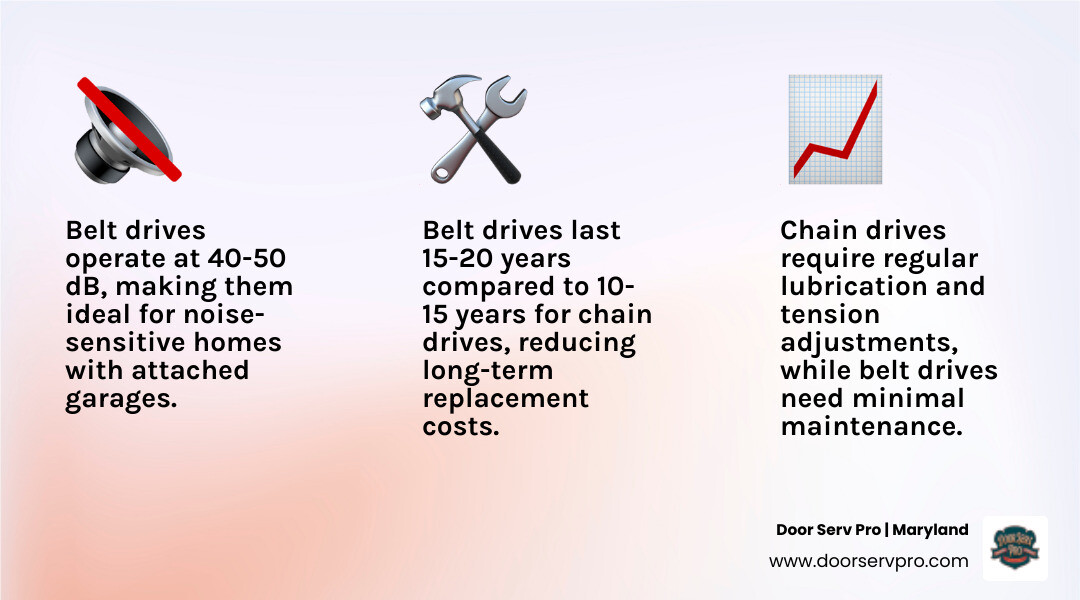
Choosing the Right Drive System for Your Maryland Home
When we sit down with families in Hagerstown or Martinsburg to discuss a new opener, the conversation usually focuses on long-term reliability. Chain drives have been the industry standard for decades, utilizing a classic metal-on-metal design that is known for its rugged durability.
The difference in component materials is where these two systems diverge. Chain drives use a high-strength metal chain—similar to a heavy-duty bicycle chain—that pulls a trolley along a rail. Belt drives, conversely, utilize a reinforced rubber, fiberglass, or carbon-fiber belt. While the rubber might sound less durable, modern belts are engineered to be incredibly tough, often providing a smoother operation because they don’t suffer from the same friction-related wear as metal chains.
If you are currently dealing with a malfunctioning unit, you might be looking for more info about garage door opener repair in Winchester, VA. Often, upgrading to a modern belt system can provide a significant improvement in daily operation.
Installation precision is vital for both systems. Belt drives are often paired with DC motors that offer "soft start and stop" technology, which requires expert calibration. We always recommend professional installation because a drive rail that isn’t perfectly level will cause premature wear on either a belt or a chain, leading to avoidable service needs down the road.
Performance Factors and Daily Operation
The value of your opener is measured in how it affects your daily life. The most significant performance gap is noise. Chain drives operate between 50 and 60 decibels, but because it is a metal-on-metal contact, that sound often vibrates through the entire frame of the house. If you have an attached garage, that vibration can be felt in the kitchen or living room every time the door is used.
Belt drives are the "silent partners" of the garage world, usually hovering between 40 and 50 decibels. For Maryland homeowners with bedrooms located directly above the garage, this noise reduction is a major benefit. There’s nothing quite like the peace of mind that comes from knowing you won't wake the family when you leave for an early shift.
However, we also consider lifting capacity. Chain drives are the undisputed "workhorses." If you have a heavy-duty door—such as a triple-layer steel carriage door or a solid wood custom entryway—a chain drive provides the raw strength needed to move that weight reliably. While high-end belt drives can handle heavy loads, they are generally optimized for standard residential doors. If you're in the market for garage door service in Hagerstown, MD, our team can help you evaluate the weight of your door against the drive type to ensure your motor operates efficiently.
Maintenance and Lifespan Considerations
Maintenance requirements differ significantly between these two technologies, impacting the long-term convenience for the homeowner.
Chain Drive Maintenance:
- Lubrication: These systems require regular lubrication (at least twice a year) to prevent rust and ensure the links move smoothly over the sprockets.
- Tension Adjustments: Metal chains can stretch slightly over time, requiring a technician to tighten the tension to prevent the chain from "slapping" against the rail.
- Cleaning: Metal chains attract dust and grime, which requires periodic attention to keep the mechanism clean.
Belt Drive Maintenance:
- Visual Inspections: You mostly just need to check for fraying or cracks.
- No Lubrication: Because the belt moves through a trolley without metal-on-metal friction, it requires zero grease. This keeps your garage cleaner and reduces your annual maintenance checklist.
| Maintenance Factor | Chain Drive | Belt Drive |
|---|---|---|
| Lubrication Frequency | Every 6 months | Never |
| Tension Check | Annual | Every 2-3 years |
| Cleaning Needs | High (grease/dust) | Low (dust only) |
| Expected Lifespan | 10-15 Years | 15-20 Years |
Environmental resilience is another factor we see frequently in places like Cumberland. Humidity can cause untreated metal chains to develop surface rust if maintenance is neglected. Modern belts, however, are designed to withstand extreme temperature swings without losing their structural integrity.
Long-term Reliability for Homeowners
When looking at a 15-year horizon, the belt drive is often the preferred choice for those seeking a low-maintenance lifestyle. Belt drives have fewer moving parts, which naturally leads to fewer points of potential wear.
Part availability is high for both, but because belt drives are becoming the preferred choice for new home constructions, we are seeing a massive influx of smart-tech compatible belt systems. If you live in an area with high humidity or frequent temperature swings, you might want to read more about Belt Vs Chain Drive Openers In Cresaptown to see how local conditions impact these components.
Evaluating Drive Systems for Heavy Doors
For oversized wooden doors or heavy insulated steel doors, the high-torque applications of a chain drive are often essential. A belt can occasionally experience strain if it is forced to lift a door that exceeds its rated weight capacity, especially in high-heat environments.
If your door is struggling to open, it might not be the drive at all—it could be the springs. We provide expert garage door spring repair in Hagerstown, MD to ensure your door is properly balanced. A balanced door makes the drive system's job much easier, extending the life of both belts and chains.
Frequently Asked Questions about Garage Door Drive Systems
Which drive system is best for a bedroom located above the garage?
Without a doubt, a belt drive is the superior choice. The vibration from a chain drive can travel through the wooden studs of your home, creating a low-frequency hum that is very disruptive. Belt drives use a rubber-like material that absorbs this vibration, making the operation nearly silent to those inside the house.
How does the local Maryland climate affect drive belt performance?
Maryland experiences everything from humid summers to freezing winters. In extreme humidity, some older belt models were known to slip slightly, but modern reinforced belts (using fiberglass or carbon fiber) are rated for temperatures as low as -20°F. Chain drives are more susceptible to rust in our humid summers if they aren't kept lubricated.
Can I switch from a chain drive to a belt drive system during a repair?
In most cases, yes! However, you usually have to replace the entire opener unit, including the rail. The internal gears and sprockets for a chain are different from the pulleys used for a belt. If your current motor is dying, upgrading to a belt system is a very common and straightforward process during a replacement.
Conclusion
Choosing between a belt and a chain drive depends on your home's specific needs. If you have a detached garage or a very heavy door, the chain drive is a reliable, time-tested workhorse. If you value peace, quiet, and a low-maintenance lifestyle—especially with an attached garage—the belt drive is an excellent choice.
At Door Serv Pro, we bring over 25 years of expertise to every driveway. As a family-owned business, we treat your home like our own, ensuring that whether you choose a chain or a belt, the installation is flawless and backed by our commitment to quality. We serve homeowners across West Virginia, Virginia, Pennsylvania, and Maryland, providing 24/7 emergency support when you need it most.
Don't leave your home's security and convenience to chance. Contact Door Serv Pro today for a professional consultation. Whether you need a simple tune-up or a brand-new system, we are here to help. Reach out to us for expert garage door installation in Frederick, MD, and let us help you find the perfect fit for your home!
Need Help?
Contact us today to discuss your needs. Our team is ready to help.
About the author
Door Serv Pro
More articles
View all postsKeep reading
Related articles
Ready to Get Started?
Whether you need a repair, maintenance, or a new installation, our expert team is here to help.