Blog
A Practical Guide to Qualifying for Energy Incentives
Door Serv Pro
Reviewed by the Door Serv Pro service team · Trained, professional garage door technicians
Last updated June 23, 2026
What West Virginia Homeowners Need to Know About Garage Door Energy Incentives
Understanding how a new garage door may qualify for energy savings incentives starts with one key fact: under the federal Energy Efficient Home Improvement Credit (Section 25C), a garage door can be treated as an exterior door — and that means it may be eligible for a federal tax credit when it meets specific energy efficiency standards.
Here is a quick summary of what qualifies:
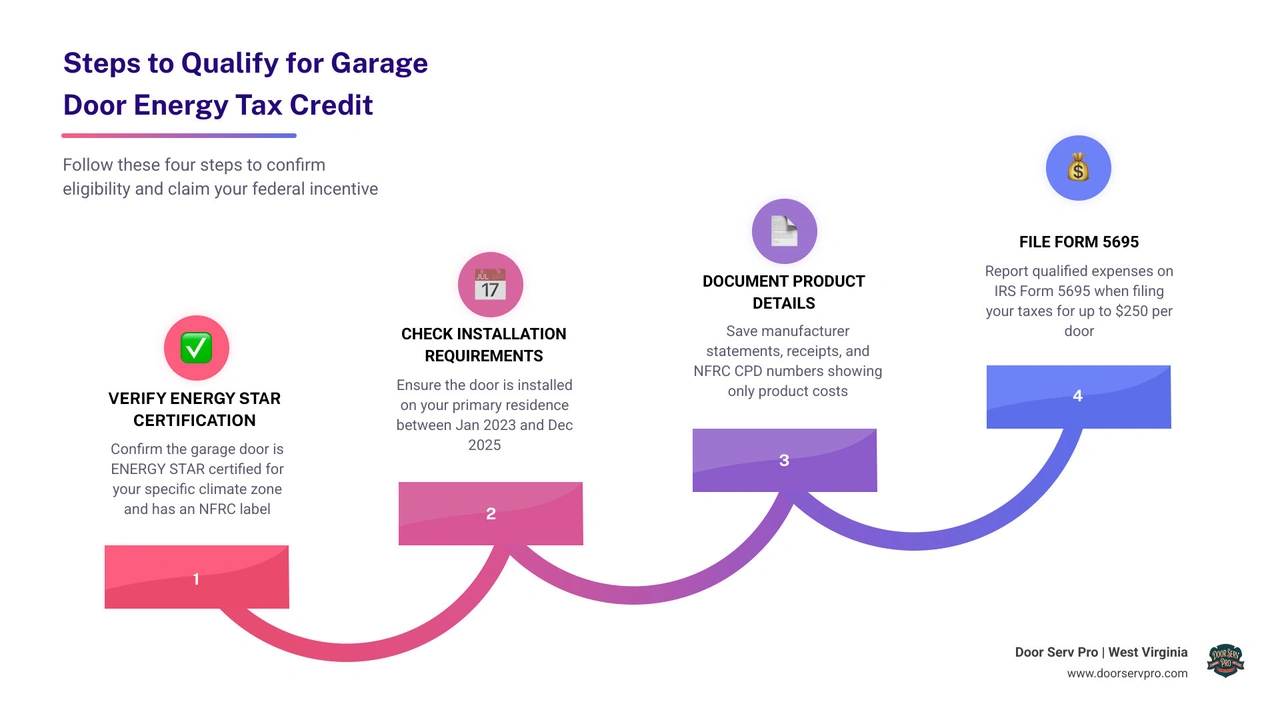
- ENERGY STAR certified for your specific climate zone
- Installed on your primary U.S. residence (not a rental or second home)
- Installed and placed in service between January 1, 2023, and December 31, 2025
- Only product costs count — labor and installation are excluded
- Maximum credit: 30% of product cost, up to $250 per door and $500 total for all exterior doors in a single tax year
Despite these savings being real and accessible, only 1.7% of 2023 tax returns actually claimed the 25C credit. Many homeowners simply don't know the rules or how to verify eligibility before buying.
This guide walks you through exactly what you need to know — from checking your climate zone to filing IRS Form 5695 — so you don't leave money on the table.
How a New Garage Door May Qualify for Energy Savings Incentives
For most homeowners in Berkeley Springs, Charles Town, Falling Waters, Gerrardstown, Great Cacapon, Harpers Ferry, Hedgesville, Inwood, Martinsburg, Paw Paw, Ranson, and Shepherdstown, the incentive conversation starts with the federal Energy Efficient Home Improvement Credit, often called Section 25C.
This credit applies to certain energy-efficient improvements made to an existing home in the United States. Exterior doors are one of the qualifying building-envelope categories, alongside items like insulation and windows. A garage door may fit into that category when it functions as an exterior door and meets the required efficiency standards.
Does a garage door count as an exterior door under the 25C credit?
In practical terms, yes, a garage door may count if it is part of the home's exterior envelope and otherwise meets the federal rules for qualifying exterior doors.
The IRS guidance focuses on whether the door is an eligible exterior door meeting Energy Star requirements. It does not carve out a separate special category just for garage doors. So the important question is not "Is it called a garage door?" but rather "Does this specific door qualify as an exterior door under the applicable program rules?"
That usually means:
- The door closes an opening to the outdoors
- It is part of the home's thermal boundary
- It meets the required ENERGY STAR certification standards for your climate zone
- It is installed on an eligible home
For an attached garage, this issue is more straightforward because the garage opening is clearly part of the exterior shell of the property. For a detached garage, qualification can be less obvious, and homeowners should verify carefully whether the product and installation still fit the credit rules for the main home.
How a new garage door may qualify for energy savings incentives under current federal rules
Under the current federal rules discussed in IRS and ENERGY STAR guidance, a qualifying garage door generally needs to check all of these boxes:
- It must be installed on an existing home in the U.S.
- The home must be your main residence.
- The door must meet ENERGY STAR requirements for exterior doors.
- The model must be appropriate for your climate zone.
- It must be placed in service by the applicable deadline.
- For 2025 installations, homeowners should also keep the product's qualified manufacturer information, including the QMID if applicable for filing.
That "placed in service" phrase matters. It means the door is not just purchased, but actually installed and ready for use in the tax year you plan to claim.
Who can and cannot claim the credit
The 25C credit is mainly for improvements to your primary residence in the United States.
Generally, that means:
- Homeowners can claim it for their main home
- Renters may be able to claim it if they personally pay for eligible improvements to their main residence and otherwise meet the rules
- Second homes usually do not qualify for this particular building-envelope credit
- Rental properties owned for investment generally do not qualify
- New construction does not qualify
- Mixed personal and business use can complicate eligibility
So if you are upgrading the garage door at the home where you actually live, you may have a path to the credit. If the door is going on a vacation home or a rental unit, the answer is usually no.
The exact garage door requirements homeowners need to verify first
Before you get excited about a tax credit, verify the product first. Hope is not a tax strategy. Documentation is.
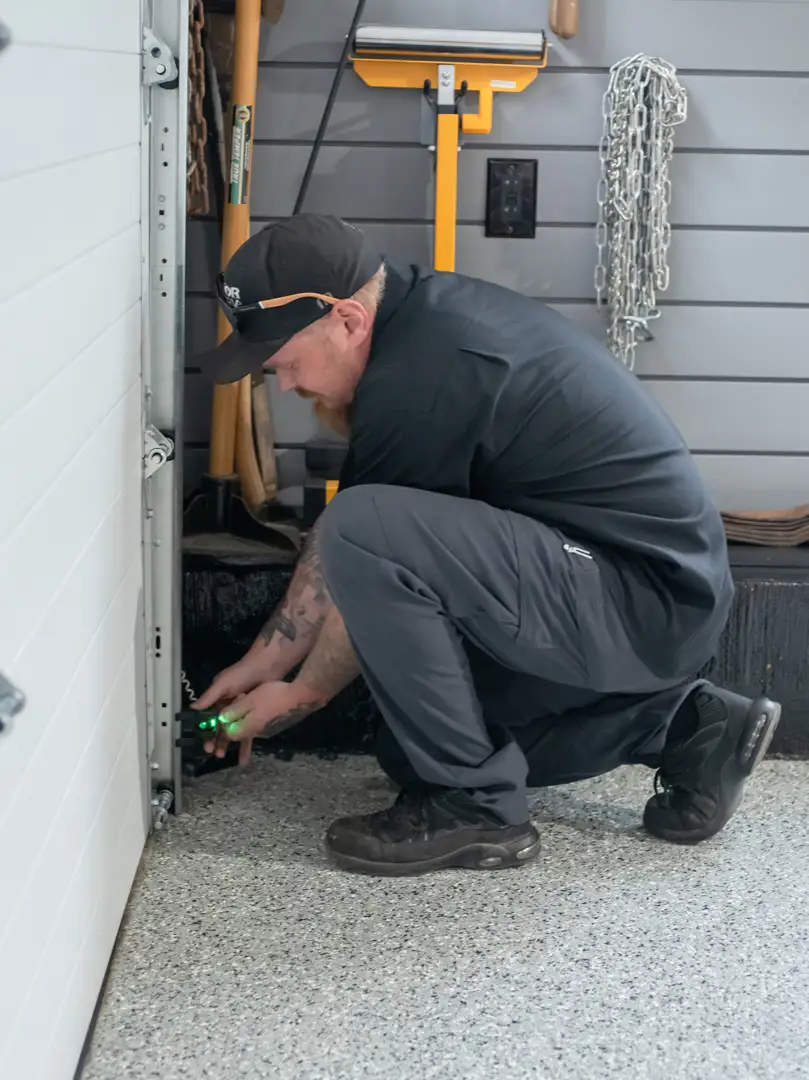
How to check ENERGY STAR climate-zone eligibility
Exterior door eligibility depends on your climate zone. ENERGY STAR certification is not one-size-fits-all.
Here is the basic process:
- Use the ENERGY STAR Climate Zone Finder to identify your climate zone based on your home location.
- Ask for the exact garage door model information before installation.
- Confirm that the door is certified for your zone, not just marketed as "energy efficient."
Many homeowners in West Virginia will fall into colder climate considerations, which makes insulation and air sealing especially important. But do not rely on assumptions. County-based lookups and product-level verification are the safer route.
How to use the NFRC directory and CPD number to confirm a model
One of the best ways to verify a specific door is through the NFRC Certified Product Directory.
Look for the CPD number on the product label or technical documentation, then:
- Go to the NFRC Certified Product Directory
- Search using the CPD number
- Review whether the listed product is certified for your climate zone
- Save a copy or screenshot of the result for your records
This step matters because a brand may sell several similar-looking garage doors, but only certain configurations may qualify. A different glass option, insulation package, or panel construction can affect certification.
What documentation to save before and after installation
If you plan to claim the credit, keep a paper trail that would make your future self proud.
Save these records:
- Manufacturer certification statement or equivalent qualifying documentation
- ENERGY STAR product information
- NFRC label details and CPD number
- Photos of labels or stickers before they are removed
- Itemized sales receipt
- Itemized invoice showing product separately from labor
- Product specifications or cut sheets
- Proof of installation date
- Proof the door was placed in service in the tax year claimed
- Any applicable QMID information for 2025 installations
- Copies of rebate paperwork, if any
If the label is on the packaging and the packaging is headed for the recycling bin five minutes after delivery, take photos first. Future-you will be grateful.
Why insulation and air sealing still matter even when certification is required
Certification is the formal requirement, but insulation and sealing are the real-world performance story.
A garage door with insulated panels, strong perimeter seals, and quality bottom weatherstripping can help reduce drafts, temperature swings, and unwanted air exchange. That matters even more if your garage is attached to the house or if there is living space above it.
For more background, see our guides on insulated garage door benefits and energy-efficient garage door installation considerations.
In short:
- Certification helps determine tax eligibility
- Insulation helps improve thermal performance
- Air sealing helps reduce leakage
- Good installation helps the whole system work as intended
What expenses count when claiming the credit
The Section 25C credit for exterior doors can help eligible homeowners, but it comes with specific limits.
How a new garage door may qualify for energy savings incentives within annual credit limits
For qualifying exterior doors, the credit is:
- 30% of qualified product cost
- Limited to $250 per door
- Limited to $500 total for all exterior doors in one tax year
There are also broader annual caps:
- Up to $1,200 total per year for many home-envelope improvements and certain energy property
- Up to $2,000 separate annual limit for qualifying heat pumps, heat pump water heaters, and biomass equipment
- Up to $3,200 total annual credit when combining these buckets properly
Here is the simple version:
| Credit category | Limit |
|---|---|
| Per qualifying exterior door | $250 |
| All qualifying exterior doors in one tax year | $500 |
| General annual bucket for envelope improvements | $1,200 |
| Separate heat pump and biomass bucket | $2,000 |
| Maximum combined annual total | $3,200 |
This means you can combine a garage door credit with other eligible improvements, but you still need to watch the category caps.
A smart strategy can be to spread projects across tax years if you are doing a bigger energy upgrade plan. That is especially useful if you are replacing doors, upgrading insulation, and making HVAC improvements around the same time.
Are labor and installation costs included for garage doors?
No. For building-envelope components like exterior doors, labor and installation costs are generally not included in the credit calculation.
For a garage door, the qualified amount is typically the eligible product cost only. That is why itemized paperwork matters so much. If the invoice bundles everything together without clearly separating the door from labor, claiming accurately becomes harder.
Can you combine a garage door credit with windows, insulation, or heat pumps?
Yes, in many cases you can combine them in the same tax year, as long as each improvement independently qualifies and you stay within the annual limits.
That may include:
- Exterior windows and skylights
- Insulation and air sealing materials
- Home energy audit credit
- Heat pumps
- Heat pump water heaters
- Certain other residential energy property
A common approach is to pair envelope improvements, like doors and insulation, with larger system upgrades. Just remember that each category has its own cap, and the credit is nonrefundable, so it can reduce your tax liability but does not create a refund beyond what you owe.
If you are planning a replacement project, our garage door installation guide can help you think through the project side of the equation.
Step-by-step: how to claim the incentive correctly
Claiming the credit is not terribly complicated, but it does reward organized homeowners.
- Choose a garage door model that is verified for your climate zone.
- Confirm the door qualifies as an ENERGY STAR certified exterior door.
- Save all supporting documentation before and after installation.
- Make sure the door is installed and placed in service by the deadline.
- Subtract any qualifying rebates or subsidies from the eligible product cost if required.
- File IRS Form 5695, Part II, with your federal tax return for the year the door was installed.
- Keep your records in case the IRS requests support later.
The install deadline and recent changes homeowners should know
Based on the research provided here, the current qualifying window for this version of the federal credit runs from January 1, 2023 through December 31, 2025.
That means:
- The garage door must be installed and placed in service by December 31, 2025
- You claim the credit on the tax return for the year of installation
- If installed in 2025, the claim is generally filed during the 2026 tax season
Another important change is the added manufacturer reporting detail for 2025. For eligible products installed in 2025, homeowners should keep the Qualified Manufacturer Identification Number, or QMID, if required for filing.
Because tax programs can change, we always recommend checking the latest IRS instructions for Form 5695 before filing.
How rebates and subsidies affect the amount you can claim
You may be able to stack a federal tax credit with state, local, or utility incentives, but there is a catch: rebates and similar subsidies often reduce the amount you can use when calculating the federal credit.
In plain English:
- If you receive a rebate that functions as a purchase price adjustment, subtract it from the qualified product cost
- Then calculate the federal credit on the net amount
- Keep records showing exactly how you arrived at the number
This is one of the easiest places to make a mistake, especially when homeowners hear "stackable" and assume every dollar counts twice. Sadly, the IRS is not known for its sense of whimsy.
Common mistakes that cause homeowners to miss the credit
A lot of homeowners miss the credit not because the rules are impossible, but because the details get skipped.
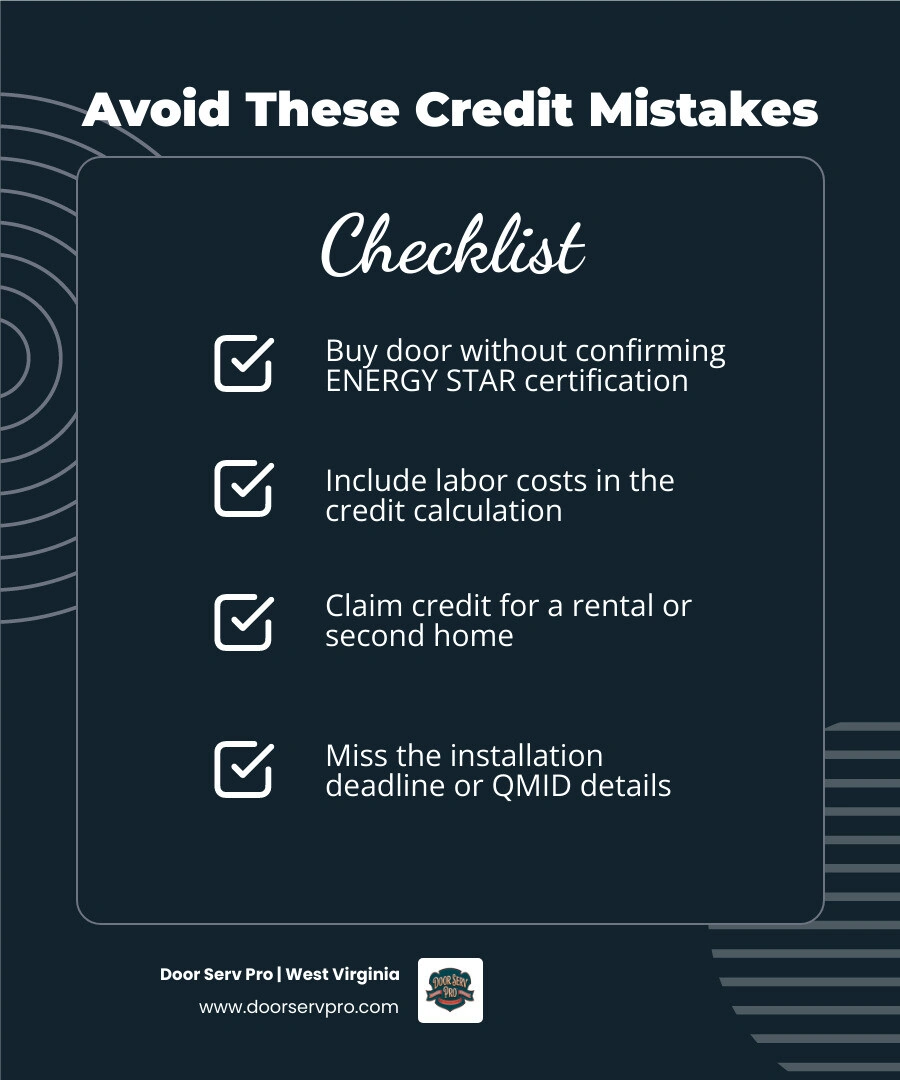
Common errors include:
- Buying a door marketed as efficient without confirming ENERGY STAR certification
- Using the wrong climate zone
- Failing to save the NFRC label or CPD number
- Including labor in the credit amount
- Claiming the credit for a rental or second home
- Missing the installation deadline
- Forgetting QMID details for 2025 if required
- Lacking an itemized invoice
- Claiming based on purchase year instead of placed-in-service year
That may help explain why only 1.7% of 2023 returns claimed the 25C credit. Many people simply do not realize how specific the process is.
State, local, and utility rebates that may stack with the federal credit
The federal credit is only one layer of possible savings.
West Virginia homeowners may also find additional programs through state agencies, utility providers, weatherization programs, or occasional manufacturer promotions. Availability changes, so this is less of a set-it-and-forget-it situation and more of a "check before you buy" situation.
Where West Virginia homeowners should look for extra incentive programs
If you live in our West Virginia service area, start your search here:
- Your electric or gas utility's rebate page
- West Virginia state energy or environmental program websites
- County or community energy-efficiency initiatives
- Weatherization assistance programs for income-qualified households
- Manufacturer rebate announcements tied to qualifying products
Some state resources also publish broader incentive lists covering home efficiency, weatherization, and federal coordination programs. These can help you identify whether a garage door upgrade fits into a larger home-envelope improvement plan.
How to stack rebates with tax credits the right way
The right order usually looks like this:
- Identify all available rebates before purchase
- Save approval emails, application forms, and payment records
- Determine whether the rebate reduces your purchase price for federal tax purposes
- Calculate your federal credit on the net eligible amount
- Keep a full documentation trail
The key is avoiding double counting. You want every legitimate savings opportunity available, but you do not want the math to get creative in a way the IRS would dislike.
When an energy-efficient garage door is worth considering even beyond incentives
Even if a specific model does not qualify for a credit, an energy-efficient garage door can still be worth considering.
Benefits may include:
- Better comfort in an attached garage
- Less drafty rooms near or above the garage
- Improved durability and quieter operation
- Better weather resistance
- Strong resale appeal
Garage door replacement is also widely known for strong return on investment, often topping 90% in industry studies. So while the tax credit is nice, it is not the only reason homeowners upgrade.
For a broader look at replacement planning, our garage door replacement guide is a helpful next read.
Frequently Asked Questions about how a new garage door may qualify for energy savings incentives
Can I claim the credit for a detached garage door?
Maybe, but verify carefully.
The closer the detached garage door is to the main home's thermal envelope and the official program requirements for an eligible exterior door, the stronger your case. Because detached structures can create gray areas, we recommend confirming product documentation and reviewing the latest IRS guidance before claiming.
Do two garage doors qualify for two separate credits?
Potentially yes, if both doors independently qualify.
But the limits still apply:
- Up to $250 per qualifying door
- Up to $500 total for all exterior doors in the same tax year
So two qualifying garage doors may each count, but the combined annual door cap does not go above $500.
What if I installed the door in 2025 but file taxes in 2026?
That is normal.
If the qualifying garage door was installed and placed in service during 2025, you generally claim the credit on your 2025 federal return, which you would typically file in 2026. Keep all records with your tax documents, including product certification, labels, receipts, and any QMID information required for that filing year.
Conclusion
If you have been wondering whether a replacement garage door can qualify for an energy incentive, the short answer is yes, sometimes, but only when the details line up.
The key steps are to:
- Confirm the door qualifies as an ENERGY STAR certified exterior door
- Verify climate-zone eligibility
- Save the NFRC and manufacturer documentation
- Keep labor separate from product cost
- Make sure the door is installed by the deadline
- File Form 5695 for the proper tax year
At Door Serv Pro, we know that energy-smart upgrades are about more than paperwork. They are about making your home more comfortable, efficient, and dependable for everyday life in West Virginia. With more than 30 years of craftsmanship and a strong community focus, we believe homeowners deserve clear information before making an important upgrade.
If you are planning a replacement and want to learn more, explore our garage door services and our guide to energy-efficient garage door opener installation solutions.
Need Help?
Contact us today to discuss your needs. Our team is ready to help.
About the author
Door Serv Pro
More articles
View all postsKeep reading
Related articles
Ready to Get Started?
Whether you need a repair, maintenance, or a new installation, our expert team is here to help.