Blog
Throwing Shade at High Utility Bills
Door Serv Pro
Reviewed by the Door Serv Pro service team · Trained, professional garage door technicians
Last updated June 24, 2026
Why High Utility Bills and Hot Windows Go Hand in Hand
How awnings reduce energy costs by shading windows is simpler than most homeowners expect. Here's the short answer:
- Awnings block sunlight before it hits the glass, stopping heat at the source
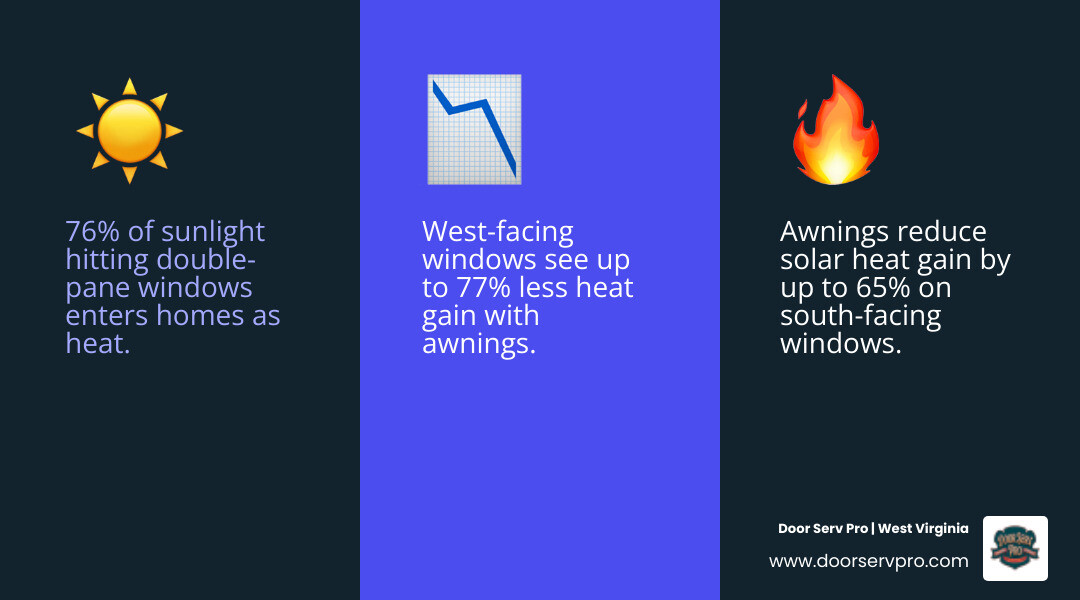
- South-facing windows can see up to 65% less solar heat gain
- West-facing windows can see up to 77% less solar heat gain
- Indoor temperatures can drop by as much as 15°F
- Cooling energy use can fall by 20–50% depending on your climate
- Homeowners can save up to $200 per year on energy bills
If your home heats up fast on sunny afternoons, your windows are likely the main culprit. According to the U.S. Department of Energy, about 76% of sunlight that hits a standard double-pane window enters the home as heat. That adds up fast — nearly 20% of your air conditioner's total workload comes directly from sunlight through glass.
In West Virginia, where summers bring long stretches of direct sun, that heat load puts real pressure on your cooling system. The good news is that exterior shading — specifically window awnings — tackles the problem before it starts, rather than trying to cool a room that's already overheated.
Introduction
When the April 2026 sun starts beating down on homes in Berkeley Springs or Martinsburg, many of us reach straight for the thermostat. We’ve all been there—watching the electric meter spin as the air conditioner struggles to keep up with the rising mercury. But what if the secret to a cooler home wasn't just a more powerful AC unit, but a smarter way to manage the sun?
By utilizing passive cooling techniques like window shading, we can significantly reduce our reliance on mechanical cooling. Awnings serve as a stylish, functional barrier that prevents solar heat gain—the process where sunlight enters your home and transforms into trapped heat. In this guide, we’ll explore the science of shade and show you exactly why an exterior awning is one of the most effective upgrades you can make for your home’s energy efficiency.
How Awnings Reduce Energy Costs by Shading Windows
To understand how awnings reduce energy costs by shading windows, we first have to look at how a house actually gets hot. Think of your windows as giant magnifiers. When solar radiation hits the glass, it doesn't just pass through; it changes. Once inside, that light hits your floors, furniture, and walls, converting into thermal energy. This is known as the "greenhouse effect," and it’s why a room with unshaded windows can feel like an oven even if the AC is running.
Awnings provide a proactive solution by intercepting this radiation before it ever touches the glass. This creates a "convective cooling" effect. Between the awning and the window, a small air gap forms. This gap acts as an insulating buffer, preventing the hot exterior air from pressing directly against your window panes.
When we talk about heat, we are actually dealing with three different types that awnings help manage:
- UV Radiation: The rays that fade your carpets and damage your skin.
- Radiant Heat: The direct energy from the sun that warms up surfaces like your sofa or dining table.
- Ambient Heat: The overall temperature of the air surrounding your home.
By blocking these, you are essentially lowering the "cooling load" of your home. You can learn more about this in our detailed guide on Energy Efficiency and Cost Savings: How Awnings Can Help.
Maximizing Efficiency Based on Window Orientation
Not all windows are created equal when it comes to energy loss. To get the best results, we need to look at which way your home faces. In the Northern Hemisphere, the sun spends most of its time in the southern sky, meaning south-facing windows are constant targets for solar gain. However, the most intense, "boiling" heat usually comes from the west in the late afternoon.
| Window Direction | Potential Heat Gain Reduction | Primary Benefit |
|---|---|---|
| South-Facing | Up to 65% | Consistent all-day cooling |
| West-Facing | Up to 77% | Blocking intense afternoon "peak" heat |
| East-Facing | Up to 25-30% | Reducing early morning temperature spikes |
By targeting these specific orientations, you can reduce "peak demand"—the times of day when your AC has to work its hardest. This doesn't just save money; it extends the life of your HVAC system by preventing it from "cycling" constantly. If you're looking for expert advice in the tristate area, checking in with a local Awning Company Hagerstown MD can help you determine the best angles for your specific property.
Strategic Placement: How Awnings Reduce Energy Costs by Shading Windows on the West Side
The west side of your home is often the "problem child" of energy efficiency. As the sun sets, it sits lower in the sky, allowing rays to shoot directly under eaves and deep into your living spaces. This creates massive glare and a rapid temperature spike just as you’re trying to enjoy dinner or relax after work.
Installing awnings on the west side is a game-changer. Because the sun is lower, these awnings often need a bit more "projection" (the distance they stick out) to be effective. By blocking this low-angle sun, you can reduce solar heat gain by a staggering 77%. For residents in areas like West Virginia, professional Awning Installation Green Spring WV ensures that these structures are mounted at the perfect height and angle to catch those late-day rays.
Choosing the Right Materials for Thermal Performance
The material of your awning is just as important as its placement. If you choose a dark, heavy fabric, it might actually absorb heat and radiate it toward the window. To maximize the energy-saving benefits, we recommend focusing on "thermal performance" metrics.
- Fabric Color: Light-colored textiles (whites, beiges, light greys) reflect more sunlight away from the home.
- Opaque Weave: A tightly woven fabric blocks more light than a loose mesh.
- Material Type: Modern acrylic and polyvinyl laminates are popular because they resist UV degradation and mildew while maintaining their shape over years of sun exposure.
When your current awning starts to look thin or faded, it’s not just an aesthetic issue—it’s losing its ability to reflect heat. In these cases, an Awning Fabric Replacement can restore your home’s cooling efficiency. For a deeper dive into making these selections, check out our tips on Choosing the Perfect Awnings: Factors to Consider for Your Home.
Material Science: How Awnings Reduce Energy Costs by Shading Windows with Reflective Fabrics
The science behind modern fabrics is impressive. High-quality awning materials are designed for high "solar reflectance." This means they bounce the sun’s energy back into the atmosphere rather than letting it soak into the fabric.
By choosing sustainable, durable materials, you're also making an eco-friendly choice. Reducing your AC usage lowers your home's carbon footprint, making Awnings as a Sustainable Design Element: Eco-Friendly Benefits a major selling point for modern homeowners. Tightly woven, synthetic fabrics like acrylic are the gold standard because they don't trap hot air underneath them, especially if the awning design allows for proper ventilation.
Retractable vs. Fixed: Year-Round Energy Management
One of the most common questions we hear is whether a fixed or retractable awning is better for energy savings. The answer depends on how you want to manage your home throughout the four seasons.
Fixed Awnings: These provide constant, "set it and forget it" shading. They are excellent for windows that get hit by the sun year-round.Retractable Awnings: These offer the ultimate in seasonal flexibility. In the summer, you extend them to block the heat. In the winter, you retract them to allow for "passive solar gain." This means the winter sun can actually help heat your home for free, which is a massive benefit in places like Hedgesville or Charles Town where winters get chilly.
Modern retractable systems can even be equipped with motorized sensors. These smart awnings will automatically extend when they detect high levels of sunlight and retract when the wind picks up, ensuring your home stays efficient even when you aren't there to manage it. You can explore these high-tech options in our post on how to Enhance Living with Modern Awnings. If you have an old fixed model that's seen better days, an Awning Replacement Arcola WV could be the perfect time to upgrade to a retractable system.
Frequently Asked Questions about Awning Energy Savings
How do awnings compare to interior blinds for energy efficiency?
While interior blinds and blackout curtains are helpful, they are "reactive." By the time sunlight hits your blinds, the heat has already passed through the glass and is inside your room. The blinds then heat up and radiate that warmth into the house. Awnings are "proactive"—they intercept the heat outside, keeping the glass itself cool and creating a much more effective thermal barrier.
Can awnings really lower indoor temperatures by 15 degrees?
Yes! Real-world data from ASHRAE and the Department of Energy shows that on a hot day, a room shaded by a high-quality awning can be up to 15°F cooler than a room with unshaded glass. This massive temperature difference means your AC doesn't have to run nearly as often, which significantly improves HVAC longevity and reduces your monthly bills.
Do awnings provide benefits during the winter months?
They do, provided you choose the right type. If you use a retractable awning, you can pull it back during the winter to allow the sun to naturally warm your home. This "passive heating" can actually lower your heating bills. Studies show that homes using this seasonal strategy achieve a total net energy savings of about 15% annually when considering both summer cooling and winter heating needs.
Conclusion
At Door Serv Pro, we’ve spent over 30 years focusing on craftsmanship and the comfort of our neighbors across West Virginia. From Berkeley Springs to Shepherdstown, we know that a home is more than just a building—it’s a sanctuary. Our family-owned business is built on community focus, whether we’re supporting veterans or helping a homeowner find the perfect way to "throw shade" at high utility bills.
Investing in an awning is one of the few home improvements that actually pays you back over time through lower energy costs. When you're ready to stop the sun from driving up your bills, we recommend looking into the Awnings Installation: Benefits of Hiring Professional Contractors to ensure your new shade is secure, level, and positioned for maximum efficiency.
Ready to cool down? Contact our Awning Company in Hancock MD today to start your journey toward a more comfortable, energy-efficient home!
Need Help?
Contact us today to discuss your needs. Our team is ready to help.
About the author
Door Serv Pro
More articles
View all postsKeep reading
Related articles
Ready to Get Started?
Whether you need a repair, maintenance, or a new installation, our expert team is here to help.