Blog
From Decks to Doors: Finding the Perfect Awning for Your Space
Door Serv Pro
Reviewed by the Door Serv Pro service team · Trained, professional garage door technicians
Last updated June 24, 2026
Why the Right Awning Makes All the Difference for Patios, Decks, and Entryways
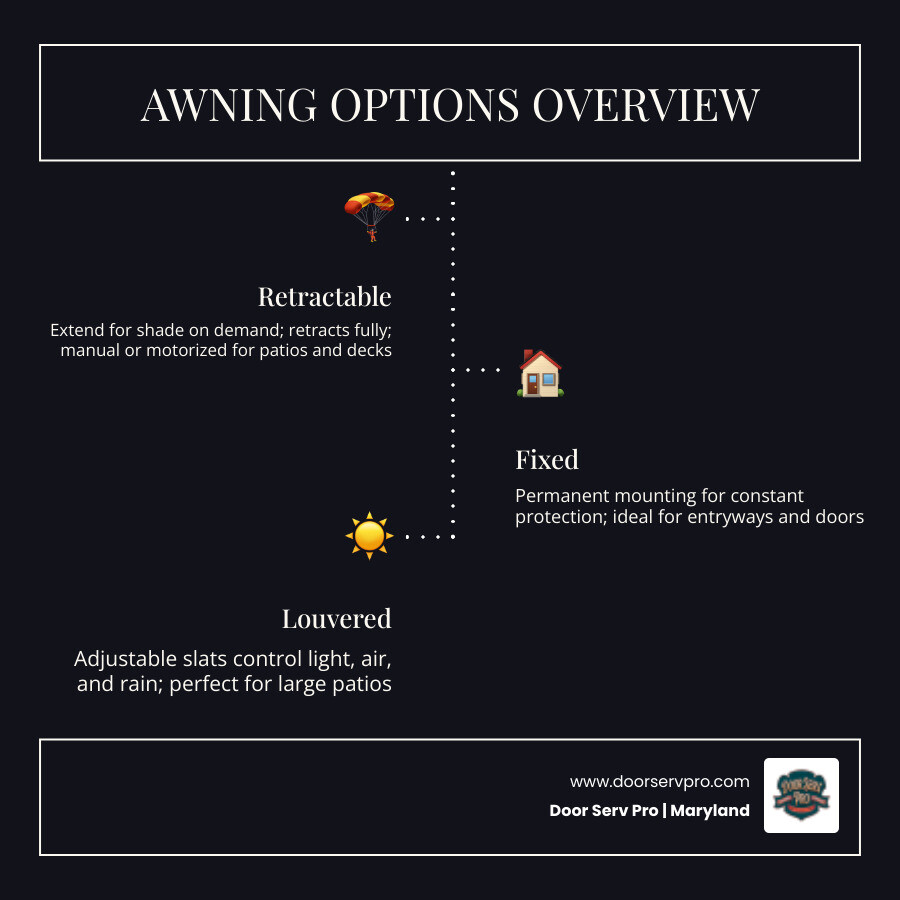
Awning options for patios decks and entryways fall into three main categories — and knowing which one fits your space can save you time, money, and frustration:
- Retractable awnings - Extend on demand for shade; retract when not needed; available in manual or motorized versions
- Fixed/stationary awnings - Permanently mounted for constant protection; ideal for entryways and high-traffic doors
- Louvered roof systems - Adjustable slats that control light, airflow, and rain; best for larger patio and deck spaces
Each type suits a different location, climate, and lifestyle — and the sections below break down exactly how to match the right awning to your specific space.
There is something genuinely satisfying about stepping outside and having your outdoor space work for you — cool shade when the afternoon sun gets intense, dry cover when a summer storm rolls in, and a front entry that looks sharp year-round. Whether you are trying to make your backyard deck more livable, protect your patio furniture from UV damage, or simply give your front door a polished, covered look, the right awning transforms how you use your home's exterior.
The challenge is that not every awning works for every space. A sleek motorized retractable awning that performs beautifully on a large patio may be completely wrong for a narrow entryway above a garage door. A permanent fixed canopy that suits a storefront-style entry may feel out of place on an open deck. The differences between awning types go beyond aesthetics — they involve mounting requirements, projection depth, fabric durability, wind resistance, and how the structure interacts with your home's architecture.
During the pandemic, outdoor living spaces became essential rather than optional, and awnings played a direct role in keeping people comfortable and protected outside. That shift stuck. In April 2026, homeowners across Maryland and beyond are investing more intentionally in outdoor shade solutions that blend function with curb appeal — and the range of available products has never been broader or better.
I'm Paul Wiese, founder of Door Serv Pro, and with over 30 years of hands-on experience helping homeowners improve and protect their properties — including awning solutions for entryways and garage doors — I've seen how the right awning options for patios decks and entryways can dramatically improve both comfort and home value. In the sections below, I'll walk you through everything you need to make a confident, well-informed decision.
Exploring the Best Awning Options for Patios Decks and Entryways
When we talk about transforming an outdoor area, we often refer to awnings as the "Swiss Army knife of outdoor comfort." They are versatile, functional, and increasingly stylish. In our 25+ years of serving homeowners from Hagerstown to Charles Town, we’ve seen how a well-chosen system can turn a scorching deck into a cool oasis.
There are three primary systems to consider: fixed, retractable, and louvered. Fixed systems are the traditional choice, offering permanent, "always-on" protection. They are rugged and can handle more consistent weather exposure but lack the flexibility to let the sun in on a chilly spring morning.
Retractable systems have become the modern standard for residential use. They offer "shade on demand," allowing you to tuck the fabric away in a protective cassette when the wind picks up or when you want to enjoy a clear night sky. Finally, louvered roofs represent the high-end hybrid of the industry. These use adjustable slats (louvers) that can rotate to block the sun while allowing airflow, or close completely to create a watertight seal during a rainstorm.
To dive deeper into how these systems can change your daily routine, check out our guide on how to Enhance Living with Modern Awnings. If you are just starting your journey, we also recommend reviewing Choosing the Perfect Awnings for Your Home to understand the architectural factors at play.
Retractable Awning Options for Patios Decks and Entryways
Retractable awnings are the ultimate choice for flexibility. Most systems utilize lateral projection arms — spring-loaded arms that push the fabric out and keep it taut. These arms are often built with multi-chambered aluminum and stainless steel cables to provide stability. In fact, high-quality retractable units can often withstand winds up to 25 or 30 mph, though we always recommend retracting them during heavy storms.
You generally have two choices for operation:
- Manual Cranks: These use a simple hand-held wand or "crank" to wind the awning in and out. They are reliable, require no electricity, and are generally more budget-friendly.
- Motorized Arms: These are the "gold standard" for convenience. With the push of a button or a smartphone app, your awning extends in less than a minute. Many modern units even include a manual override so you aren't stuck if the power goes out.
Beyond just comfort, these systems are a vital tool for health. By blocking up to 98% of harmful rays, they provide a safe zone for children and pets. Learn more about Retractable Awnings for Sun Safety to see how they protect your family.
| Feature | Manual Retractable | Motorized Retractable |
|---|---|---|
| Ease of Use | Requires physical effort | One-touch operation |
| Power Source | None (Human power) | 110V Electric outlet |
| Maintenance | Low | Moderate (Motor care) |
| Smart Sensors | Not compatible | Wind/Rain sensor ready |
| Backup | Always manual | Manual override available |
Stationary and Fixed Solutions for Entryways
While retractables rule the backyard, fixed awnings are often the heroes of the front door. A fixed entryway awning provides permanent protection for your guests as they wait for you to open the door, and it shields your foyer from rain and snow.
For homeowners with garage doors, a fixed awning can be a game-changer. It prevents water from pooling at the base of the door and protects the delicate electronics of your opener from moisture. We often discuss the benefits of Awnings for Entryways and Garage Doors with our clients in Falling Waters and Martinsburg who want to extend the lifespan of their garage door systems.
Louvered Roofs and Pergola Hybrids
If you want the "best of both worlds," a louvered roof or pergola hybrid is the way to go. These structures are usually freestanding or attached to the house with support posts. The roof consists of slats that can be tilted.
When tilted open, they create a "chimney effect," drawing hot air up and away from the patio while still providing shade. When closed, they provide a solid roof that can handle rain. This is a top-tier option for Enhancing Patio Weatherproofing with Awnings, especially if you enjoy hosting dinner parties regardless of the forecast.
Selecting Materials for Durability and Energy Efficiency
The "fit and finish" of your awning matters, but the materials determine how long it will actually last. In our region — where we deal with everything from humid Maryland summers to Pennsylvania snow — material choice is everything.
- Solution-Dyed Acrylic: This is the industry standard for high-end awnings. Unlike cheaper fabrics where the color is only on the surface, solution-dyed acrylic has the color locked into the fibers. This makes it incredibly fade-resistant, breathable, and water-repellent.
- Polyester Blends: Often coated with PU (polyurethane), these are more affordable and offer great water resistance. However, they may not last as long as acrylic under intense, constant UV exposure.
- Aluminum Frames: Most modern frames are made of powder-coated aluminum. It’s lightweight, won't rust, and provides the structural integrity needed to support large projections (which can range from 5 to 14 feet).
Choosing the right "skin" for your awning is a big decision. We’ve put together a specialized guide on the Best Awning Fabric Choices to help you navigate the pros and cons of each.
UV Protection and Solar Heat Gain
Did you know that an awning can actually lower your air conditioning bills? It’s true. By blocking the sun before it hits your windows and glass doors, awnings minimize "solar heat gain." This is the process where sunlight enters your home and turns into heat, forcing your AC to work overtime.
Awnings can reduce the temperature on your patio by up to 20°F and significantly lower the temperature inside the adjacent room. This leads to real-world Energy Efficiency and Cost Savings with Awnings. Plus, by blocking 98% of UV rays, you are also protecting your indoor carpets and furniture from fading.
Smart Features for Modern Awning Options for Patios Decks and Entryways
In 2026, awnings are smarter than ever. We no longer just "roll them out"; we program them.
- Wind Sensors: These are essential for retractable units. If the sensor detects gusts over a certain threshold (usually 20-25 mph), it automatically signals the motor to retract the awning, protecting your investment from damage.
- Rain Automation: Similar to wind sensors, these can close the awning (or tilt louvers) the moment moisture is detected.
- App & Voice Control: Integration with systems like Alexa or Google Home allows you to say, "Hey Google, open the patio awning," while you're carrying a tray of drinks outside.
- LED Lighting: Many modern lateral arms now have built-in, dimmable LED strips that allow you to transition from afternoon shade to evening ambiance seamlessly.
Professional Installation and Maintenance Best Practices
We often get asked, "Can I DIY my awning installation?" While some small, manual window awnings are manageable for a handy homeowner, large patio and deck systems are a different story. These units are heavy (often 75 to 150 lbs) and exert a tremendous amount of "torque" or pulling force on your home's structure.
Professional Awning Installation ensures that the brackets are anchored into the structural studs or headers of your home, not just the siding. Whether you are mounting to brick, wood siding, or a roofline, a professional team knows how to use the correct flashing and sealants to prevent leaks.
Sizing, Projection, and Pitch Adjustment
Getting the size right is about more than just matching the width of your sliding door. You need to consider:
- Width: Standard widths range from 8 ft to 24 ft.
- Projection: This is how far the awning extends out from the house. Common depths are 10 to 13 feet.
- The Pitch: This is the angle of the slope. A proper pitch (usually between 0° and 15°) is vital for rain runoff. If the pitch is too flat, water can pool on the fabric, causing it to stretch or the frame to buckle.
Seasonal Care and Cleaning Routines
With proper care, a high-quality retractable awning can last 10–15 years. Maintenance isn't difficult, but it must be consistent.
- Debris Removal: Use a soft brush to sweep off leaves, twigs, and bird droppings. If left to rot, these can stain the fabric or cause mildew.
- Mild Detergents: Never use bleach or a power washer! A gentle rinse with a garden hose and a mild soap solution is all you need.
- Seasonal Retraction: In our service areas like Berkeley Springs and Waynesboro, we recommend keeping the awning retracted during the winter months to avoid heavy snow loads.
For a deeper dive into keeping your system pristine, refer to our Spring Awning Maintenance and Cleaning Guide.
Frequently Asked Questions
How do awnings perform in wind and rain?
Modern retractable awnings are designed for shade and light rain. While they are built with sturdy aluminum frames and stainless steel cables, they are not umbrellas. We recommend retracting them during heavy downpours to prevent water pooling. For wind, most quality units are tested up to 25-30 mph, but using a wind sensor for automatic retraction is the safest way to prevent damage.
Can awnings really lower my energy bills?
Yes! By shading windows and glass doors, awnings can reduce solar heat gain by up to 77%. This keeps your home naturally cooler, meaning your air conditioner doesn't have to run as often. Over a long Maryland summer, those savings add up significantly.
What is the typical lifespan of a high-quality awning?
A well-maintained awning typically lasts between 10 and 15 years. The aluminum frames often last much longer, and many manufacturers offer replaceable fabric covers, allowing you to "refresh" the look of your home without replacing the entire mechanical system.
Conclusion
Finding the perfect awning options for patios decks and entryways is about blending your personal style with the practical needs of your home. Whether you want the sleek, motorized convenience of a retractable system for your backyard in Shepherdstown or a rugged, fixed shield for your entryway in Falling Waters, the right choice will pay dividends in comfort and curb appeal for years to come.
At Door Serv Pro, we are more than just garage door experts — we are specialists in home exteriors. As a family-owned company with over 25 years of experience, we pride ourselves on bringing a personal touch to every project. From Ranson to Greencastle, our NATE-certified team is dedicated to your 100% satisfaction.
Ready to reclaim your outdoor space from the sun? Transform your outdoor space with professional awning replacement and see why homeowners across the region trust us to create lasting impressions. Give us a call today for a consultation!
Need Help?
Contact us today to discuss your needs. Our team is ready to help.
About the author
Door Serv Pro
More articles
View all postsKeep reading
Related articles
Ready to Get Started?
Whether you need a repair, maintenance, or a new installation, our expert team is here to help.