Blog
What to expect when you book a professional garage door tune up
Door Serv Pro
Reviewed by the Door Serv Pro service team · Trained, professional garage door technicians
Last updated June 24, 2026
Why Every Pennsylvania Homeowner Should Know What a Professional Garage Door Tune-Up Includes
What does a professional garage door tune-up include is one of the most practical questions you can ask as a homeowner — and the answer directly affects your safety, your budget, and how long your door lasts.
Your garage door is likely the largest moving part of your entire home. It opens and closes hundreds of times a year, putting constant stress on springs, cables, rollers, tracks, and sensors. Most people don't think about it until something goes wrong — and by then, a small problem has often turned into a costly repair.
Here is a quick overview of what a professional tune-up typically covers:
- Full visual inspection of panels, springs, cables, rollers, tracks, and hinges
- Hardware tightening — bolts, brackets, and track fasteners
- Door balance test — disconnecting the opener and checking spring tension
- Lubrication of springs, hinges, rollers, and opener drive components
- Safety sensor testing — photo-eye alignment and auto-reverse function
- Opener performance check — force settings, travel limits, and motor function
- Weather seal inspection — checking for gaps, cracks, or worn seals
- Technician recommendations — flagging worn parts before they fail
The whole service typically takes about one hour for a standard residential door. Experts recommend scheduling one at least once a year — or every six months if your garage is your primary entry point.
The good news? Well over 70% of major garage door failures start as issues a proper tune-up would have caught early. A little preventative care goes a long way.
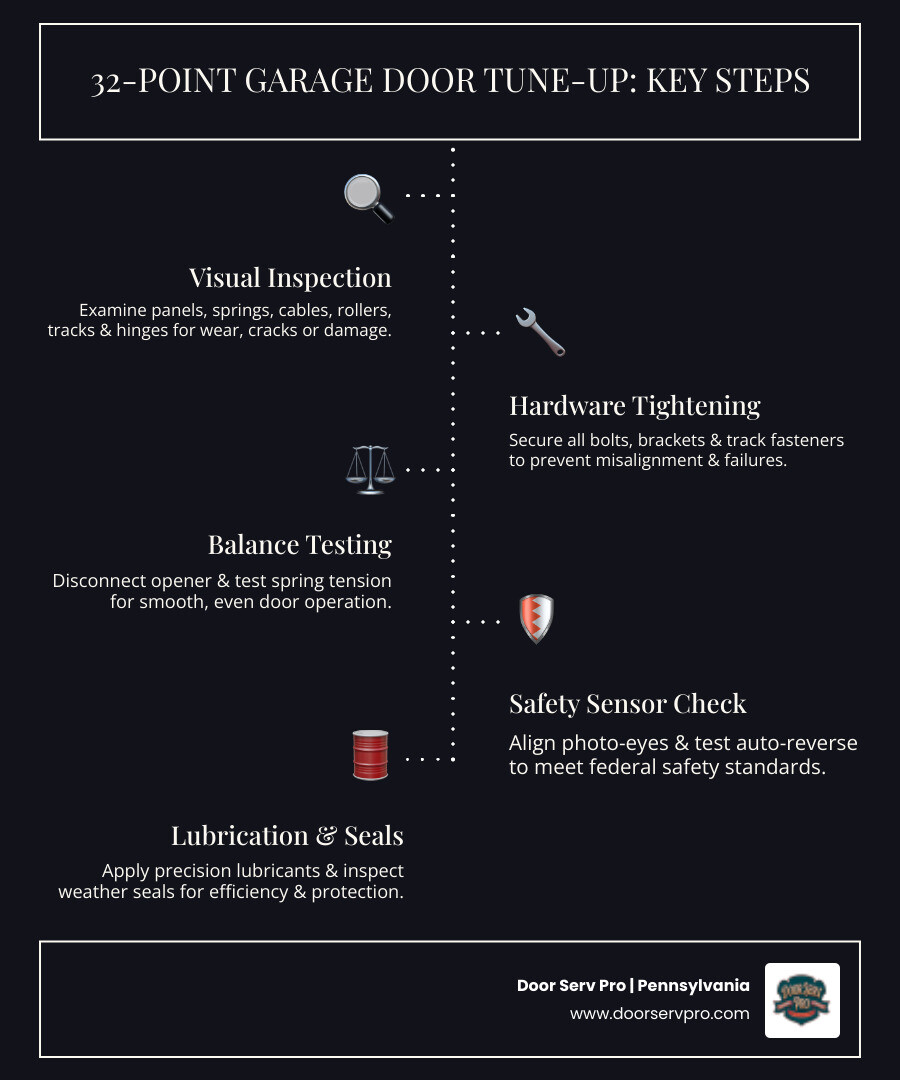
Understanding the 32-point checklist: what does a professional garage door tune up include?
When we arrive at your home in Chambersburg or Greencastle, we don’t just "look" at the door. A professional tune-up is a systematic process. We follow a detailed 32-point safety inspection designed to uncover hidden fatigue in the system. Many homeowners are surprised to learn that a garage door can "look" fine while a critical component, like a torsion spring or a lift cable, is on the verge of snapping.
Our process begins with a comprehensive visual assessment. We examine the door panels for cracks or warping, which can affect the door's structural integrity. We then move to the tracks, ensuring they are perfectly aligned and free of debris. Even a small pebble or a buildup of hardened grease can cause the rollers to jump the track, leading to a dangerous situation.
Tightening the hardware is another vital step. Because your garage door vibrates every time it moves, nuts and bolts naturally loosen over time. We go through and secure every hinge bolt, track fastener, and bracket screw to ensure the system remains rigid and quiet. For a deeper dive into how these components interact, check out our Spring Garage Door Maintenance Complete Guide.
Mechanical inspection: what does a professional garage door tune up include for moving parts?
The mechanical inspection focuses on the "muscles" of your door. We look closely at the rollers—if they are nylon, we check for flat spots or bearings that no longer spin freely; if they are steel, we look for excessive wear or rust.
Hinges are another area of concern. We inspect the "knuckles" of the hinges for elongation (where the hole becomes oval-shaped) and the leaves for stress cracks. We also perform a high-level check of the cable tension. If a cable is fraying or "ballooning," it’s a ticking time bomb. This level of detail is what separates a professional service from a simple DIY walkthrough. Residents looking for local expertise can find more in our Best Garage Door Maintenance Guide Stephens City VA.
Critical safety testing and performance calibration
Safety is our absolute priority. Since 1993, federal law has mandated specific safety features for automatic garage door openers, and a professional tune-up ensures these systems are functioning exactly as intended. We perform two primary tests: the auto-reverse test and the photo-eye sensor test.
To test the auto-reverse mechanism, we place a solid object (like a 2x4 piece of wood) on the floor in the door's path. When the door strikes the object, it should immediately reverse. If it doesn't, the "force settings" on your opener need adjustment. We also calibrate the travel limits—the settings that tell the opener exactly where the door should stop when opening and closing. If these are off, the door might slam into the floor or stop too early, leaving a gap for pests or intruders.
Safety protocols: what does a professional garage door tune up include for sensors?
The photo-eye sensors are the small "eyes" located near the bottom of your tracks. They send an invisible infrared beam across the opening. If that beam is broken while the door is closing, the door must stop and reverse.
During a tune-up, we clean the lenses, check the wiring for signs of pest damage (mice love chewing these wires!), and ensure the sensors are perfectly aligned. Misaligned sensors are the #1 reason for "phantom" door reversals where the door starts to close and then pops back up for no apparent reason. You can learn more about this in our guide on Garage Door Maintenance: Ensuring Safety and Functionality of Sensor. For those in our local service areas, we offer specific Best Garage Door Maintenance Tips Greencastle PA.
The importance of balance and precision lubrication
One of the most critical parts of the service is the door balance test. We disconnect the garage door opener and lift the door manually. A well-balanced door should be easy to lift with one hand and stay halfway open on its own. If the door falls or shoots upward, the spring tension is incorrect.
The springs do the heavy lifting—the opener is only there to guide the door. If the door is out of balance, your opener motor has to work twice as hard, which can lead to a premature (and expensive) motor burnout. To understand why this is so vital, read about The Importance of Balance in Garage Door Maintenance.
Once the balance is verified, we apply high-quality lubrication. We never use "all-purpose" solvents like WD-40, which can actually strip away necessary grease. Instead, we use professional-grade silicone or lithium-based lubricants.
Professional Lubricants vs. Household Solvents
| Feature | Professional Silicone/Lithium | Common Solvent (e.g., WD-40) |
|---|---|---|
| Primary Function | Long-term lubrication | Degreasing/Cleaning |
| Dust Attraction | Low (does not stay "tacky") | High (attracts gunk and grit) |
| Longevity | Months of protection | Evaporates quickly |
| Component Safety | Safe for nylon and plastic | Can degrade certain plastics |
Recognizing the signs your Pennsylvania home needs a tune-up
How do you know it's time to call us? Your garage door usually tries to tell you when it’s struggling. If your door sounds like it’s "screaming" or grinding, it’s likely a sign of dry bearings or worn rollers. Jerky movement or a door that seems "sluggish" often points to a balance issue or track obstruction.
Another sign is a sagging section or a door that closes unevenly, leaving a gap on one side. This is often a symptom of a failing spring or a cable that has slipped. In Pennsylvania, we also see a lot of worn weatherstripping. If you see light peeking through the edges of your door, you’re essentially paying to heat the outdoors. Avoid these common pitfalls by reviewing Top Garage Door Maintenance Mistakes to Avoid for Optimal Function.
Recommended frequency for seasonal maintenance
In areas like Waynesboro and Chambersburg, our garage doors face tough conditions. The freeze-thaw cycles of a Pennsylvania winter can cause metal components to expand and contract, which loosens hardware and thickens old grease.
We recommend a professional tune-up at least once a year, ideally in the fall before the first freeze. If you use your garage as your main front door, every six months is a smarter investment. Regular maintenance keeps your weather seals tight, helping your home stay energy-efficient year-round. Check out our Seasonal Garage Door Maintenance Tips for more advice.
The dangers of DIY: why professional expertise is essential
We love a good DIY project as much as anyone, but the garage door is the one place where "doing it yourself" can be genuinely dangerous. The torsion springs on your door are under incredible tension—enough energy to cause severe injury or even be lethal if they snap or are released improperly.
Professionals use specialized tools, such as winding bars, to safely adjust these springs. Attempting to use a screwdriver or a pair of pliers for spring work is a recipe for disaster. Furthermore, cables are under the same high tension and can "whip" with extreme force if they break.
Beyond the physical danger, there is the risk of property damage. A door that is improperly balanced or a track that is "forced" into alignment can cause the door to crash down, damaging your car or the door itself. We bring 30+ years of craftsmanship and professional diagnostic tools to every job, ensuring the work is done safely and correctly the first time.
Frequently Asked Questions about garage door maintenance
How long does a professional garage door tune-up typically take?
For a standard residential door in average condition, a tune-up usually takes between 60 and 90 minutes. We work efficiently, but we never cut corners on the 32-point safety check.
What is the difference between a tune-up and a repair?
A tune-up is preventative maintenance—it’s like getting an oil change for your car. We inspect, lubricate, and make minor adjustments to keep the door running smoothly. A repair happens after something has already broken (like a snapped spring or a bent track). Regular tune-ups are designed to prevent the need for emergency repairs.
Why shouldn't I use WD-40 on my garage door tracks and rollers?
This is the most common mistake we see! Standard WD-40 is a solvent, not a lubricant. While it might provide a temporary "fix" for a squeak, it actually strips away existing grease and attracts dust, hair, and grit. Over time, this creates a "grinding paste" that wears out your rollers and hinges much faster. Always use a dedicated silicone or lithium-based garage door lubricant.
Conclusion
At Door Serv Pro, we believe a garage door should be "stupidly reliable." As a family-owned business with over 30 years of experience, we take pride in serving our neighbors in Chambersburg, Greencastle, and Waynesboro. Whether we are supporting our local veterans through philanthropic campaigns or ensuring your family's safety with a 24/7 emergency response, our focus is always on quality craftsmanship.
Don’t wait for your door to "cry for help" with a loud bang or a grinding screech. A professional tune-up is a small investment that provides peace of mind and keeps your home secure.
Schedule your professional garage door maintenance in Ashburn today and let our expert technicians ensure your door operates safely and silently for years to come.
Need Help?
Contact us today to discuss your needs. Our team is ready to help.
About the author
Door Serv Pro
More articles
View all postsKeep reading
Related articles
Ready to Get Started?
Whether you need a repair, maintenance, or a new installation, our expert team is here to help.