Blog
How Window Awnings Keep Your House Cool and Your Wallet Full
Door Serv Pro
Reviewed by the Door Serv Pro service team · Trained, professional garage door technicians
Last updated June 24, 2026
Why Understanding How Awnings Reduce Energy Costs by Shading Windows Can Cut Your Maryland Utility Bills
How awnings reduce energy costs by shading windows is simpler than most homeowners expect — here's the quick version:
- Awnings block sunlight before it hits your window glass, stopping solar heat from entering your home in the first place
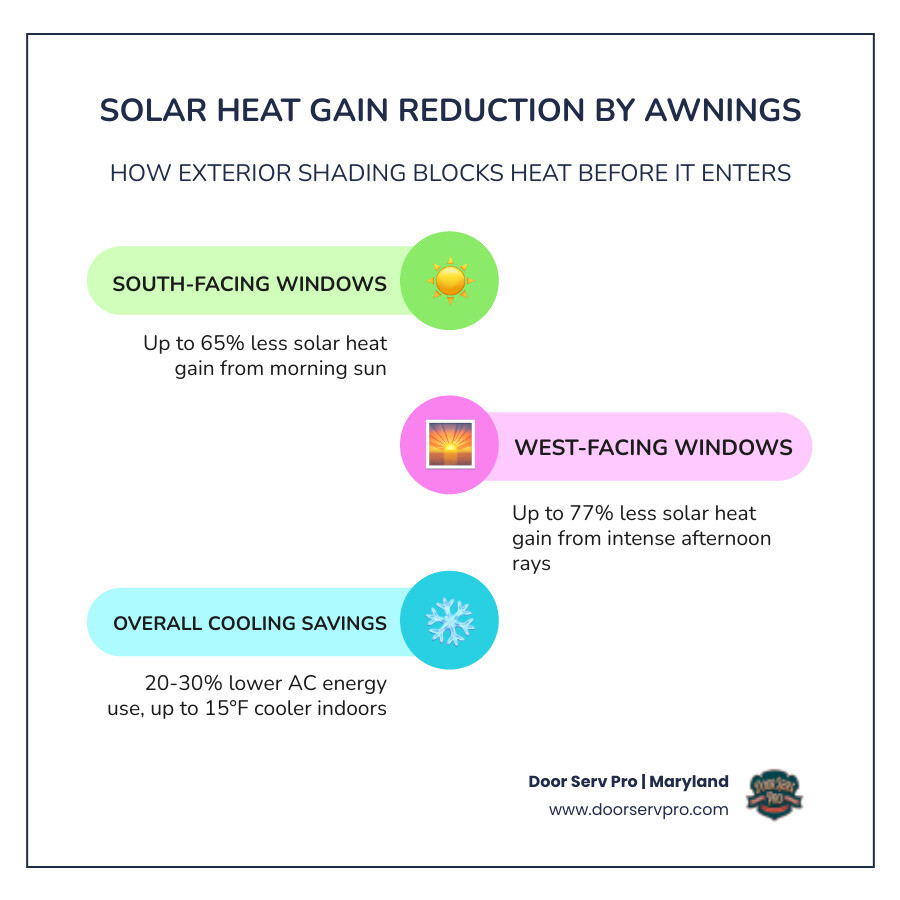
- South-facing windows can see up to 65% less solar heat gain with an awning installed
- West-facing windows — the worst offenders for afternoon heat — can see up to 77% less solar heat gain
- That translates to 20–30% lower cooling energy use during warm months, according to the Professional Awning Manufacturers Association (PAMA)
- Homes with awnings can run up to 15°F cooler on hot days, meaning your air conditioner runs less and works easier
- Seasonal use from April through September alone can cut total annual HVAC energy consumption by around 15%
If your Maryland home heats up fast in the afternoon sun and your energy bills spike every summer, awnings are one of the most effective passive cooling tools available. About 76% of sunlight that hits a standard double-pane window converts directly into indoor heat — and interior blinds or curtains can't stop that process before it starts. An exterior awning can.
I'm Paul Wiese, founder of Door Serv Pro, and with over 30 years of hands-on experience helping Maryland homeowners improve their homes' efficiency and comfort — including awning solutions designed specifically for how awnings reduce energy costs by shading windows in our region's demanding climate. In the sections below, I'll walk you through exactly how this works, what the real numbers look like for Mid-Atlantic homes, and how to choose the right setup for your situation.
The Science of How Awnings Reduce Energy Costs by Shading Windows
To understand why an awning is so effective, we have to look at how your home actually gets hot. Most people think it’s just the outside air temperature, but the real culprit is solar radiation. When those powerful UV rays hit your window glass, the glass acts like a magnifier. It allows the energy to pass through and then traps it inside your living room or kitchen, creating a "greenhouse effect."
Once that heat is inside, your air conditioner has to work double-time to remove it. By the time your interior blinds feel warm to the touch, the battle is already lost—the heat is already in the building.
Blocking Solar Heat Gain Before It Enters
The primary secret to Energy Efficiency and Cost Savings: How Awnings Can Help lies in interception. Unlike curtains or films that sit on or behind the glass, an awning stops the sun’s rays several feet before they ever reach your window.
This significantly reduces the "thermal load" on your home. Think of your house like an oven. If the sun is the heating element, the awning is like a shield that keeps the element from ever touching the food. When we install these systems in places like Hagerstown or Frederick, we see a massive reduction in radiant heat—the kind of heat you feel on your skin when standing near a sunny window.
Creating an Insulating Air Buffer
Beyond just blocking light, awnings create a "buffer zone" of cooler air. Because the window is shaded, the glass itself stays much cooler. This prevents a process called convective cooling from being overwhelmed; essentially, it creates a pocket of air that isn't being baked by the sun.
This air gap acts as a secondary layer of insulation. During those sticky Maryland July afternoons, this buffer keeps the temperature of the glass closer to the temperature of your indoor air, preventing the window from acting like a radiator that pumps heat into your home. This is a form of passive cooling that requires zero electricity but provides 24/7 relief.
Quantifying Your Savings: Maryland and Pennsylvania Data
We know it feels cooler, but what does the data say? According to the Professional Awning Manufacturers Association (PAMA), the energy savings are substantial. In our service areas—from Smithsburg, MD, to Waynesboro, PA—homeowners often see their cooling energy use drop by 20% to 30%.
When your home stays naturally cooler, your HVAC system doesn't have to "cycle" as often. Constant starting and stopping is what wears out an AC compressor. By reducing the peak demand on your system, you aren't just saving on your monthly utility bill; you are extending the life of your expensive HVAC equipment. You can learn more about how external home factors impact these systems in our guide on The Impact of Garage Door Services on Home Energy Efficiency.
Maximizing Impact on South and West-Facing Windows
Not all windows are created equal when it comes to heat.
- South-facing windows: These receive the most consistent sun throughout the day. Awnings here can reduce solar heat gain by about 65%.
- West-facing windows: These are the real "budget-killers." They catch the low, intense afternoon sun when the outside air is already at its hottest. Awnings on west-facing glass can block up to 77% of that heat.
By strategically placing awnings on these specific sides of your home, you get the highest return on investment.
Regional Performance in the Mid-Atlantic Climate
Our climate in the Mid-Atlantic is unique. We deal with high humidity and intense summer sun, followed by cold, snowy winters. Research shows that in cities like Pittsburgh (which shares a very similar climate to Chambersburg and Hagerstown), awnings on homes with older single- or double-pane windows can reduce cooling energy by a staggering 46-50% during a particularly hot year.
In a typical Maryland summer, you can expect an indoor temperature drop of up to 15°F. Imagine coming home to a house that is 75°F naturally when it’s 90°F outside—before you even touch the thermostat.
Choosing Materials and Styles for Maximum Efficiency
To get the most out of your awning, the material matters just as much as the placement. You want a fabric that is opaque and tightly woven.
| Awning Feature | Impact on Energy Efficiency |
|---|---|
| Fixed Awning | Constant shade, best for windows that always overheat. |
| Retractable Awning | Maximum flexibility; allows for winter sun and summer shade. |
| Light Colors | Reflects more sunlight; best for cooling-heavy climates. |
| Dark Colors | Absorbs more heat; can be used to help warm spaces in specific designs. |
| Acrylic/Polyester | High UV resistance and breathability; prevents hot air from trapping. |
Why Retractable Designs are Ideal for Four-Season Climates
In Maryland and Pennsylvania, we have four distinct seasons. While we want to block the sun in July, we actually want that sun in January to help heat the house for free. This is why retractable designs are so popular in our region.
Retractable awnings allow you to:
- Extend them from April to September to slash cooling costs.
- Retract them in the winter to take advantage of "passive solar gain," which can actually help lower your heating bills.
- Protect the investment by pulling the fabric in during heavy snowfalls or high-wind storms typical of our area.
Many of our customers opt for motorization and smart sensors. These systems can automatically extend the awning when the sun hits a certain intensity and retract it if the wind picks up, ensuring you save energy even when you aren't home.
How Awnings Reduce Energy Costs by Shading Windows More Effectively Than Blinds
Why not just use heavy blackout curtains? While they help, they suffer from the "interior greenhouse effect." Once sunlight passes through the glass, the heat is already inside your envelope. The curtains trap the heat against the window, but that heat eventually leaks into the room.
Awnings offer a "first line of defense." They provide:
- Better Ventilation: Awnings allow for airflow between the shade and the window.
- UV Protection: They block 90% of harmful UV rays that fade your expensive hardwood floors and furniture.
- Curb Appeal: Awnings add a custom, high-end look to your home that interior blinds simply can't match.
- Property Value: Energy-efficient upgrades are a major selling point for modern homebuyers in Maryland.
Frequently Asked Questions about Energy-Efficient Awnings
How much can indoor temperatures drop with awnings?
As mentioned, you can see a drop of up to 15°F. This is significant because it often keeps your home below the "discomfort threshold," meaning you might not even need to turn on the AC during mild summer days. This reduces the number of "cycles" your AC performs, saving you money on both electricity and future repairs.
Do awnings provide benefits during the winter months?
If you have a fixed awning, it might actually slightly increase your heating costs by blocking the sun. However, with a retractable awning, you get the best of both worlds. By retracting the awning in the winter, you allow the sun to naturally warm your home, which is a huge benefit in our colder Mid-Atlantic months.
How do awnings reduce energy costs by shading windows compared to window film?
Window film is a permanent treatment applied to the glass. While it helps, it can sometimes trap heat within the glass pane itself, which can lead to seal failure in double-pane windows. Awnings avoid this entirely by keeping the sun off the glass altogether. Plus, awnings provide glare reduction without darkening your view of the outdoors like some dark-tinted films do.
Conclusion
At Door Serv Pro, we’ve spent over 25 years helping our neighbors in Maryland, Pennsylvania, and West Virginia create homes that are as efficient as they are beautiful. From our base in Frederick, MD, we serve homeowners across Hagerstown, Charles Town, and beyond with the expertise that only comes from decades in the industry.
Whether you are looking to slash your summer utility bills or simply want to enjoy your patio without melting, our team of NATE-certified technicians is ready to help. We are a family-owned business that stands behind our work with a 100% satisfaction guarantee and 24/7 emergency availability.
Ready to stop the sun from stealing your hard-earned money? Schedule your energy-efficient awning consultation with Door Serv Pro today and let's make your home the coolest one on the block.
Need Help?
Contact us today to discuss your needs. Our team is ready to help.
About the author
Door Serv Pro
More articles
View all postsKeep reading
Related articles
Ready to Get Started?
Whether you need a repair, maintenance, or a new installation, our expert team is here to help.