Blog
Stay Chill: How Awnings Reduce Your Monthly Cooling Costs
Door Serv Pro
Reviewed by the Door Serv Pro service team · Trained, professional garage door technicians
Last updated June 23, 2026
How Awnings Reduce Energy Costs by Shading Windows: What Virginia Homeowners Need to Know
How awnings reduce energy costs by shading windows comes down to one simple principle: stop the heat before it ever gets inside.
Quick answer — here's how it works:
- Block solar radiation — Awnings intercept sunlight before it hits your glass, cutting solar heat gain by up to 65% on south-facing windows and up to 77% on west-facing windows (U.S. Department of Energy)
- Lower indoor temperatures — Shaded homes can run up to 15°F cooler on hot days without extra AC effort
- Reduce cooling energy use — Studies by the Professional Awning Manufacturers Association (PAMA) show awnings can cut cooling energy by 20–30% in warm months
- Save real money — That can translate to $200 or more in annual savings, according to PAMA
- Ease AC strain — Less heat load means your air conditioner runs less, extending its lifespan
If you live in Virginia, this matters a lot right now. Summers are getting hotter, energy bills are climbing, and air conditioners are working overtime to keep up. The problem isn't just the heat outside — it's the heat pouring through your windows.
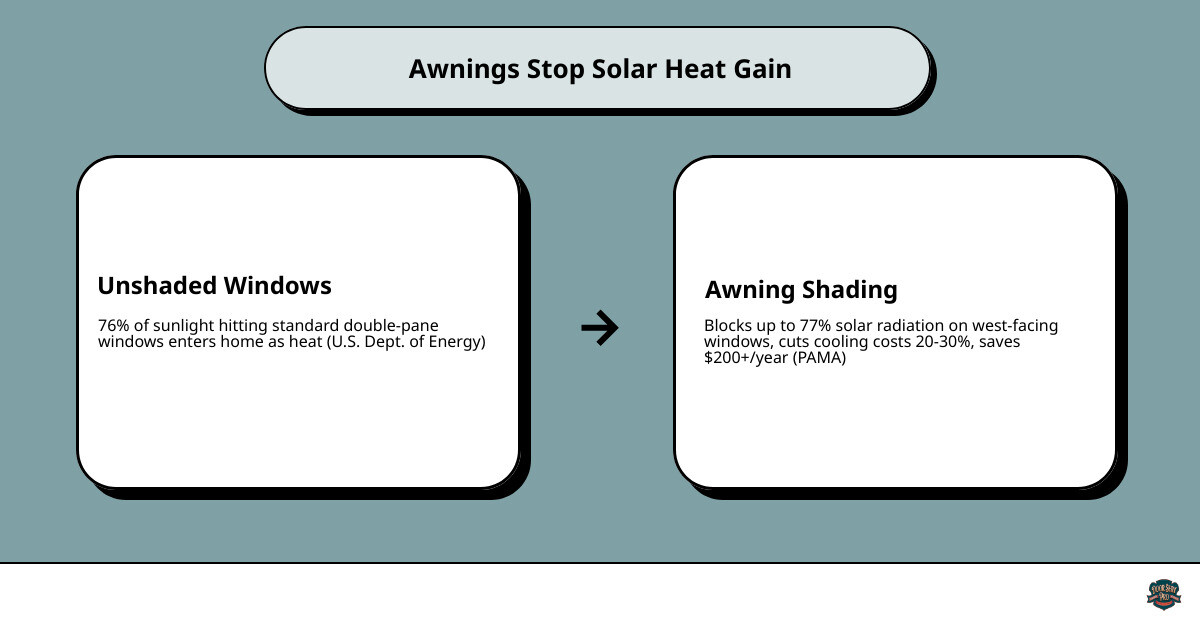
Here's a sobering fact from the U.S. Department of Energy: in cooling seasons, about 76% of the sunlight that hits a standard double-pane window enters your home and becomes heat. That's not a small leak — that's your AC fighting a losing battle every sunny afternoon.
The good news? A well-placed awning is one of the simplest, most cost-effective ways to stop that heat at the source — before it ever touches your glass.
The Science of Solar Heat Gain and Window Shading
To understand why we see such a massive difference in our utility bills after an awning installation, we have to look at the science of "solar heat gain." In home efficiency, windows are often the weakest link in the chain. While your walls are packed with insulation, your windows are essentially holes in that thermal envelope.
Even high-quality double-pane windows have a high level of conductivity. When short-wave radiation from the sun hits the glass, it passes through and is absorbed by your floors, rugs, and furniture. These objects then radiate that energy back as long-wave infrared heat, which gets trapped inside—a process known as the greenhouse effect. According to the Department of Energy, about 76% of sunlight on standard windows turns into heat once it gets inside.
By utilizing Weather Protection Benefits Of Quality Awning Systems, you are practicing what experts call "passive cooling." Instead of relying solely on a mechanical system (your AC) to remove heat after it has already entered the room, you are preventing the heat from ever arriving. This "active solar protection" can reduce indoor temperatures by as much as 15°F. Imagine walking into your living room in McLean or Reston on a 95-degree July afternoon and feeling a natural coolness because the sun's rays were blocked three feet away from the glass.
How Awnings Reduce Energy Costs by Shading Windows

The primary way how awnings reduce energy costs by shading windows is by intercepting up to 77% of solar radiation. When the sun hits an awning fabric, the energy is either reflected or absorbed by the fabric and then dissipated into the outdoor air, rather than being transmitted through the window.
There is also a secondary benefit that many homeowners overlook: the "air gap" insulation effect. When an awning is installed over a window, it creates a pocket of shaded, relatively still air between the fabric and the glass. This buffer zone slows down the transfer of heat from the hot outside air to the cooler inside air.
The Professional Awning Manufacturers Association (PAMA) has conducted extensive studies showing that this combination of radiation blocking and air-gap insulation leads to an average cooling energy saving of 25%. In some regions, especially during particularly hot years, those savings can spike even higher. By checking out Energy Efficiency And Cost Savings How Awnings Can Help, you can see how these small changes lead to significant long-term financial relief.
Strategic Placement: How Awnings Reduce Energy Costs by Shading Windows on West-Facing Walls
Not all windows are created equal when it comes to heat gain. If you’ve ever sat in a room with large west-facing windows during a Virginia summer peak, you know exactly what we mean. The afternoon sun hits at a lower angle and with intense strength, turning your home into an oven just as you’re trying to relax after work.
- West-Facing Windows: These benefit the most, with potential solar heat gain reductions of up to 77%.
- South-Facing Windows: These are the second most important, seeing reductions of approximately 65% because the sun is higher in the sky during the hottest part of the day.
- East-Facing Windows: These help prevent your home from heating up too early in the morning, easing the initial load on your AC.
In areas like Ashburn and Leesburg, where many homes feature large rear decks or patios facing the west, a retractable awning isn't just a luxury—it's a critical component of your home's thermal defense.
Material Science: How Awnings Reduce Energy Costs by Shading Windows with Reflective Fabrics
The type of fabric you choose plays a massive role in the final efficiency numbers. In our experience serving the Shenandoah Valley and Northern Virginia, we’ve found that high-tech synthetic acrylics are the gold standard. These materials are specifically engineered to resist UV degradation while maintaining high reflectivity.
When selecting your material, consider these factors:
- Color: Light-colored fabrics are generally better for energy efficiency because they reflect more sunlight away. Darker colors might absorb more heat, though they are excellent for reducing glare.
- Weave Density: A tight weave blocks more radiation but can sometimes trap heat underneath.
- Ventilation: High-quality awnings often include grommets or specific design features to allow hot air to escape from the top, preventing a "heat chimney" effect against your siding.
For a deeper dive into choosing the right style for your home, our Awning Benefits Home Outdoor Guide offers practical tips on balancing aesthetics with performance.
Retractable vs. Fixed: Seasonal Efficiency in Virginia
One of the most common questions we get at Door Serv Pro is whether a fixed or retractable awning is better for energy savings. In a four-season climate like ours—ranging from the humid summers of Vienna to the chilly winters of Berryville—flexibility is key.
| Feature | Fixed Awnings | Retractable Awnings |
|---|---|---|
| Summer Cooling | Excellent (Constant Shade) | Excellent (Adjustable Shade) |
| Winter Heating | May block beneficial sun | Can be retracted for passive solar gain |
| Durability | High (Sturdy Frames) | High (Protected when retracted) |
| Automation | N/A | Available with wind/sun sensors |
Retractable awnings offer a unique advantage: seasonal flexibility. During an April 2026 spring day, you might want the sun to help warm your home. By retracting the awning, you allow for "passive solar gain," which reduces your heating bill. In the summer, you extend it to slash the cooling load. Modern versions even come with motorized sensors that automatically deploy the awning when the sun hits a certain intensity, ensuring your home stays cool even if you aren't there to flip a switch. This versatility is one reason why Boosting Home Value Garage Door Awnings And Curb Appeal is such a popular topic for homeowners looking to modernize their properties.
Extending HVAC Life and Protecting Home Interiors
Beyond the monthly line item on your utility bill, how awnings reduce energy costs by shading windows has a "hidden" financial benefit: protecting your equipment and your belongings.
When your home is shaded, your air conditioner doesn't have to cycle on and off nearly as often. This reduces the wear and tear on the compressor and fan motor. By lowering the demand on the system, you are effectively extending the life of your HVAC unit by years. Replacing an AC system is a major expense; an awning acts as a preventative maintenance tool for your entire cooling infrastructure.
Furthermore, we can't ignore the "UV factor." The same solar radiation that heats your home also destroys your interior. Over time, direct sunlight through unshaded windows will:
- Fade expensive hardwood floors.
- Discolor area rugs and carpets.
- Cause leather and fabric furniture to crack or lose its vibrancy.
In historic or well-maintained homes in Winchester and Stephens City, preserving the interior is just as important as saving on the electric bill. An awning provides a "full-spectrum" defense, keeping your home cool, your AC healthy, and your decor looking brand new.
Frequently Asked Questions about Energy-Saving Awnings
How much can I save on my cooling bills in Virginia?
While every home is different, PAMA and the Department of Energy suggest that homeowners in the Eastern U.S. can see cooling energy savings between 3% and 24%. In Virginia's specific climate, many homeowners report a reduction of about 20-25% in their AC-related electricity usage during the peak of summer.
Are exterior awnings more effective than interior blinds?
Yes, significantly so. Interior blinds and shades stop the sun after it has already passed through the glass. At that point, the heat is already inside your home's envelope. Exterior awnings stop the energy before it even touches the window, which is much more efficient at keeping the glass surface cool.
Do awnings provide benefits during the winter months?
If you have a retractable awning, yes! By retracting the awning in the winter, you allow the sun to shine directly into your windows. This provides free "passive solar heating," which can help take the chill off your rooms and reduce the load on your furnace or heat pump.
Conclusion
As we look at the energy trends of April 2026, it is clear that sustainability and smart home design are more important than ever. How awnings reduce energy costs by shading windows is a proven, low-tech solution that delivers high-tech results. Whether you are looking to boost your property value, protect your interior, or simply stop dreading your monthly power bill, a high-quality awning is a wise investment.
At Door Serv Pro, we bring 30+ years of craftsmanship and a deep commitment to our Virginia neighbors. From the bustling streets of Reston and McLean to the quiet neighborhoods of Front Royal and Middletown, we take pride in helping our community stay comfortable and efficient. Our family-owned approach means we don't just see a house; we see a home that deserves the best protection available.
Ready to feel the difference that professional shade can make? Schedule your professional awning consultation today and let us help you reclaim your home from the summer heat.
Need Help?
Contact us today to discuss your needs. Our team is ready to help.
About the author
Door Serv Pro
More articles
View all postsKeep reading
Related articles
Ready to Get Started?
Whether you need a repair, maintenance, or a new installation, our expert team is here to help.