Blog
Spring Garage Door Maintenance Checklist for Homeowners
Door Serv Pro
Reviewed by the Door Serv Pro service team · Trained, professional garage door technicians
Last updated June 23, 2026
Your Spring Garage Door Maintenance Checklist for Homeowners Starts Here
A spring garage door maintenance checklist for homeowners is one of the smartest ways to protect your home after a long Virginia winter. Here's a quick overview of what it covers:
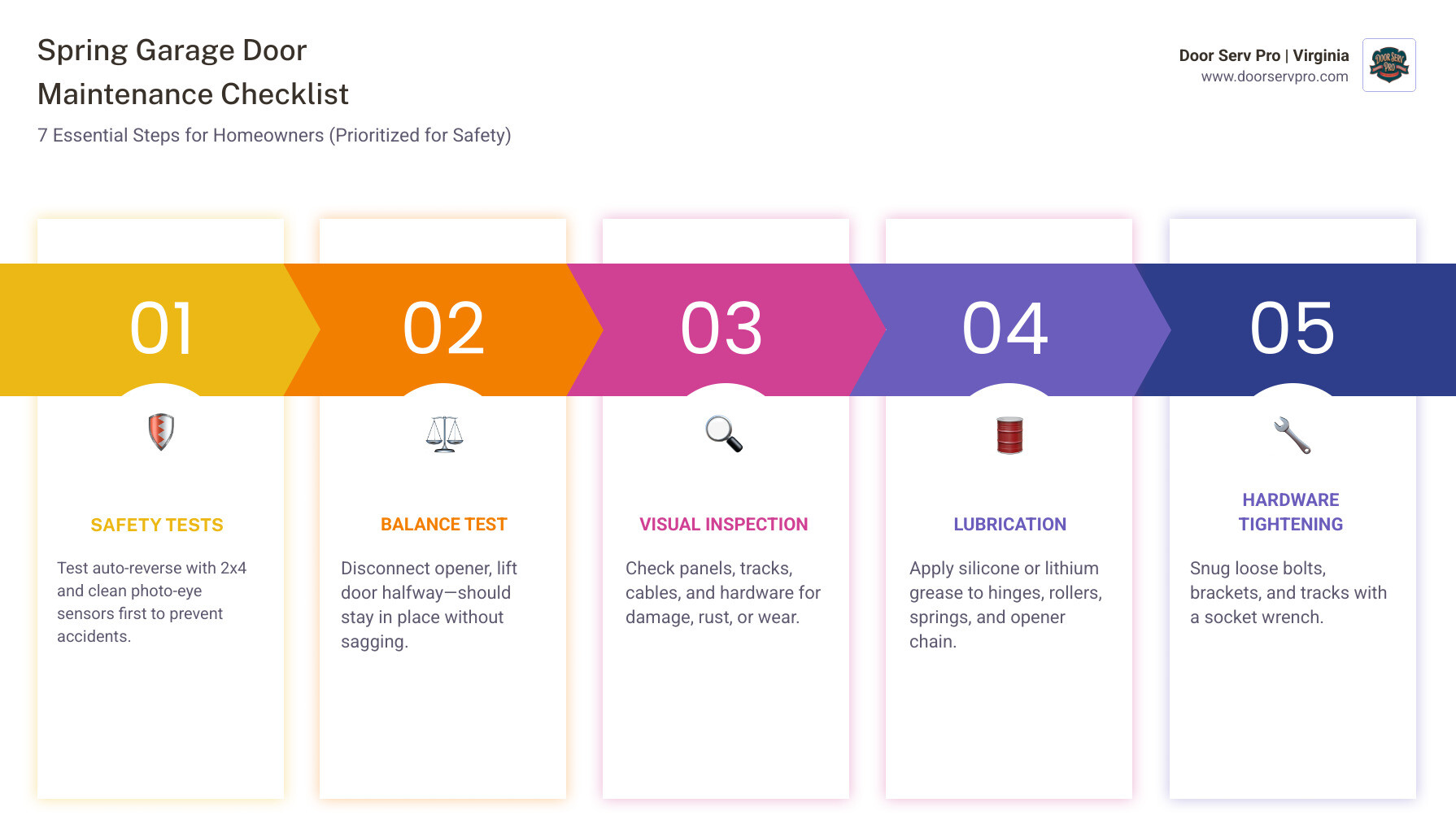
- Visual inspection - Check panels, tracks, cables, and hardware for damage or wear
- Lubrication - Apply silicone or lithium-based lubricant to hinges, rollers, and springs
- Balance test - Disconnect the opener and lift the door halfway to check if it holds position
- Safety tests - Test the auto-reverse feature and clean photo-eye sensors
- Weatherstripping check - Look for cracks, brittleness, or drafts along door seals
- Hardware tightening - Snug up loose bolts and mounting brackets with a socket wrench
- Know your limits - Leave springs, cables, and opener adjustments to a professional
Your garage door is the largest moving part of your home - and one of the hardest-working. The average garage door opens and closes over 1,500 times per year. That's a lot of stress on springs, rollers, hinges, and cables - especially after months of cold temperatures, ice, and metal contraction that Virginia winters bring.
Yet most homeowners don't think about their garage door until something goes wrong. A little preventive care each spring can stop small problems from turning into expensive repairs, and it can also catch worn safety features before they become a real hazard.
Why Spring is the Best Time for Your Spring Garage Door Maintenance Checklist for Homeowners
As we move into April 2026, the transition from the freezing temperatures of winter to the milder Virginia spring is the perfect signal to check your home's exterior systems. Why is spring the "golden hour" for garage door care?
First, think about the physics of winter. Metal contracts when it's cold. Those steel springs, tracks, and rollers have spent the last few months under significant physical stress. If you live in areas like Winchester or Stephens City, you know that ice buildup around the bottom seal can cause the door to stick, putting immense strain on the opener motor when you try to force it open.
Spring maintenance allows us to assess the "battle scars" left by winter. The Benefits Of Routine Garage Door Maintenance For Homeowners are numerous, but the most immediate is longevity. By catching a frayed cable or a rusted roller now, you prevent a total system failure in the middle of a summer thunderstorm or a busy Monday morning.
Furthermore, the moderate temperatures of April make it comfortable to spend thirty minutes in the garage. It’s a time for cleaning, landscaping, and refreshing the home. Adding your garage door to that list ensures that the system providing 70% of your home's curb appeal stays as functional as it is beautiful.
Essential Visual Inspections and Hardware Tightening
The first step in any spring garage door maintenance checklist for homeowners is a thorough visual "walk-around." You don't need to be an engineer to spot trouble; you just need to know where to look. We recommend starting this process with the door closed, then watching it through one full cycle of opening and closing.
While the door is moving, listen. Do you hear grinding, scraping, or sudden "pops"? A healthy door should hum, not scream. If it sounds like a bag of wrenches in a dryer, that’s your first sign that something is misaligned or desperately needs lubrication.
Check the mounting brackets—the metal parts that attach the tracks to the walls and ceiling. Because a garage door vibrates every time it moves, these bolts can slowly wiggle loose over time. Use a socket wrench to ensure they are snug, but be careful not to over-tighten, which can strip the lag screws.
Also, keep a close eye on the lift cables. These are the high-tension steel ropes that do the heavy lifting. If you see even a single "hair" of wire sticking out (fraying) or significant rust near the bottom bracket, stop. Cables are under extreme tension and should only be handled by professionals. You can find more detailed steps in our Spring Garage Door And Awning Maintenance Checklist.
Inspecting Panels and Tracks for Damage
Your garage door panels are more than just decoration; they provide structural integrity. In places like Leesburg and McLean, where spring winds can be gusty, a weakened panel can buckle under pressure. Look for:
- Dents or Cracks: Even small dents can affect how the door folds as it moves through the curved section of the track.
- Rust Spots: Especially on the bottom panel where salt and slush from the driveway often sit.
- Alignment: Look straight up the vertical tracks. They should be perfectly plumb. If they are leaning or bent, the rollers will bind, causing the motor to work twice as hard.
Don't forget to clear out any spider webs, dirt, or debris from the tracks themselves. A small pebble or a clump of dried mud can cause the door to "jump" or trigger the safety reverse. For those in our neighboring communities, these Garage Door Maintenance Chambersburg Pa Tips offer great local insights into keeping tracks clear.
Cleaning and Lubricating Moving Parts for Quiet Operation
If your garage door sounds like a haunted house every time you come home, lubrication is usually the cure. However, there is a major "don't" that many homeowners get wrong: Never use WD-40 to lubricate your garage door.
WD-40 is a degreaser and a cleaner, not a long-term lubricant. It will actually strip away existing grease and attract more dust and grime, making the problem worse in a few weeks. Instead, we use a high-quality silicone-based spray or a white lithium grease. These products are designed to withstand temperature swings and stay "slippery" even when it gets dusty.
Proper lubrication is the secret to No Noise Reduction Through Proper Garage Door Maintenance. When parts glide smoothly, there is less friction, less heat, and significantly less noise.
How to Use Your Spring Garage Door Maintenance Checklist for Homeowners to Lubricate Parts
Focus your efforts on the "moving" parts. You don't need to coat the entire door in oil; a little goes a long way. Follow these steps for a quiet spring:
- Hinges: Spray the pivot points where the metal folds.
- Rollers: If you have metal rollers, lubricate the bearings in the center. If you have nylon rollers, only lubricate the stem that slides into the hinge—don't get oil on the nylon wheel itself, as it needs friction to roll, not slide.
- Springs: A light coat of spray on the torsion spring (the big coil above the door) helps prevent "coil bind" and reduces the "clanging" sound as the spring winds and unwinds.
- The Rail: If you have a chain-drive or screw-drive opener, apply a small amount of grease to the top of the rail where the trolley travels.
Always wipe away any excess drippings with a clean rag. You want a thin film, not a puddle. For a more localized guide, check out the Garage Door Maintenance Waynesboro Pa Guide for specific hardware recommendations.
Critical Safety Tests and Balance Checks
This is the most important part of the spring garage door maintenance checklist for homeowners. A garage door can weigh anywhere from 150 to 400 pounds. If the safety features fail, it becomes a major liability for children, pets, and vehicles.
First, test the Photo-Eye Sensors. These are the small "boxes" near the floor on either side of the door. They send an invisible beam across the opening. While the door is closing, simply wave a broomstick (or your leg) through the path. The door should immediately stop and reverse. If it doesn't, the sensors may be misaligned or the lenses might just be dirty from winter salt spray. Wipe them with a soft cloth and try again.
Next is the Auto-Reverse Test. Place a solid object, like a 2x4 piece of wood or a roll of paper towels, flat on the ground where the door would touch down. Close the door using the remote. When the door strikes the object, it should sense the resistance and reverse within two seconds. If it keeps trying to crush the object, your "down force" settings need professional adjustment. You can find more safety checklists in our Monthly Garage Door Safety Tips.
Performing a Balance Test with Your Spring Garage Door Maintenance Checklist for Homeowners
A "balanced" door is one where the springs are doing exactly half the work. If the door is out of balance, your opener will burn out prematurely because it’s trying to lift dead weight.
To test this:
- Close the door completely.
- Pull the red emergency release cord to disconnect the opener.
- Lift the door manually by hand. It should move smoothly with very little effort.
- Lift it to the "halfway" point and let go.
The Result: A perfectly balanced door will stay hovering in place or move only slightly. If it crashes to the floor, the springs have lost tension. If it flies upward, the springs are too tight.
Warning: If your door fails the balance test, do not attempt to wind the springs yourself. This is a Preventive Maintenance Key Step To Avoid Costly Garage Door Repair, but the adjustment itself requires specialized tools and can be extremely dangerous for DIYers.
Weatherstripping and Warning Signs for Professional Help
Virginia springs are notorious for "pollen storms" and sudden heavy rains. Your weatherstripping is the only thing standing between your clean garage and the elements. Over the winter, the rubber seal at the bottom of the door often becomes brittle or gets torn if it freezes to the driveway.
Check the sides and the top of the door frame as well. If you can see daylight peeking through when the door is closed, you’re losing energy and inviting pests like mice or ants into your home. Replacing a bottom seal is a relatively simple DIY task, but it makes a massive difference in the "feel" of your garage.
To help you decide when to roll up your sleeves and when to pick up the phone, refer to this guide:
| Task | DIY Friendly? | Why? |
|---|---|---|
| Cleaning Tracks | Yes | Simple damp cloth and elbow grease. |
| Lubricating Hinges | Yes | Easy with the right silicone spray. |
| Tightening Bolts | Yes | Only requires a basic socket set. |
| Replacing Bottom Seal | Yes | Usually slides into a track or nails on. |
| Spring Adjustment | No | High tension; risk of severe injury. |
| Cable Replacement | No | Requires specialized tensioning tools. |
| Opener Logic Board | No | Sensitive electronics and wiring. |
For residents in Northern Virginia, our Ultimate Garage Door Maintenance Guide Vienna Va offers even more specific details on weather-resistant seals.
When to Call for Expert Assistance
Sometimes, despite our best efforts with a spring garage door maintenance checklist for homeowners, we find issues that are beyond a Saturday afternoon fix. Don't ignore these "red flags":
- The "Gap": If you see a physical gap in the coils of your torsion spring, it is broken. Do not attempt to open the door, even manually.
- Jerky Movement: If the door shudders or moves at an angle, a cable may be slipping or a track might be severely misaligned.
- Persistent Noise: If you’ve lubricated everything and it still sounds like metal grinding on metal, a bearing or a gear inside the motor may be failing.
Ignoring these signs is one of the Top Garage Door Maintenance Mistakes To Avoid For Optimal Function. Catching them now saves you from the "emergency" call-out when the door eventually gets stuck halfway.
Frequently Asked Questions about Garage Door Care
How often should I perform a garage door maintenance check?
Ideally, you should do a full inspection twice a year—once in the spring and once in the fall. However, a quick "visual and audio" check once a month (taking only 5 minutes) is a great habit to build.
Can I repair garage door springs myself?
We strongly advise against it. Garage door springs are under enough tension to lift a 300-pound door. If a spring snaps or a tool slips during a DIY repair, it can result in serious injury or property damage. This is one task where the professional fee is well worth the safety and peace of mind.
What is the best lubricant for garage doors?
Look for a "Garage Door Pro" labeled spray, which is typically a high-quality silicone or lithium-based lubricant. Avoid heavy greases that "clump" and never use WD-40 or engine oil, as these attract dirt and will eventually gum up the rollers.
Conclusion
Taking the time to walk through this spring garage door maintenance checklist for homeowners is an investment in your home’s safety, security, and value. Whether you’re in Ashburn, Reston, or our home base in Winchester, your garage door deserves a little TLC after a long winter.
At Door Serv Pro, we’ve spent over 30 years perfecting the art of garage door craftsmanship. We are a family-owned business deeply rooted in the Virginia community, and we take pride in helping our neighbors keep their homes running smoothly. From Middletown to McLean, we’ve seen it all—from frozen rollers to complex spring failures.
If your spring inspection reveals something that feels a bit too heavy or dangerous to handle on your own, don’t hesitate to reach out. We offer comprehensive safety tune-ups and professional maintenance that go deep into the mechanics of your system. You can even sign up for our Maintenance Plan to ensure your door gets the expert attention it needs every single year, without you having to lift a finger.
Enjoy the beautiful Virginia spring, and rest easy knowing your garage door is ready for the 1,500 cycles ahead!
Need Help?
Contact us today to discuss your needs. Our team is ready to help.
About the author
Door Serv Pro
More articles
View all postsKeep reading
Related articles
Ready to Get Started?
Whether you need a repair, maintenance, or a new installation, our expert team is here to help.