Blog
How to clean or care for a Dickson folding arm awning
Door Serv Pro
Reviewed by the Door Serv Pro service team · Trained, professional garage door technicians
Last updated June 24, 2026
Why Awning Fabric Care and Maintenance Tips Matter for Your Maryland Home
Awning fabric care and maintenance tips are something every homeowner with an outdoor awning needs to know — because even the toughest, most weather-resistant fabric will deteriorate early without the right upkeep. A well-maintained awning does a lot of work: it blocks harsh UV rays, adds curb appeal, and creates comfortable outdoor living space. Neglect it, and you're looking at mold, fading, water damage, and a fabric that fails long before it should.
Here is a quick-reference summary of the most important awning fabric care steps:
- Brush off loose debris with a soft-bristle brush regularly — weekly if possible.
- Hose down the fabric with clean water once a month to prevent dirt from embedding.
- Clean with mild soap (such as Woolite or Dawn) and lukewarm water at least once or twice a year.
- Never use a pressure washer — it strips the protective finish and can damage the weave.
- Always dry completely before retracting — a damp rolled awning is a fast track to mold and mildew.
- Treat stains promptly — bird droppings, tree sap, and grease get much harder to remove once they set.
- Re-waterproof the fabric after deep cleaning or bleach treatments to restore UV and water resistance.
- Retract during high winds or storms to prevent mechanical damage and fabric tearing.
- Inspect the frame and hardware twice a year — lubricate moving parts and tighten any loose bolts.
- Store properly in the off-season — clean, dry, and in a well-ventilated space.
I'm Paul Wiese, founder of Door Serv Pro, and with over three decades of hands-on experience in home exterior systems — including awning solutions across Maryland — I've seen how a simple, consistent approach to awning fabric care and maintenance tips can double the life of an awning and save homeowners significant money. In the sections below, I'll walk you through everything from routine cleaning to stain removal, re-waterproofing, and knowing when it's time to replace your fabric altogether.
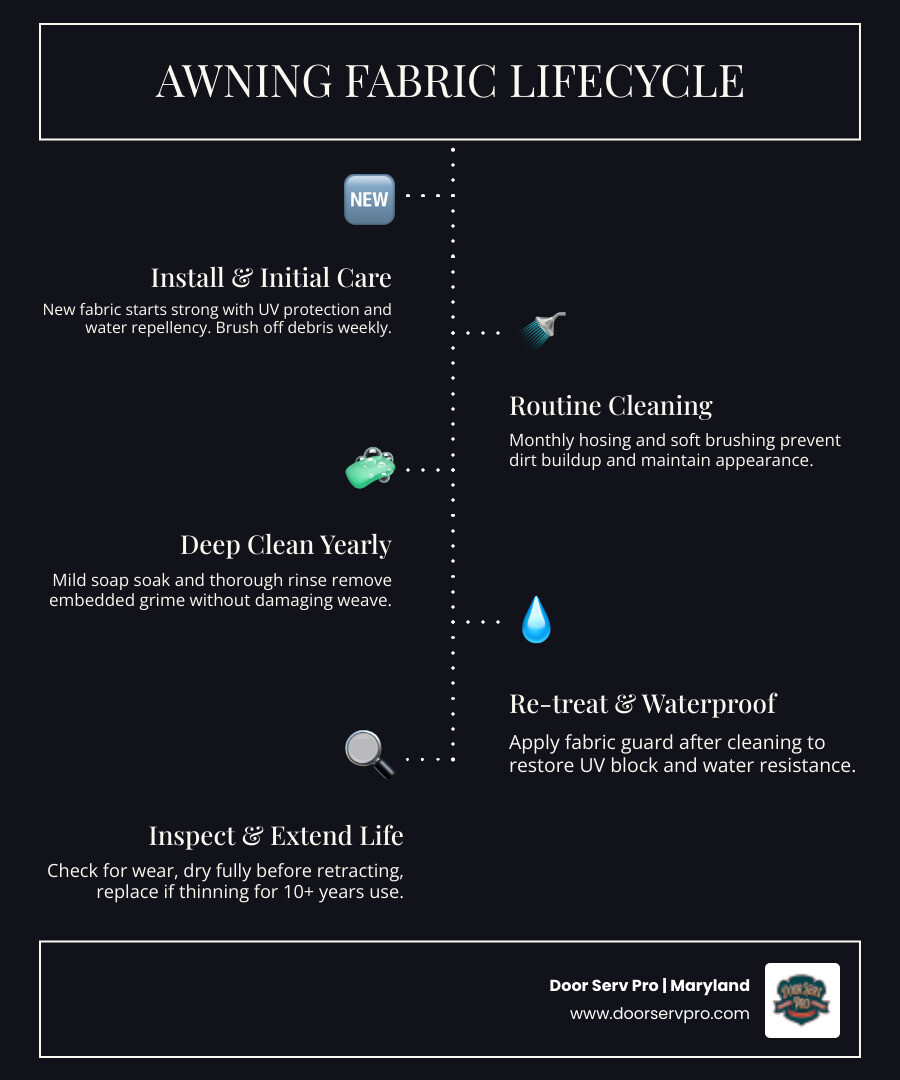
Essential awning fabric care and maintenance tips for longevity
When we install a new system, like an Awning Installation Sterling VA, we always emphasize that the first year of care sets the tone for the next decade. The most effective maintenance isn't a grueling weekend of scrubbing; it is the small, consistent actions you take throughout the season.
The "golden rule" of awning care is to prevent dirt from becoming embedded in the fibers. Most modern outdoor fabrics, such as those from Dickson or Sunbrella, are designed to be breathable and water-repellent. However, if dust, pollen, and pollution sit on the surface for too long, they can work their way into the weave. Once dirt is trapped, it acts as a food source for mold and mildew. To prevent this, we recommend hosing down your awning with cool or lukewarm water once a month. This simple rinse washes away surface contaminants before they can cause trouble.
Routine awning fabric care and maintenance tips
For daily or weekly upkeep, your best friend is a soft-bristle brush or a clean household broom. We suggest walking under your awning once a week to brush off loose leaves, twigs, or spider webs. Don't forget to brush the underside of the fabric as well! While the top takes the brunt of the weather, the underside often collects dust and organic matter that can lead to staining.
If you live in areas with heavy tree cover, such as near an Awning Company New Market MD, you need to be especially vigilant about falling debris. Leaves contain tannins and acids that can "dye" the fabric if they get wet and sit for too long. A quick sweep takes thirty seconds but can save you hours of deep cleaning later.
Safe cleaning tools and solutions
Using the wrong chemicals is one of the fastest ways to ruin a high-quality awning. We have seen many well-intentioned homeowners use harsh degreasers or bleach-heavy "all-purpose" cleaners that strip away the factory-applied water-repellent finish.
For safe, effective cleaning, stick to these approved supplies:
- Mild Soap: Brands like Woolite, Dawn dish soap, or Ivory Snow are perfect.
- Soft-Bristle Brush: Avoid wire brushes or anything with stiff plastic bristles that could fray the fabric.
- Lukewarm Water: Never use boiling water, as it can shrink or distort synthetic fibers.
- Vinegar Solution: A 50/50 mix of white vinegar and water is a fantastic, eco-friendly way to kill surface bacteria without damaging the material.
Step-by-step guide to deep cleaning your awning
Even with monthly hosing, your awning will eventually need a "deep clean"—usually every two to three years, or annually if you are in a high-pollen or high-pollution environment. If your fabric is starting to look dingy or you're planning an Awning Fabric Replacement Monrovia MD, a thorough cleaning can often restore that "like-new" look.
Follow this professional process for the best results:
- Preparation: Choose a warm, sunny day. This ensures the fabric dries quickly.
- Dry Brush: Sweep away all loose dirt and cobwebs while the awning is dry.
- Pre-Moisten: Hose down the entire awning with clear water. This softens any dried-on grime.
- Apply Solution: Mix your mild soap with lukewarm water in a bucket. Use a sponge or soft brush to apply the soapy water to the fabric.
- The "Soak" Trick: For retractable models, some homeowners find success by applying the soap, rolling the awning up for 15–20 minutes to let the solution penetrate, and then extending it again. Just don't leave it rolled up for more than 20 minutes!
- Light Scrubbing: Gently work the brush in circular motions over any visible spots.
- Rinse Thoroughly: This is the most important step. Rinse until the water runs clear and no soap bubbles remain. Residual soap acts like a magnet for new dirt.
- Air Dry: Leave the awning fully extended until it is bone-dry.
Fabric-specific cleaning protocols
Not all awning materials are created equal. Identifying your fabric type is crucial before you start scrubbing.
| Fabric Type | Key Characteristics | Best Cleaning Practice |
|---|---|---|
| Solution-Dyed Acrylic | Woven, breathable, color-fast (e.g., Sunbrella, Dickson). | Gentle brushing, mild soap. Avoid heavy scrubbing on the underside. |
| Vinyl-Coated Polyester | Waterproof, smooth surface, heavy. | Can handle slightly more vigorous cleaning; wipe down with sponges. |
| Natural Fibers | Cotton or canvas blends. | Prone to shrinking; use cold water only and very mild detergents. |
| Mesh/Screen | PVC-coated mesh for sun shades. | Hose down every few months; use a soft brush to clear the "holes" in the weave. |
Drying and storage best practices
The biggest enemy of awning fabric isn't the sun or the rain—it's moisture trapped in a rolled-up state. If you must retract your awning while it is damp (perhaps a sudden storm rolled in), make sure to extend it again as soon as the weather clears to let it "breathe."
For those in areas like an Awning Installation Falling Waters WV, winter storage is vital. Before the first snow, give your awning a final deep clean. Once it is 100% dry, retract it. If your model doesn't have a built-in protective hood, consider a winter cover accessory. This keeps birds, squirrels, and freezing rain away from the fabric during the months of inactivity.
Advanced awning fabric care and maintenance tips for tough stains
Sometimes, life happens. A bird decides your awning is a target, or a nearby tree drips sap during a heatwave. When routine cleaning isn't enough, you need to step up your game.
- Bird Droppings: These are acidic and can eat through fabric coatings. Remove them as soon as you see them using a mixture of dish soap and water. If the stain persists, a small amount of enzyme-based cleaner (like those used for pet messes) can help.
- Tree Sap: This is notoriously sticky. Try using a dull knife to gently scrape off the excess once it's dry, then treat the residue with a mixture of isopropyl alcohol and water.
- Mold and Mildew: While modern acrylics are mildew-resistant, mold can grow on the dirt that sits on the fabric. If you see black or green spots, use a solution of 1 cup bleach and 1/4 cup mild soap per gallon of water. Warning: This should only be used on solution-dyed acrylics, and you must rinse immediately and thoroughly.
If your fabric has become too stained to save, it might be time for an Awning Fabric Replacement Walkersville MD.
Removing grease and environmental pollutants
If you enjoy barbecuing under or near your awning, grease splatter and smoke residue can build up. This creates a sticky film that traps dust. A heavy-duty degreaser (like Dawn Platinum) worked into the spot with a sponge usually does the trick. For rust stains—often caused by water dripping off old metal hardware—specialized rust removers are available, but always test them on an inconspicuous corner first to ensure they don't bleach the color.
Re-waterproofing and fabric retreatment
After a few years of sun exposure or a deep cleaning that involved bleach, your fabric might lose its "beading" ability. If water starts soaking into the fabric rather than rolling off, it’s time to retreat.
Products like 303 Fabric Guard are the industry standard for restoring water repellency and UV protection. When you're ready for an Awning Fabric Replacement Cascade MD, we often recommend applying a protectant shortly after the new fabric is installed to keep it looking fresh for as long as possible. Always apply these treatments to clean, dry fabric in a well-ventilated area.
Maintaining the awning frame and hardware
While the fabric gets all the attention, the "bones" of the system need love too. A beautiful fabric is useless if the arms are seized or the mounting bolts are loose.
Twice a year—typically in the spring and fall—you should perform a hardware "physical":
- Wipe the Frame: Use a damp cloth to remove salt, dirt, and grit from the aluminum or steel parts. This is especially important if you are near an Awning Company Jefferson MD where road salt or environmental dust is common.
- Lubricate: Use a silicone-based lubricant on the moving pivot points and hinges. Avoid WD-40 or oil-based lubricants, as they attract dust and can drip onto your fabric, causing permanent grease stains.
- Tighten Bolts: Check the mounting brackets and the bolts on the arms. Vibrations from the wind can loosen these over time.
Protecting your investment from severe weather
High winds are the #1 killer of awnings in Maryland. Even a sturdy Awning Installation Ashburn VA can be ripped from the wall or have its arms bent by a 30-mph gust.
- Retract at Night: Never leave your awning out overnight. Unexpected storms can pop up while you’re sleeping.
- Wind Sensors: If you have a motorized awning, we highly recommend installing a wind sensor. These automatically retract the awning when they detect dangerous vibration levels.
- Foliage Management: Keep nearby trees trimmed. A falling branch during a storm can easily tear through even the toughest Dickson or Sunbrella fabric.
When to choose fabric replacement over cleaning
There comes a point where no amount of scrubbing will bring an awning back to life. If your fabric is thinning, has large tears, or the colors have faded into a dull gray, replacement is the most cost-effective and sustainable path forward.
The great news is that you rarely need to replace the entire system. If your frame and motor are in good shape, we can simply install a new fabric cover. This is faster, cheaper, and gives your home an instant facelift. For a deep dive into this process, check out our Awning Replacement Frederick MD Guide.
Signs your awning needs professional attention
If you notice any of the following, it’s time to call in the pros at Door Serv Pro:
- Mechanical Grinding: This indicates a motor or gear failure.
- Excessive Sagging: This could mean the fabric has stretched beyond repair or the arm tension is off.
- Hardware Corrosion: If you see deep rust on the mounting brackets, the structural integrity of the awning is at risk.
- Persistent Mold: If mold has "pitted" the fabric, it can no longer be cleaned safely.
For residents needing an Awning Fabric Replacement Edinburg VA, we can assess the frame and provide a fresh, modern fabric that matches your home’s current style.
Frequently Asked Questions about awning maintenance
How often should I clean my awning fabric?
You should hose it down monthly during the season and perform a light cleaning with mild soap once or twice a year. A deep professional-style clean is usually only needed every 2–3 years.
Can I use a pressure washer on my awning?
No! We cannot stress this enough. A pressure washer can tear the fabric, blow out the stitching, and strip away the protective coatings. A standard garden hose with a spray nozzle is all you need.
What is the best way to prevent mold and mildew?
Keep it clean and keep it dry. Mold doesn't grow on the synthetic fabric itself; it grows on the dirt, pollen, and organic matter that settles on the fabric. Regular rinsing and ensuring the awning is 100% dry before retracting are your best defenses.
Conclusion
At Door Serv Pro, we’ve spent over 25 years helping families across Maryland, West Virginia, Virginia, and Pennsylvania protect and enhance their homes. Whether we are fixing a garage door or helping you with an Awning Fabric Replacement Frederick MD, our goal is always the same: quality craftsmanship and 100% satisfaction.
By following these awning fabric care and maintenance tips, you’re doing more than just keeping a "shade" clean—you’re protecting an investment that adds value and comfort to your home. If your awning has reached the point where cleaning isn't enough, or if you're ready to upgrade to a more durable, modern fabric, give us a call. We're a family-owned team that treats your home like our own. Let's make sure your outdoor space stays beautiful for years to come!
Need Help?
Contact us today to discuss your needs. Our team is ready to help.
About the author
Door Serv Pro
More articles
View all postsKeep reading
Related articles
Ready to Get Started?
Whether you need a repair, maintenance, or a new installation, our expert team is here to help.