Blog
Stop the Squeak with the Best Garage Door Drive Type
Door Serv Pro
Reviewed by the Door Serv Pro service team · Trained, professional garage door technicians
Last updated June 24, 2026
The Honest Belt Drive vs Chain Drive Garage Door Opener Comparison Maryland Homeowners Need
The belt drive vs chain drive garage door opener comparison comes down to four things: noise, cost, door weight, and maintenance. Here's a quick breakdown before we dive deeper:
| Feature | Belt Drive | Chain Drive |
|---|---|---|
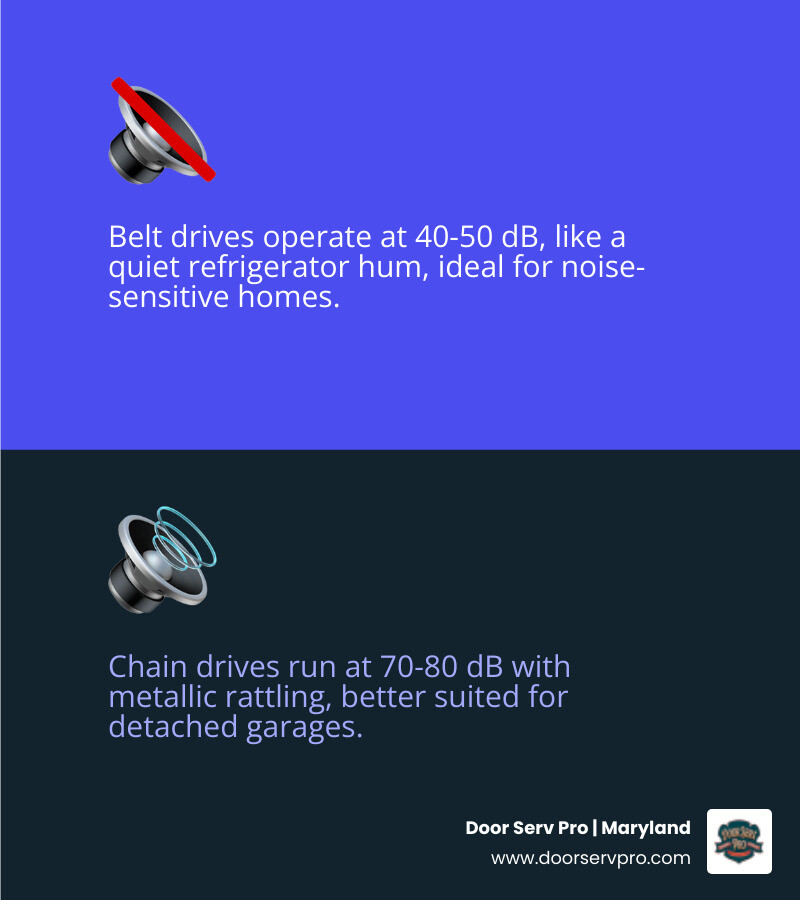
| Noise Level | 40-50 dB (refrigerator hum) | 75 dB (vacuum cleaner) |
| Best For | Attached garages, light sleepers | Heavy/oversized doors, detached garages |
| Maintenance | Minimal — no lubrication needed | Lubrication 1-2x per year |
| Door Weight | Up to ~350 lbs | 350+ lbs |
| Lifespan | 15-20 years | 15-20 years |
| Smart Features | Yes | Yes |
If your garage shares a wall with a bedroom or living space — a very common setup in Maryland homes — a belt drive is almost always the better choice. If you have a heavy wooden or oversized door and noise isn't a concern, a chain drive gets the job done reliably and at a lower upfront cost.
Most homeowners don't lose sleep over their garage door opener — until it starts waking everyone up at 6 AM, or worse, stops working entirely. The drive system you choose affects your daily comfort for the next 15 to 20 years, which makes it worth getting right.
I'm Paul Wiese, founder of Door Serv Pro, and with over 30 years in the garage door industry I've seen how the right belt drive vs chain drive garage door opener comparison can make or break daily life in a home — especially in Maryland's humid, temperature-swinging climate. Let's walk through everything you need to know to make a confident, informed decision.
How do these systems actually work to lift my door?
When we pull into our driveways in Hagerstown or Martinsburg and click that remote, we expect magic. But behind the scenes, it’s all about mechanical advantage. Both systems use an electric motor housed in a power head, but the way they transfer that power to your door is where the magic happens.
The Chain Drive Mechanism
Think of a chain drive like a bicycle. It uses a high-strength metal roller chain that loops around a sprocket on the motor and an idler pulley at the other end of the rail. As the motor turns, the chain pulls a trolley—a small carriage—back and forth along the rail. Because it is metal-on-metal, it is incredibly strong and doesn't stretch easily. However, that same metal contact is what creates the "clinking" and "chattering" sounds as the links engage with the gears.
The Belt Drive Mechanism
A belt drive replaces that metal chain with a reinforced rubber, polyurethane, or fiberglass-core belt. It operates on the same trolley principle, but instead of metal teeth clashing against metal gears, the smooth, flexible belt glides over the sprocket. This material naturally absorbs energy and vibration. When we perform a garage door opener installation, homeowners are often shocked at how the "jerkiness" of the door disappears when they switch to a belt.
Belt drive vs chain drive garage door opener comparison: Which is the quietest?
If you have a bedroom directly above the garage, this section is for you. In acoustics, the difference between these two systems is massive. Noise is measured in decibels (dB), and because the scale is logarithmic, a small jump in numbers feels like a huge jump in volume.
| Sound Source | Decibel Level (Approx.) | Comparison |
|---|---|---|
| Belt Drive Opener | 40–50 dB | A quiet refrigerator hum |
| Normal Conversation | 60 dB | Comfortable background noise |
| Chain Drive Opener | 75–80 dB | A vacuum cleaner or loud TV |
A chain drive produces a distinct metallic rattling. Over time, as the chain creates vibrations, those vibrations travel through the mounting brackets and into the wooden framing of your home. This is why you can often "feel" a chain drive opening from the other side of the house.
On the other hand, a belt drive operates at a level comparable to a normal conversation. It’s the "stealth mode" of garage doors. For attached garages in suburban Maryland, this is often the deciding factor. No more waking up the baby or signaling to the whole neighborhood that you’re heading out for a 5 AM shift at the hospital.
Which drive type handles heavy or oversized doors in Maryland?
While belt drives win the "noise war," chain drives are the undisputed heavyweights of the industry. Maryland homes feature a wide variety of architecture, from modern aluminum doors to massive, custom-built carriage-style wood doors.
If your door is oversized—perhaps for an RV or a multi-car opening—the tensile strength of a metal chain is a significant advantage. Metal chains are less likely to slip or "jump" under extreme tension. For doors weighing over 350 pounds, we typically recommend a high-horsepower chain drive system. This ensures the motor doesn't strain and the drive system doesn't wear out prematurely.
If you are currently struggling with a door that hesitates or makes a straining sound, it might be time for a garage door opener replacement to match the drive type to the actual weight of your entryway.
Why a belt drive vs chain drive garage door opener comparison matters for wooden doors
Solid wood doors are beautiful, but they are also heavy and sensitive to the weather. In the summer, they can absorb moisture and become even heavier. A chain drive provides the "brute force" necessary to lift these doors consistently year-round. However, if you insist on a quiet belt drive for a heavy door, you must ensure the motor is rated for at least 3/4 HP or 1 HP. Using an underpowered belt on a heavy door leads to "belt stretch," which can cause the door to close unevenly. If the motor is already struggling, you may need a technician to repair garage door motor components before switching drive types.
What are the maintenance needs for different openers in our humid climate?
Living in the Mid-Atlantic means dealing with high humidity in the summer and freezing temperatures in the winter. These environmental factors play a huge role in your belt drive vs chain drive garage door opener comparison.
Chain Drive Maintenance
Because they are made of metal, chain drives are susceptible to Maryland’s humidity. Without proper care, the links can develop surface rust, which increases friction and noise. We recommend:
- Lubrication: Applying a high-quality silicone or lithium-based lubricant to the chain 1–2 times per year.
- Tension Checks: Chains can develop "slack" over time. If you see the chain drooping or hitting the rail, it needs a tension adjustment.
- Cleaning: Wiping away old, grimy grease that can attract dust and debris.
If neglected, you might need a pro to resolve chain drive opener issues like skipping or jamming.
Belt Drive Maintenance
Belt drives are the "set it and forget it" option. The reinforced rubber materials don't rust, and modern belts are engineered not to stretch under normal residential loads. They require virtually no lubrication on the belt itself (in fact, putting oil on a rubber belt can actually damage it). You’ll still need to maintain the garage door springs and rollers, but the drive system itself is incredibly low-maintenance.
Long-term reliability in a belt drive vs chain drive garage door opener comparison
Both systems are built to last. On average, you can expect 15 to 20 years of service from either type if they are installed correctly. Chain drives have been the industry standard for decades because they are nearly indestructible. However, belt drives have caught up. Modern belts are often reinforced with internal steel cords or fiberglass, making them nearly as strong as their chain counterparts while offering a better warranty—many manufacturers offer a lifetime warranty on the belt itself.
Frequently Asked Questions about Garage Drive Types
Which drive type is best for a bedroom located above the garage?
Without a doubt, the belt drive is the best choice for this scenario. Beyond just the decibel level, belt drives offer "vibration isolation." Because the belt is flexible, it doesn't transmit the motor's vibrations into the ceiling joists. Many modern belt drives also feature "soft start and stop" technology, which slows the door down just before it touches the ground, preventing that final "thud" that echoes through the house.
Do both belt and chain drives support smart Wi-Fi features?
Yes! Smart features are independent of the drive type. Whether you choose chain or belt, you can enjoy:
- Wi-Fi Connectivity: Open or close your door from your smartphone anywhere in the world.
- Battery Backup: Essential for Maryland storms that knock out power; your door will still work.
- Rolling Code Technology: Changes the security code every time the remote is pressed to prevent hacking.
- Safety Sensors: Infrared beams that stop the door if a child, pet, or car is in the way.
Can I switch from a chain drive to a belt drive easily?
Yes, but it usually requires replacing the entire unit, including the rail. While the mounting points on your ceiling are often compatible, the rail and trolley system for a belt are designed differently than those for a chain. During a professional assessment, we can determine if your existing header bracket and power outlet are positioned correctly for a seamless upgrade.
Conclusion
Choosing between a belt and a chain drive isn't about finding the "perfect" opener; it's about finding the one that fits your home's layout and your family's needs. At Door Serv Pro, we’ve spent over 25 years helping our neighbors in Hagerstown, Frederick, and Martinsburg find that perfect balance.
As a family-owned company, we take pride in our craftsmanship and our NATE-certified technicians. We understand that a garage door is more than just a piece of equipment—it’s the main entrance to your home. Whether you need an emergency repair in Falling Waters or a brand-new installation in Shepherdstown, we are here 24/7 to ensure your home stays secure and quiet.
Don't let a squeaky, rattling door disrupt your peace and quiet. Whether you're in Charles Town, Berkeley Springs, or Chambersburg, our team is ready to help you "stop the squeak" for good.
Schedule your professional garage door service in Hagerstown, MD today and experience the difference that 25 years of expertise can make!
Need Help?
Contact us today to discuss your needs. Our team is ready to help.
About the author
Door Serv Pro
More articles
View all postsKeep reading
Related articles
Ready to Get Started?
Whether you need a repair, maintenance, or a new installation, our expert team is here to help.