Blog
Warning Signs Your Garage Door Spring is Ready to Snap
Door Serv Pro
Reviewed by the Door Serv Pro service team · Trained, professional garage door technicians
Last updated June 24, 2026
Why Knowing the Signs Your Garage Door Spring Is About to Break Could Save You a Major Headache
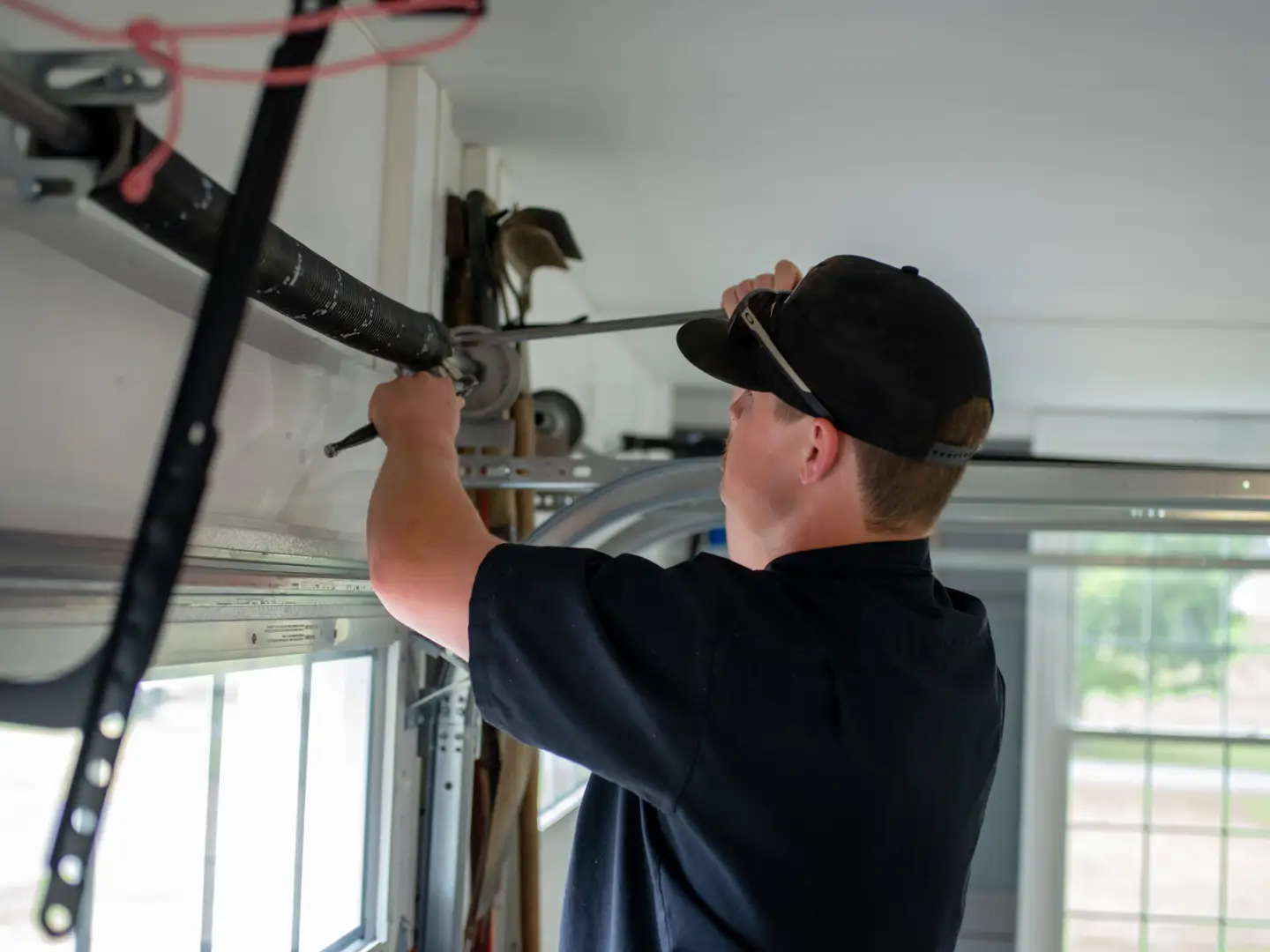
The signs your garage door spring is about to break are often right in front of you — you just need to know what to look for. Here's a quick summary:
- Loud bang or snap from the garage, even when no one is using the door
- Visible gap of 1–2 inches in the torsion spring coil above the door
- Door feels extremely heavy when lifted manually
- Door only opens a few inches before stopping
- Uneven or crooked movement as the door rises or lowers
- Opener straining, hesitating, or clicking more than usual
- Loose or hanging cables along the sides of the door
- Visible rust, corrosion, or elongated coils on the spring itself
If any of these sound familiar, keep reading — your spring may be close to failure.
Your garage door is one of the hardest-working parts of your home. In fact, the average household opens and closes it upwards of 1,500 times per year — and for the 55% of homeowners who use it as their main entryway, that number climbs even higher. The springs are what make all of that movement possible. They carry roughly 80–90% of the door's weight every single time it moves, storing and releasing tension with each cycle.
That tension is no small thing. Garage door springs can store up to 200 pounds of force. When one fails — and they do fail — it can happen without much warning. Or, more accurately, the warning signs were there, but easy to miss.
Whether you've heard a strange noise, noticed your door moving oddly, or just want to stay ahead of a problem before it becomes an emergency, this guide walks you through exactly what to watch for.
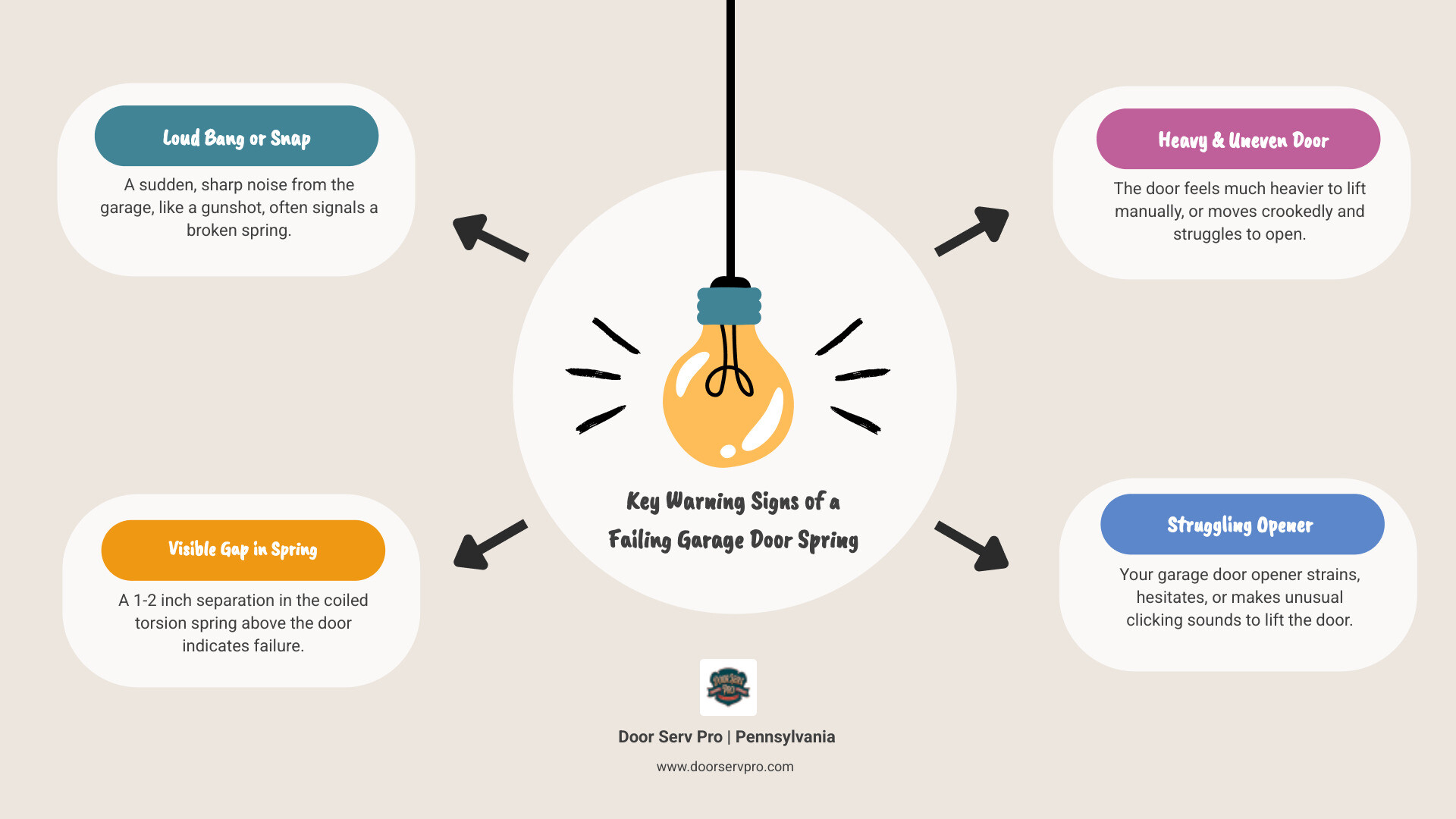
Auditory and Visual Signs Your Garage Door Spring is About to Break
One of the most startling signs your garage door spring is about to break (or has already snapped) is a sound you won’t soon forget. Many of our neighbors in Chambersburg and Waynesboro have described it as a gunshot or a loud firecracker echoing through the house. This happens because the spring is a tightly wound coil of metal under immense torque; when that metal finally fatigues and snaps, all that stored energy is released in a single, violent instant. If you hear a loud bang coming from the garage while the door is idle, don't ignore it—it’s the sound of a spring reaching its breaking point.
Visually, the evidence is often just as clear if you know where to look. For those with a Garage Door Torsion Spring system—the kind mounted horizontally on a bar above the door opening—a break will manifest as a visible gap. Because the spring is designed to be under tension, a snap causes the two sides to pull away from each other, leaving a 1-to-2-inch gap somewhere along the coil.
Beyond a total break, there are early visual warnings of Garage Door Spring Issues Stephens City and surrounding areas. Look for:
- Rust Accumulation: Rust is a spring's worst enemy. It increases friction between the coils and creates "pitting" that weakens the steel.
- Elongated Coils: If your extension springs (the ones that run along the side tracks) look stretched out or have uneven spacing between the loops, they’ve lost their "memory" and are ready to snap.
- Frayed Safety Cables: Extension springs should always have a safety cable running through the center. If you see these cables fraying or hanging loose, it means the spring is vibrating or moving erratically, likely due to a loss of tension.
How Mechanical Failure Impacts Door Movement
When a spring begins to fail, the delicate balance of your garage door system is thrown out of whack. Your garage door isn't just a piece of aluminum or wood; it’s a heavy machine. Most residential doors weigh between 130 and 400 pounds. Without a healthy spring to act as the "muscle," that weight becomes dead weight.
The symptoms of failure often depend on the type of spring system you have. We often see homeowners confused by the difference, so here is a quick breakdown:
| Symptom | Torsion Spring (Above Door) | Extension Spring (Side Tracks) |
|---|---|---|
| Manual Lift | Feels like lifting a car; nearly impossible. | Extremely heavy and lopsided. |
| Door Alignment | Usually stays level but won't rise. | Often pulls to one side (crooked). |
| Movement | Jerky or stops after 6 inches. | Squealing, grinding, and lopsided. |
| Closing Speed | May slam shut violently. | May "drop" suddenly on one side. |
A crooked door alignment is a classic indicator that one spring in a pair has failed. If you have extension springs and one snaps, the side with the working spring will lift, while the broken side drags. This creates a lopsided appearance that can actually bend your tracks or cause the door to pop out of the rollers entirely.
Furthermore, watch out for jerky movement. If the door seems to "stutter" as it moves up or down, the springs are no longer providing a smooth counterbalance. This is a major safety hazard, as a door with failing springs can slam shut without warning, posing a risk to anyone—or any pet—standing underneath it.
The Impact of Failing Springs on Your Opener
A common mistake we see in Pennsylvania is homeowners assuming their garage door opener is "dying" when the real culprit is a failing spring. Your garage door opener is the "brain" of the operation, but it isn't meant to be the "brawn." Most residential openers are only rated to lift about 15 to 20 pounds. They rely on the springs to do the other 90% of the work.
When you ignore the signs your garage door spring is about to break, you are essentially asking your opener to lift a 300-pound weight with a motor designed for a small fraction of that. This leads to:
- Opener Strain: You’ll hear the motor humming louder than usual or making a strained, high-pitched whining sound.
- Slow Opening Speed: If the door used to zip up in 10 seconds and now takes 30, the motor is struggling against gravity.
- Carriage Hesitation: The opener may pull the door up a few inches, "think" about it, and then reverse or stop because the safety sensors detect too much resistance.
- Clicking Sounds: This often indicates that the internal gears of the opener are stripping because they are being overworked.
If you continue to use the opener with a bad spring, you’ll likely end up needing a Garage Door Spring Service plus a total opener replacement. It’s much more efficient to Find a Local Garage Door Spring Service Near Paw Paw WV for Routine Maintenance before the motor burns out completely.
Why Professional Replacement is Non-Negotiable
We know the "DIY" spirit is strong here in Greencastle and Chambersburg, but garage door springs are the one area where we urge you to put down the wrench. These components are under extreme tension—often holding back 200 pounds of force or more. If a spring or a winding cone slips while you are working on it, the metal can whip around with enough force to break bones or cause life-altering injuries.
Professional technicians use specialized tools, such as winding bars and locking pliers, specifically designed to handle this torque safely. A Safe Garage Door Spring Repair involves precisely calculating the weight of your door to ensure the new springs have the correct wire gauge and length. If you use the wrong size, you’ll only be back in the same position a few months later.
Our Garage Door Spring Fix Guide always recommends replacing springs in pairs. Even if only one spring has snapped, the other has endured the same number of cycles (usually 10,000 to 15,000) and is likely days or weeks away from failing itself. Replacing them together ensures even tension, a balanced door, and a full 7-to-10-year lifespan for your new system.
Frequently Asked Questions About Failing Springs
What are the most common signs your garage door spring is about to break?
The most obvious signs include a loud snapping noise (like a gunshot) coming from the garage, a visible 1-to-2-inch gap in the coil of a torsion spring, or the door suddenly feeling twice as heavy as usual. You might also notice the opener struggling to lift the door more than a few inches, or cables hanging loosely from the drums because the tension that holds them in place has vanished.
How long do garage door springs typically last in Pennsylvania?
On average, standard springs last between 7 and 10 years, or about 10,000 "cycles" (one cycle is one opening and closing). However, Pennsylvania's temperature fluctuations can play a role. The transition from humid summers to freezing winters causes the metal to expand and contract, which can accelerate metal fatigue. Rust from high humidity is also a common factor in our region. If you use your door more than four times a day, you might want to consider high-cycle spring upgrades that can last up to 20,000 or 30,000 cycles.
Should I replace both springs if only one shows signs your garage door spring is about to break?
Yes, absolutely. Garage door springs are installed as matched pairs. They "age" at the same rate. If one has reached the point of failure, the other is not far behind. Replacing only one spring creates uneven tension, which makes the door rise crookedly and puts unnecessary strain on your opener and the new spring. Replacing both ensures the entire system is balanced and safe, saving you the cost of a second service call just a few months down the road. You can learn more about this in our guide on Safe Garage Door Spring Repair.
Trust the Experts at Door Serv Pro for Your Spring Repairs
At Door Serv Pro, we understand that a broken garage door isn't just an inconvenience—it’s a security risk and a safety hazard for your family. As a family-owned business with over 30 years of craftsmanship, we take pride in serving our neighbors in Chambersburg, Waynesboro, and Greencastle with the same care we’d give our own homes.
We don't just swap out parts; we perform a comprehensive safety check to ensure your tracks, cables, and rollers are all in top shape. Our community focus means we’re here for you 24/7 with emergency availability, ensuring you aren't stuck behind a heavy door when you need to get to work or pick up the kids.
If you’ve noticed any of the signs your garage door spring is about to break, don't wait for the "big bang." Contact us today to Schedule Professional Garage Door Spring Repair and keep your home running smoothly and safely.
Need Help?
Contact us today to discuss your needs. Our team is ready to help.
About the author
Door Serv Pro
More articles
View all postsKeep reading
Related articles
Ready to Get Started?
Whether you need a repair, maintenance, or a new installation, our expert team is here to help.