Blog
Why Your Garage Door Springs Have an Expiration Date
Door Serv Pro
Reviewed by the Door Serv Pro service team · Trained, professional garage door technicians
Last updated June 24, 2026
Why Garage Door Springs Have an Expiration Date (And What Happens When They Run Out)
How garage door springs work and why they break comes down to one simple idea: every spring has a finite number of cycles before the metal gives out — and most homeowners in Pennsylvania never see it coming until the door stops moving.
Here is a quick answer to what you need to know:
How garage door springs work:
- Springs store mechanical energy (tension) as the door closes
- That stored energy is released to help lift the door when it opens
- They counterbalance the door's weight — a standard residential door weighs between 150 and 250 pounds — so your opener (and your arms) do not have to
Why garage door springs break:
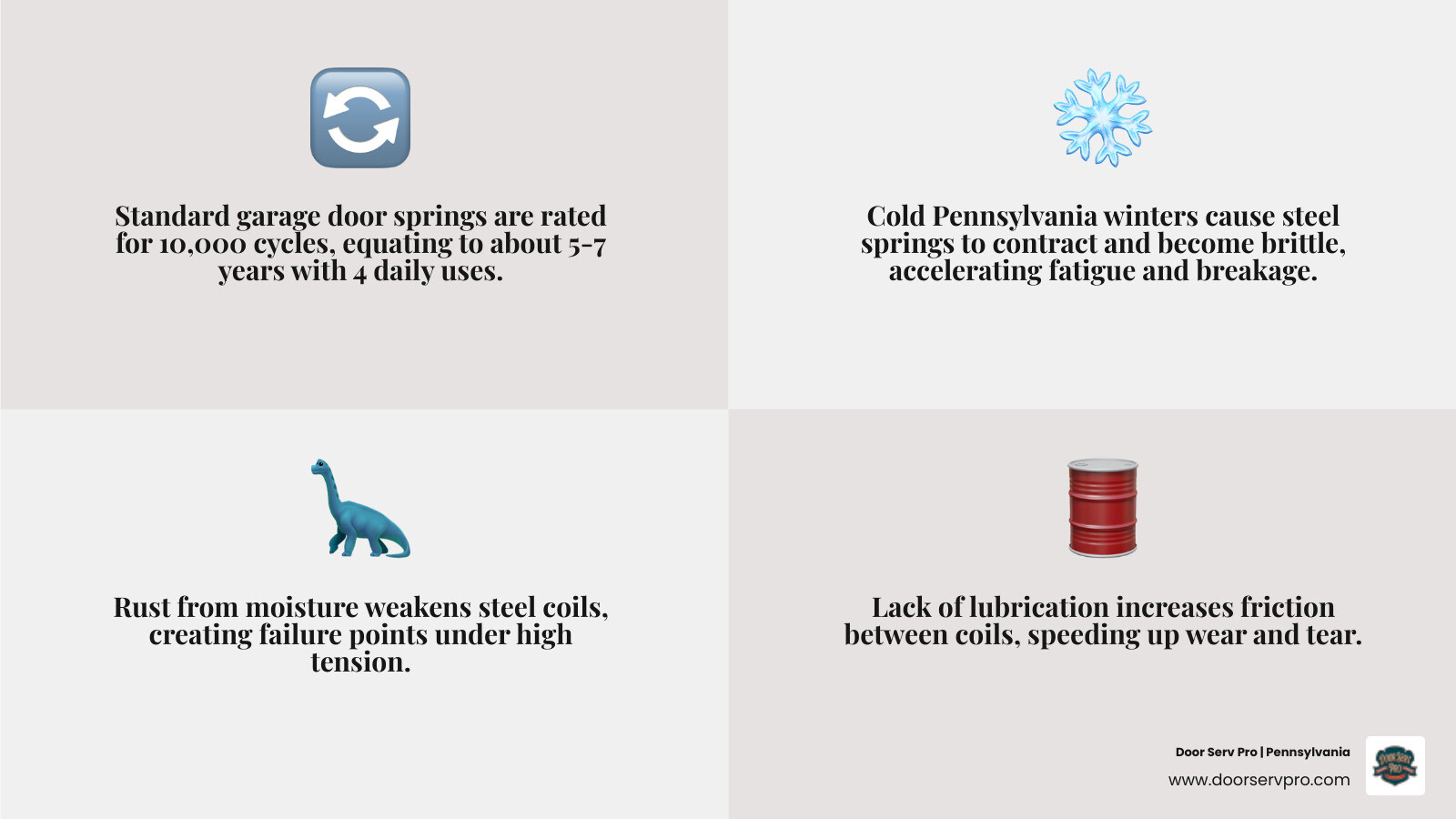
- Wear and tear — Standard springs are rated for roughly 10,000 cycles; once that limit is reached, the metal fatigues and snaps
- Rust and corrosion — Moisture degrades the steel coils, creating weak points that fail under tension
- Lack of lubrication — Without proper lubrication, friction builds between coils and accelerates wear
- Extreme temperatures — Cold Pennsylvania winters cause steel to contract and become brittle, making fatigued springs far more likely to snap
- Improper installation or wrong spring size — A spring not matched to your door's weight wears out faster and unevenly
For most households using the garage door around four times a day, a 10,000-cycle spring lasts roughly five to seven years. If your garage door is your main entryway — as it is for 55% of homeowners — that lifespan shrinks even faster.
The rest of this guide walks through the mechanics, the warning signs, and what to do when a spring reaches the end of its life.
Understanding How Garage Door Springs Work and Why They Break
To understand the health of your garage door, we first have to look at the massive amount of work these springs perform. Many homeowners assume the electric opener does the heavy lifting. In reality, the opener is just the "brain" that guides the movement; the springs are the "muscles" that do the actual work.
The core concept of how garage door springs work and why they break involves the storage and release of energy. When you close your garage door, the springs are stretched or twisted, creating an immense amount of stored mechanical energy. When you hit the button to open it, that energy is released, providing the "lifting force" necessary to move a 200-pound door with ease.
Without this counterbalance system, the weight of the door would be far too much for a standard motor to handle. Over time, this constant winding and unwinding creates internal stress within the metal. Understanding How Garage Door Spring Repairs Can Prevent Future Door Malfunctions is essential because a spring that is losing its "springiness" forces the rest of the system—the cables, rollers, and opener—to work twice as hard, leading to a total system failure.
The Physics of How Garage Door Springs Work and Why They Break
The science behind your garage door is actually governed by a principle called Hooke’s Law. This law states that the force needed to extend or compress a spring by some distance is proportional to that distance. In your garage, this means as the door descends, the helical coils of the spring tighten.
Most residential garage doors in areas like Waynesboro or Greencastle weigh between 150 and 250 pounds. Commercial doors can weigh significantly more, often between 500 and 1,000 pounds. The springs must be calibrated perfectly to match this weight. If the spring is too "weak," the door will feel heavy and may slam shut. If it is too "strong," the door might be difficult to close or could even fly open unexpectedly. To dive deeper into these mechanics, you can Understand Garage Door Springs Cumberland and how they apply to your specific home setup.
Why Springs Typically Break When the Door is Closed
It is a common story: you hear a sound like a gunshot from the garage in the middle of the night, or you go to leave for work in the morning and the door won't budge. Why does it always seem to happen when the door is down?
The reason is simple: maximum tension. When your garage door is closed, the springs are at their highest state of stress. They are fully wound (torsion) or fully stretched (extension). Because they are holding the full weight of the door in check, any microscopic fractures in the steel—caused by years of "metal fatigue"—finally reach a breaking point.
When the metal fails, it releases all that stored energy instantly. This is why we tell our neighbors in Pennsylvania that there are 5 Reasons You Should Not Ignore Garage Door Spring Repair; a spring that snaps while the door is open could cause the door to crash down, but a spring that snaps while the door is closed ensures you aren't getting your car out of the garage until a professional arrives.
The Two Main Types of Garage Door Systems in Pennsylvania
In our 30+ years of serving the Chambersburg area, we typically see two types of spring systems. While they both serve the same purpose, they go about it in very different ways. Knowing which one you have is the first step in proper maintenance. You can learn more about the Role Of Torsion And Extension In Garage Door Spring Repair to see which fits your garage's architecture.
- Torsion Springs: These are the modern standard. They are mounted on a metal shaft directly above the door opening. They work by twisting (torque). As the door closes, cables attached to the bottom corners of the door pull on drums, which winds the spring.
- Extension Springs: These are more common in older homes or garages with low headroom. They run horizontally along the overhead tracks. They work by stretching out as the door closes. Because these can fly apart when they break, they must always be equipped with safety cables to catch the metal if it snaps.
Torsion Springs vs. Extension Springs
| Feature | Torsion Springs | Extension Springs |
|---|---|---|
| Mounting Location | Above the door header | Along the side tracks |
| Lifespan (Cycles) | 10,000 to 20,000+ | ~10,000 |
| Safety | High (contained on shaft) | Lower (requires safety cables) |
| Operation | Smooth and quiet | Can be jerky or loud |
| Cost | Higher initial investment | Budget-friendly |
Most standard springs are made of oil-tempered wire or galvanized steel. Oil-tempered springs are heat-treated for extreme durability, while galvanized springs are coated in zinc to help fight off the rust that is so common in our humid Pennsylvania climate.
High-Cycle and Extended-Life Options
If you are part of the 55% of homeowners who use their garage as the primary "front door" for the family, a standard 10,000-cycle spring might only last you 3 to 5 years. Think about it: one cycle is the door going up and coming back down. If you leave for work, come home for lunch, go back to work, and return in the evening, that’s 4 cycles a day just for one person. Add in a spouse and kids with bikes, and you could be hitting 10 cycles a day.
In these cases, we often recommend "High-Cycle" or "Extended-Life" springs. These are engineered with thicker wire and larger diameters to last 25,000 cycles or more. While they cost a bit more upfront, they save you the headache of frequent repairs. We are always looking at Revolutionizing Garage Door Spring Repair: Technological Innovations to provide our customers with the longest-lasting parts available on the market today.
Primary Reasons Why Garage Door Springs Break
While "reaching the expiration date" (metal fatigue) is the number one cause, several other factors can send your springs to an early grave. Understanding these Common Causes Of Garage Door Spring Repair can help you extend the life of your door.
- Metal Fatigue: Just like bending a paperclip back and forth until it snaps, the steel in your springs eventually loses its structural integrity.
- Improper Installation: If the springs aren't wound to the correct tension or if the wrong size was installed for the door's weight, they will fail prematurely.
- Misalignment: If the door tracks are crooked, one spring will end up doing more work than the other, leading to an unbalanced system.
Environmental Factors: How Garage Door Springs Work and Why They Break in Cold Weather
Pennsylvania winters are notoriously hard on garage doors. When the temperature drops below freezing—and especially when it hits extreme lows like -13 degrees Fahrenheit—the molecular structure of the steel changes. The metal contracts and becomes brittle.
If you have a spring that is already near the end of its 10,000-cycle lifespan, a cold snap is often the "final straw." The brittle steel simply cannot handle the intense tension required to lift the door on a freezing morning. For those living in the area, our Garage Door Spring Repair Greencastle PA Guide offers specific advice on how to prep your door for these temperature swings.
The Impact of Rust and Lack of Lubrication
Rust is a silent killer for garage door springs. In our region, road salt from our cars and humidity in the air can lead to surface rust on the coils. Rust creates friction between the coils as they move against each other. This friction acts like sandpaper, thinning the metal and creating tiny "stress pits" where a snap is likely to occur.
The fix is simple: lubrication. Using a high-quality silicone lubricant or white lithium grease (never WD-40, which is a degreaser, not a long-term lubricant) can prevent rust and reduce friction. For a step-by-step on how to do this correctly, check out the Hagerstown MD Garage Spring Repair Guide, which covers maintenance for our neighbors just across the line.
Warning Signs of Failing Springs and How to Test Them
You don't always have to wait for the "bang" to know there is a problem. Your garage door will often "talk" to you if you know what to listen for. Common signs include:
- The "Gunshot" Sound: A loud snap coming from the garage.
- Visible Gaps: If you see a 2-inch gap in your torsion spring, it’s already broken.
- Crooked Door: If the door looks slanted as it moves, one spring (or cable) has likely failed.
- Jerky Movement: The door struggles to open or moves in fits and starts.
- Heavy Door: The door feels like it weighs 500 pounds when you try to lift it manually.
If you notice any of these, consult our Garage Door Spring Fix Guide immediately to avoid damaging your opener's motor.
How to Perform a Simple Balance Test
We recommend performing a balance test at least twice a year. It is the easiest way to see if your springs are reaching their "expiration date."
- Close the door completely.
- Pull the emergency release cord (the red handle) to put the door in manual mode.
- Lift the door manually about halfway up (3 to 4 feet off the ground).
- Let go.
A well-balanced door with healthy springs should stay in place or move only slightly. If the door slams shut, your springs have lost their tension and are likely about to break. If the door shoots upward, the springs are under too much tension. This test ensures the system stays in equilibrium. Our Best Garage Door Spring Repair Waynesboro PA Guide provides more local tips on keeping your door balanced year-round.
Why You Should Replace Both Springs Simultaneously
When one spring breaks, many homeowners ask if they can just replace that one to save money. We strongly advise against this. Springs are almost always installed as a matched pair. They have lived the same life, endured the same Pennsylvania winters, and performed the same number of cycles.
If one has snapped, the other is usually only days or weeks away from failing as well. Furthermore, installing a brand-new, high-tension spring next to an old, fatigued spring creates an "imbalanced" door. This puts uneven strain on the cables and the opener, often leading to more expensive repairs down the road. Avoiding Common Mistakes To Avoid With Garage Door Spring Repair starts with replacing both at once to ensure a fresh "expiration date" for the whole system.
Frequently Asked Questions about Garage Door Springs
How long do garage door springs typically last in average household use?
Standard springs are rated for 10,000 cycles. For a family that uses the door 3 to 5 times a day, this typically equates to 6 to 9 years. If the garage is the main entrance for a large family, you might see them fail in as little as 3 to 4 years.
What are the dangers and risks of a broken garage door spring?
The biggest risk is the weight of the door. Without the springs, a 200-pound door can crash down with enough force to crush a vehicle or cause severe injury. Additionally, attempting to use an electric opener on a broken spring can burn out the motor, leading to a much higher repair bill. Torsion springs also store enough energy to be lethal if they snap while a person is working on them without the proper tools.
Why is professional repair recommended over DIY for broken springs?
Garage door springs are under "extreme tension." To replace a torsion spring, you must use specialized winding bars to manually wind the metal. One slip can result in broken bones, facial injuries, or even death. Professionals have the training, the exact-sized replacement parts, and the safety equipment to handle the torque safely. Plus, we back our work with warranties that DIY jobs simply don't have.
Conclusion
At Door Serv Pro, we know that a broken garage door is more than just a nuisance—it’s a disruption to your family's safety and schedule. Whether you are in Chambersburg, Greencastle, or Waynesboro, we bring over 30 years of craftsmanship and family-owned reliability to every driveway we visit.
We don't just fix doors; we care about our community, from supporting our local veterans to ensuring our neighbors have a door they can depend on. If you suspect your springs are reaching their expiration date, don't wait for the "bang." Contact us today for a professional inspection and Garage Door Spring Repair that will keep your home secure for years to come.
Need Help?
Contact us today to discuss your needs. Our team is ready to help.
About the author
Door Serv Pro
More articles
View all postsKeep reading
Related articles
Ready to Get Started?
Whether you need a repair, maintenance, or a new installation, our expert team is here to help.