Blog
Stop the Squeak with Post Winter Garage Door Inspections
Door Serv Pro
Reviewed by the Door Serv Pro service team · Trained, professional garage door technicians
Last updated June 24, 2026
Why Your Garage Door Needs Attention Every Spring in Pennsylvania
A spring garage door maintenance checklist for homeowners is the single best way to catch winter damage before it turns into a costly repair — and if you want the short version, here it is:
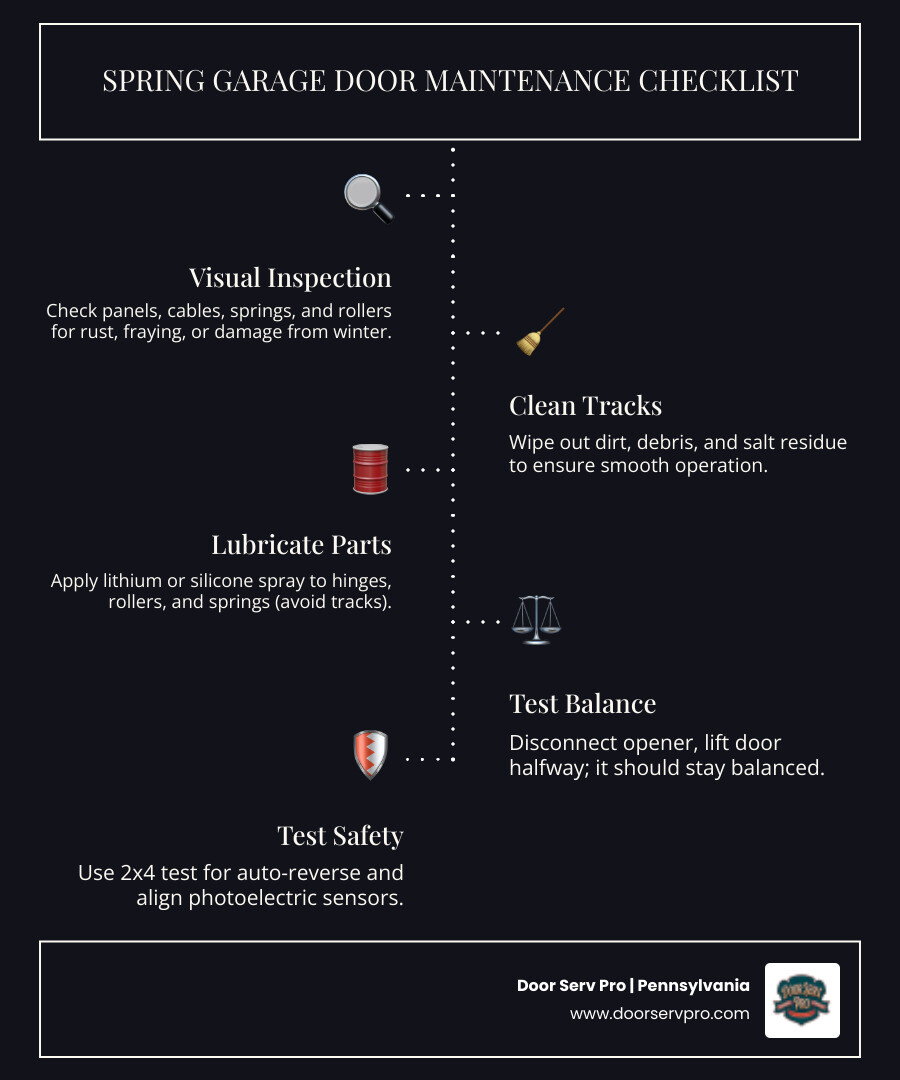
Quick Spring Garage Door Maintenance Checklist:
- Visual inspection — Check panels, cables, springs, and rollers for rust, fraying, or damage
- Clean the tracks — Wipe out dirt, debris, and salt residue with a damp cloth
- Lubricate moving parts — Apply a lithium or silicone-based spray to hinges, rollers, and springs (not the tracks)
- Test door balance — Disconnect the opener and manually lift the door to the halfway point; it should stay put
- Test auto-reverse — Place a 2x4 in the door's path and close it; the door must reverse on contact
- Check photoelectric sensors — Clean the lenses and confirm the indicator lights show proper alignment
- Inspect weatherstripping — Look for cracks, brittleness, or gaps along the bottom and sides
- Tighten hardware — Use a socket wrench to snug up loose bolts on brackets and hinges
- Check opener function — Listen for grinding or jerking, and replace remote batteries if needed
- Call a pro for springs or cables — Never adjust high-tension components yourself
Your garage door is the largest moving part of your home. According to industry data, the average door opens and closes more than 1,500 times per year — and that's before you factor in what a Pennsylvania winter throws at it. Freeze-thaw cycles, road salt, ice buildup, and bitter cold temperatures all stress metal components, stiffen weatherstripping, and can quietly rob your springs of tension. By the time spring arrives in 2026, the damage may already be done — you just haven't noticed it yet.
The good news? Most of this is preventable with a focused inspection and a few straightforward maintenance steps. This guide walks you through everything, step by step.
Why a Spring Garage Door Maintenance Checklist for Homeowners is Essential in 2026
As we move through April 2026, many homeowners in Chambersburg and Waynesboro are busy with landscaping and "spring cleaning." However, the garage door is often the most neglected part of the home until it stops working. Understanding the benefits of timely garage door repair to secure your property's safety is the first step in protecting your investment.
Beyond safety, there is a significant financial incentive. Did you know a new garage door can offer a 267% ROI for homeowners? Even if you aren't replacing your door, routine maintenance can extend the life of your system for years longer than a neglected one. By following a spring garage door maintenance checklist for homeowners, you prevent the "emergency" phone call on a Monday morning when you're already late for work.
Regular upkeep also plays a major role in opening up to safety: the importance of regular garage door maintenance. A door that isn't maintained is a door that can fail unexpectedly, posing a risk to your family and vehicles. Plus, who doesn't want a quieter home? We’ve seen how noise reduction through proper garage door maintenance can turn a clanking, screeching door into a smooth, silent operator.
Step-by-Step Spring Garage Door Maintenance Checklist for Homeowners
Ready to get to work? This checklist is designed to be completed in about 30 to 60 minutes. Grab a flashlight, a damp rag, and a socket wrench.
1. The Visual Inspection
Start with the door closed. Look at the springs, cables, rollers, and tracks. In Pennsylvania, road salt is a major enemy. Look for a reddish-brown tint on the springs—this is rust, which makes the metal brittle. Check the door panels for dents or peeling paint. If you’re in Greencastle or surrounding areas, follow these garage door maintenance Chambersburg PA tips to keep your local curb appeal high.
2. Tighten the Hardware
Because your door moves so much, the constant vibration can loosen the bolts. Use your socket wrench to snug up the brackets that hold the tracks to the wall and the bolts that secure the hinges to the door panels. Be careful not to touch any bolts painted red—these are usually connected to high-tension parts.
3. Clean the Tracks
Wipe the inside of the tracks with a damp cloth to remove grease buildup and dirt. Pro tip: Never grease the tracks! Grease actually attracts dirt and hair, which creates a "sludge" that makes the rollers slip or get stuck. For a deeper dive into track care, see our garage door tune-up complete guide.
4. Inspect Weatherstripping and Insulation
Winter ice often causes the bottom rubber seal to stick to the driveway, leading to tears. Check the garage door weather seal for cracks or brittleness. If you can see daylight under or around the door when it's closed, you're losing money on energy bills. This is where insulations vital role in garage door maintenance and efficiency becomes clear; a tight seal keeps the Pennsylvania humidity out and the cool air in.
Essential Lubrication for Your Spring Garage Door Maintenance Checklist for Homeowners
Lubrication is the "secret sauce" of a long-lasting door. However, using the wrong product (like WD-40, which is a cleaner, not a long-term lubricant) can actually do more harm than good. You want a high-quality silicone-based spray or white lithium grease.
Review these lubrication essentials for effective garage door maintenance to ensure you're applying the right product to the right spot. Here is what needs your attention:
- Rollers: Lubricate the bearings inside the rollers (if they are metal).
- Hinges: Apply a small amount to the pivot points.
- Springs: Spray the entire length of the torsion spring. This reduces friction between the coils as they expand and contract.
- Opener Rail: If you have a chain or screw-drive opener, apply a light coat of grease to the rail.
Learning how to maintain your garage door with regular garage door services often starts with this simple lubrication routine every six months.
Visual Inspection Tips for Your Spring Garage Door Maintenance Checklist for Homeowners
When performing your visual check, pay close attention to the "lifting" components. These are under incredible stress every time the door moves.
- Cables: Look for "meat hooks"—little frayed strands of wire sticking out. If the cable looks like a fuzzy sweater, it’s about to snap.
- Rollers: Check for cracked plastic or wobbly metal wheels.
- Mounting Brackets: Ensure the brackets attached to the header (above the door) aren't pulling away from the wood.
- Rust Spots: Check the bottom of the door where salt-slush sits during the winter.
For those looking for essential garage door maintenance services for improved performance, catching these visual cues early can save you from a door that gets stuck halfway up.
Testing Critical Safety Features and Door Balance
Safety isn't just a buzzword; it's a necessity. Modern garage doors are equipped with features designed to prevent the door from crushing objects or people.
The Auto-Reverse Test
Open your door and place a solid object, like a 2x4 board or a roll of paper towels, flat on the ground in the center of the door opening. Close the door. When the door hits the object, it should immediately reverse and go back up. If it keeps trying to close, your opener's force settings are too high and need professional adjustment.
The Sensor Test
Your photoelectric sensors (the "eyes" at the bottom of the tracks) must be aligned. Clean the lenses with a soft cloth. To test them, close the door and wave a broomstick in the path of the beam. The door should stop and reverse instantly. Ensuring garage door maintenance ensuring safety and functionality of sensor is a monthly task that takes less than two minutes.
| Feature | DIY Safety Test | Professional Safety Audit |
|---|---|---|
| Auto-Reverse | 2x4 board contact test | Precision force gauge testing |
| Safety Sensors | Obstruction beam test | Voltage and alignment calibration |
| Balance | Manual lift halfway test | Spring tension measurement |
| Cables | Visual fraying check | Structural integrity load check |
How to Perform a Manual Balance Test
This is perhaps the most important part of the spring garage door maintenance checklist for homeowners. A door that is out of balance will burn out your opener motor prematurely.
- Close the door.
- Pull the red emergency release cord to disconnect the opener.
- Manually lift the door. It should be light enough to lift with one hand.
- Lift it to the "halfway" point and let go.
The door should stay put. If it slams shut, the springs have lost their "memory" (tension). If it shoots upward, the springs are too tight. Understanding the importance of balance in garage door maintenance helps you realize that the springs do the heavy lifting, not the motor. If the door fails this test, do not attempt to fix the springs yourself.
When to Call a Professional for Garage Door Repairs
While we love a good DIY project, there is a line that shouldn't be crossed for safety reasons. Garage door springs and cables are under enough tension to cause serious injury or property damage. If you're unsure, DIY garage door maintenance mistakes that could cost you more often involve homeowners trying to "wind" their own springs.
You should call Door Serv Pro if you notice:
- Snapped Coils: A visible gap in your torsion spring.
- Frayed Cables: Any signs of wear on the lifting cables.
- Jerky Movement: The door "jumps" or shudders as it moves.
- Loud Popping: A sound like a gunshot often indicates a spring has broken.
- Structural Damage: Bent tracks or warped door panels.
Seeking essential garage door maintenance services for improved performance from a certified technician ensures the job is done safely and with the right tools.
Signs of Dangerous Spring and Cable Wear
The opening up to safety: the importance of regular garage door maintenance philosophy dictates that we look for "The Gap." A torsion spring (the big one above the door) will show a 2-inch gap if it has snapped. If you have extension springs (the ones that run along the tracks), look for safety cables. If those springs snap without a safety cable, they can become dangerous projectiles.
Frequently Asked Questions about Spring Garage Door Maintenance
What type of lubricant is best for garage doors in Pennsylvania?
In our local climate, we recommend a high-quality silicone-based spray or a lithium-based grease. These don't get "gummy" in the humidity and won't freeze up during those late-spring cold snaps. Avoid WD-40 or heavy axle grease.
How often should I test the auto-reverse safety feature?
You should test this feature at least once every three months. It only takes a minute and ensures that your family and pets are safe from a malfunctioning door.
Can I adjust my own garage door springs?
We strongly advise against this. Torsion springs require specialized tools and training to adjust safely. A mistake can lead to broken bones or worse. It’s one of the few home maintenance tasks that is truly "Pro Only."
Conclusion
Taking the time to walk through this spring garage door maintenance checklist for homeowners is the best way to ensure your home remains safe and efficient throughout 2026. At Door Serv Pro, we bring over 30 years of craftsmanship and family-owned reliability to every job. We are proud to serve our neighbors in Chambersburg, Waynesboro, and Greencastle, and we take our community focus seriously—from supporting veterans to local cancer charities.
Don't let a small squeak turn into a major headache. If your door failed the balance test, or if you noticed fraying cables during your inspection, we’re here to help.
Schedule your professional spring maintenance with Door Serv Pro today and enjoy the peace of mind that comes with a perfectly tuned door!
Need Help?
Contact us today to discuss your needs. Our team is ready to help.
About the author
Door Serv Pro
More articles
View all postsKeep reading
Related articles
Ready to Get Started?
Whether you need a repair, maintenance, or a new installation, our expert team is here to help.