Why the Steel vs Wood vs Aluminum Garage Door Comparison Matters for Your Home
When making a steel vs wood vs aluminum garage door comparison, the right choice depends on your priorities — durability, budget, maintenance, and curb appeal all play a role. Here's a quick breakdown:
| Material | Best For | Key Strength | Main Weakness |
|---|---|---|---|
| Steel | Most homeowners | Durability, insulation, value | Can rust if scratched |
| Wood | Premium aesthetics | Natural beauty, insulation | High maintenance, cost |
| Aluminum | Coastal/modern homes | Rust-proof, lightweight | Dents easily, lower R-value |
- Steel is the most popular choice, making up roughly 80% of residential garage doors sold in the U.S. — and for good reason.
- Wood delivers unmatched natural beauty but demands the most upkeep.
- Aluminum resists corrosion naturally and is the lightest option, but sacrifices some insulation and dent resistance.
Your garage door is one of the first things people notice about your home. It also plays a direct role in your home's security, energy efficiency, and daily convenience. Yet with so many material options available, it's easy to feel overwhelmed before you even start shopping.
Steel, wood, and aluminum each bring real strengths to the table — and real trade-offs. What works perfectly for a craftsman-style home in a dry climate may be a poor fit for a Pennsylvania property that faces humid summers, heavy snow, and freezing winters. The material you choose will affect how often you're out there painting, sealing, or patching — and how well your garage holds up a decade from now.
In this guide, we break down exactly how each material performs so you can make a confident, informed decision.
Analyzing the Steel vs Wood vs Aluminum Garage Door Comparison
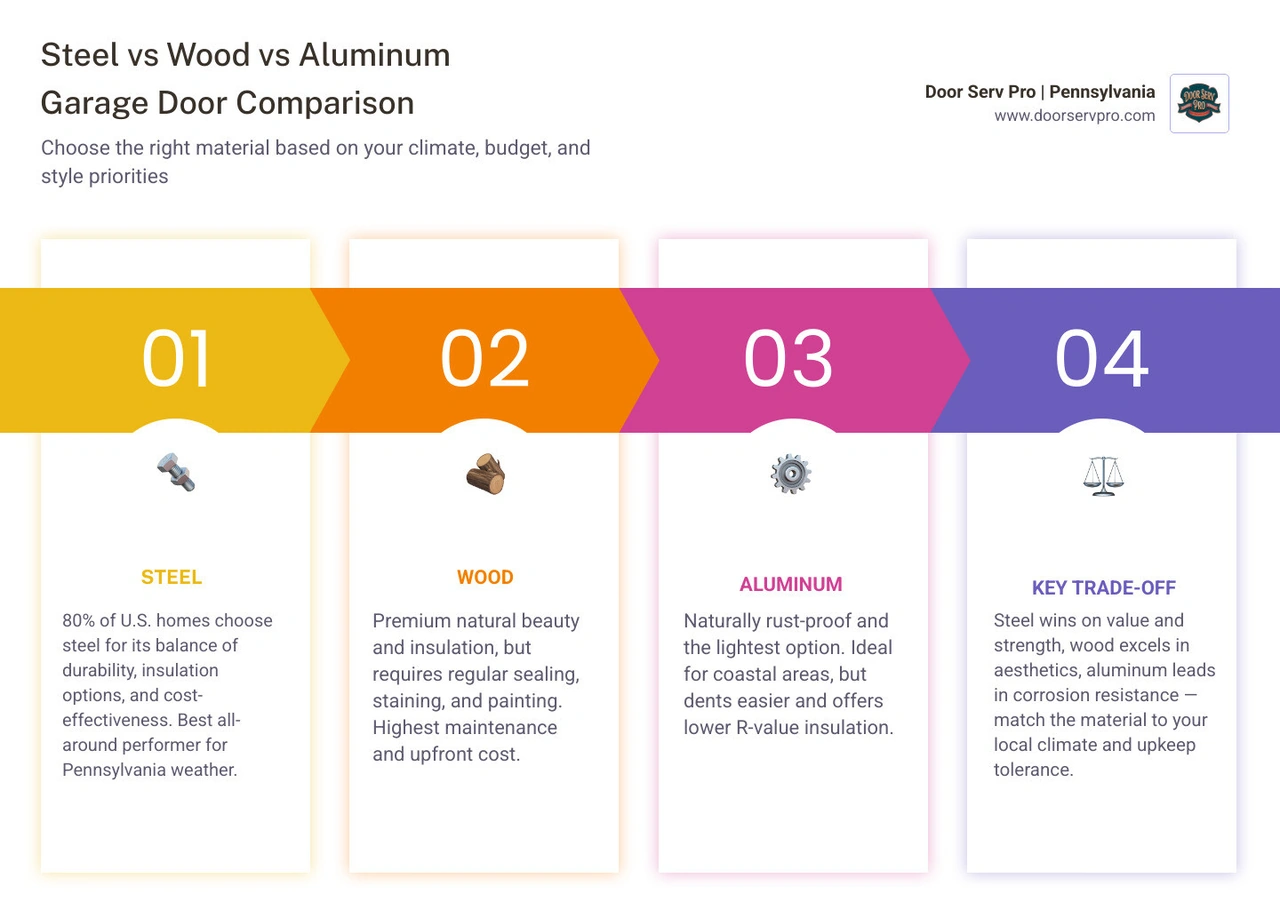
At a high level, steel is usually the best all-around performer for Pennsylvania homeowners, wood is the beauty king that asks for more attention, and aluminum is the lightweight modern option with excellent corrosion resistance.
Here is the side-by-side view most homeowners actually want:
| Material | Durability | Weather Resistance | Weight | Common Risks |
|---|---|---|---|---|
| Steel | High | Very good with protective finish | Medium | Rust at scratches, dents in thinner panels |
| Wood | Medium to high | Good only with regular sealing | Heavy | Rot, warping, swelling, pests |
| Aluminum | Medium | Excellent against corrosion | Light | Dents, lower insulation, heat transfer |
A few practical takeaways:
- Steel is the workhorse material and fits the widest range of home styles.
- Wood looks fantastic but behaves a bit like a classic car: beautiful, impressive, and happiest when cared for regularly.
- Aluminum shines in modern designs and humid conditions, but it is easier to ding or dent.
If you are still narrowing down the look you want, our guide to finding the right garage door style can help connect material choice with architecture and curb appeal.
Durability in a Steel vs Wood vs Aluminum Garage Door Comparison
Durability is where these three materials really separate.
Steel is generally the toughest overall option for daily residential use. It stands up well to rain, snow, wind, and temperature swings, which matters in Chambersburg, Greencastle, and Waynesboro where the weather likes to keep us guessing. Heavier-gauge steel and multi-layer insulated steel doors offer better dent resistance than budget single-layer models. Steel can also last 30 years or more when maintained properly.
That said, steel is not invincible. If the finish gets scratched down to bare metal and the area is ignored, rust can develop. This is especially important around the bottom section where road salt, slush, and wet leaves collect.
Wood is naturally strong and can absorb impact better than many people expect. It does not dent the way thin metal can. But wood has a different enemy list: moisture, rot, swelling, splitting, and insects. In Pennsylvania's freeze-thaw cycle, an unprotected wood door can expand in humid weather and contract in winter, which may lead to warping over time. Engineered wood designs can improve stability, but real wood still requires the most climate awareness.
Aluminum does not rust, which is one of its biggest advantages. It forms a protective oxide layer naturally, so corrosion is less of a concern than with scratched steel. But aluminum is softer than steel, so it dents more easily from bumps, sports equipment, and everyday mishaps. If your driveway doubles as a basketball court, aluminum may end up collecting memories in the form of dents.
If your current door is showing age-related issues, our garage door replacement guide for Waynesboro homeowners is a helpful next step.
Maintenance Needs in a Steel vs Wood vs Aluminum Garage Door Comparison
Maintenance is where homeowner patience gets tested.
Steel is the lowest-maintenance option for most homes. Usually, it needs:
- Occasional washing with mild soap and water
- Prompt touch-up of scratches or chips
- Basic inspection of weather seals and hardware
If the door has a factory finish, upkeep is fairly simple. In our local climate, we recommend routine cleaning and quick attention to exposed metal so moisture does not get a foothold.
Wood needs the most maintenance, no contest. To stay in good condition, wood doors usually require:
- Regular painting, staining, or sealing
- Inspection for peeling finish or moisture intrusion
- More frequent refinishing in harsh weather exposure
- Monitoring for swelling, cracking, or pest damage
This is the material for homeowners who love the look enough to commit to the upkeep. If that sounds like you, great. If not, it is better to be honest now than annoyed later.
Aluminum is also low-maintenance, but in a different way. Since rust is not the big concern, the main tasks are:
- Gentle cleaning
- Checking hardware and moving parts
- Keeping protective finishes and seals in good shape
- Watching for cosmetic dents
For homeowners comparing long-term ownership effort, steel and aluminum are easier to live with than wood.
If you are planning a new installation, our Chambersburg garage door installation guide covers what to expect before and after the project.
Performance and Energy Efficiency Across Materials
If your garage is attached to your home, sits below a bedroom, or doubles as a workshop, insulation should move way up your priority list.
Steel usually offers the best insulation performance because it is widely available in insulated, multi-layer construction. Research consistently shows insulated steel doors commonly reaching around R-8 to R-9, while higher-end polyurethane-filled models can go even higher depending on thickness and construction. Polyurethane insulation generally outperforms polystyrene because it fills cavities more completely and adds structural stiffness too.
Wood has natural insulating value because it is dense, but that does not always mean it beats insulated steel in real-world performance. A solid wood door can help moderate temperature and noise, but many modern insulated steel sandwich doors are still more energy efficient overall.
Aluminum typically trails steel in insulation unless it is built with upgraded features such as:
- Insulated cores
- Thermal breaks
- High-performance glass
- Quality perimeter weather seals
Standard insulated aluminum doors often reach about R-6, which is respectable but usually lower than insulated steel. Full-view aluminum and glass doors can look stunning, but without thermal breaks and insulated glass, they may allow more heat loss in winter and more heat gain in summer.
For Pennsylvania homeowners, here is the practical ranking for energy efficiency:
- Insulated steel
- Well-built wood
- Insulated aluminum
- Non-insulated versions of any material
Beyond temperature control, better insulation usually improves:
- Indoor comfort
- Noise reduction
- Opener smoothness
- Overall door rigidity
If you want a deeper look at the steel-versus-aluminum side of the equation, check out our steel vs aluminum garage door comparison.
Maintenance and Longevity in the Pennsylvania Climate
Pennsylvania weather is not especially gentle. Between humid summers, wet springs, falling leaves, snow, and freeze-thaw cycles, your garage door material has to handle moisture and temperature changes without falling apart or demanding constant rescue.
Steel performs very well here, especially when it has a quality finish and insulated construction. It resists rot, does not attract pests, and handles seasonal shifts better than wood. The biggest local concern is surface damage that exposes bare metal. Road salt and winter moisture can speed up corrosion if scratches are ignored.
Wood is the trickiest material in our climate. It can absolutely work, and it can look amazing, but it needs disciplined maintenance. Humidity can cause swelling. Snow and rain can challenge the finish. Repeated freeze-thaw cycles can worsen cracks or seams if water gets in. In short: wood can thrive here, but only if you stay ahead of the maintenance calendar.
Aluminum handles humidity very well because it does not rust like steel or rot like wood. That makes it appealing for homeowners worried about corrosion. But Pennsylvania weather still tests aluminum in other ways. Ice, hail, debris, and accidental impacts can leave visible dents more easily than on steel.
For local homeowners, the best climate match usually looks like this:
- Steel: best all-around option for mixed Pennsylvania weather
- Wood: best for appearance-first homeowners willing to maintain it
- Aluminum: best for modern design and corrosion resistance, but less ideal where impacts are common
For more local planning tips, our Greencastle garage door installation guide is worth a read.
Aesthetics, Customization, and Curb Appeal
This is where the "best" material becomes more personal.
Wood has the most natural warmth and character. If you want a traditional, rustic, carriage-house, or craftsman look, real wood is hard to beat. Grain pattern, stain depth, and custom detailing give it a premium feel that many homeowners love. It often delivers the strongest emotional reaction too. Nobody walks past a beautiful wood door and says, "What a sensible medium-density decision."
Steel is the most versatile stylistically. It is available in raised-panel, flush, carriage-house, and modern designs, plus a wide range of factory colors and textures. One major advantage is faux-wood finishes. These allow homeowners to get a wood-look appearance with far less maintenance than real wood.
Aluminum works especially well with contemporary architecture. Clean lines, narrow frames, powder-coated finishes, and glass panel designs create a sleek, modern look. If your home leans modern or minimalist, aluminum may feel like the obvious fit. Full-view aluminum doors can also bring in natural light, which is great if the garage is used as a gym, hobby space, or workshop.
Customization options by material tend to follow this pattern:
- Wood: best for custom craftsmanship and stain-grade beauty
- Steel: best for broad style selection and wood-look alternatives
- Aluminum: best for modern glass-heavy design
If curb appeal is a top priority, our Greencastle garage door replacement guide can help you think through style and replacement timing.
Security, Weight, and Installation Considerations
Material affects more than looks. It also changes how the door operates, how much strain it puts on hardware, and how secure it feels.
Steel is typically the strongest material for forced-entry resistance in residential garage doors. Combined with solid panel construction, reinforced tracks, modern openers, and locking features, it offers excellent security. It also tends to balance strength and manageable weight better than wood.
Wood doors are heavy and substantial, which can be a security advantage, but that extra mass increases stress on springs, openers, and hardware. Professional installation matters even more here because a heavy, poorly balanced door is not just inconvenient. It is unsafe.
Aluminum is the lightest of the three. Research suggests a typical 16x7 aluminum door may weigh around 115 pounds compared with roughly 165 pounds for a similar steel door. That lighter weight can reduce strain on moving parts and may make manual operation easier if the opener is disconnected. It can also support longer component life in some setups. The trade-off is that lighter, softer panels are generally not as resistant to impact or forced damage as steel.
A few installation realities matter regardless of material:
- Springs must be sized to the door weight
- Opener force settings should be calibrated correctly
- Tracks and reinforcement should match door size and design
- Wider doors often need additional struts
- Safety sensors and auto-reverse features should always be tested
In many cases, the quietness and lifespan of the full system depend just as much on installation quality as on the door material itself. That is why professional setup matters.
Frequently Asked Questions about Garage Door Materials
Which material is best for Pennsylvania's humid summers and cold winters?
For most homes in Chambersburg, Greencastle, and Waynesboro, insulated steel is the best all-around choice.
Why? Because it handles humidity, snow, and temperature swings well while offering strong insulation, good durability, and relatively low maintenance. Wood can perform well, but moisture control is a constant priority. Aluminum resists corrosion beautifully, but it usually does not match insulated steel for thermal performance or dent resistance.
If you want the simplest answer, it is this:
- Choose steel for the best overall balance
- Choose wood for premium beauty if you are ready for upkeep
- Choose aluminum for a lightweight modern door where corrosion resistance matters more than dent resistance
How do noise levels differ between steel and aluminum doors?
Noise is not only about the material itself. It is also about insulation, rollers, hinges, track condition, and opener type.
That said, insulated steel doors often do better at reducing noise because their layered construction and foam cores help dampen vibration. Wood also performs well acoustically because of its density. Aluminum doors can be noisier, especially lighter non-insulated models, since they transfer vibration more easily.
If home comfort matters, especially with bedrooms above the garage, focus on the whole system:
- Insulated door panels
- Nylon rollers
- Properly lubricated hinges
- Belt-drive opener
- Good weather sealing
Material matters, but hardware and installation matter a lot too.
Which garage door material offers the highest return on investment?
Steel usually offers the strongest long-term value for most homeowners. Research regularly shows steel garage door replacement delivering excellent return on investment, with some national studies placing it around 93%.
That strong value comes from a few things working together:
- Broad buyer appeal
- Good durability
- Lower maintenance needs
- Strong style variety
- Reliable insulation options
Wood can boost curb appeal significantly, especially on higher-end or historic homes, but its maintenance demands can reduce practical value for some buyers. Aluminum can also perform well, particularly on modern homes, but it is often a more style-specific choice.
If you are trying to balance resale value with everyday usability, steel is usually the smartest bet. Our budget-minded garage door upgrade guide can help you think through value-focused improvements.
Conclusion
A smart garage door decision comes down to matching the material to your home, your climate, and your willingness to maintain it.
- Steel is the best all-around choice for most Pennsylvania homeowners
- Wood offers unmatched natural beauty but needs the most upkeep
- Aluminum is lightweight, rust-resistant, and modern, but more prone to dents and usually less insulating
At Door Serv Pro, we help homeowners make practical choices that still look great years down the road. As a family-owned company with more than 30 years of craftsmanship, we believe the right garage door should improve curb appeal, comfort, security, and daily reliability all at once.
If you are ready to repair, replace, or upgrade your garage door in Chambersburg, Greencastle, Waynesboro, or nearby Pennsylvania communities, contact our team for professional garage door services.