Blog
A Step-by-Step Guide to Checking Your Garage Door Contractor's License
Door Serv Pro
Reviewed by the Door Serv Pro service team · Trained, professional garage door technicians
Last updated June 23, 2026
Why Knowing How to Verify Your Garage Door Company is Licensed Could Save You Thousands
Knowing how to verify your garage door company is licensed is one of the most important steps you can take before letting anyone work on your home. Here's a quick answer if you need it fast:
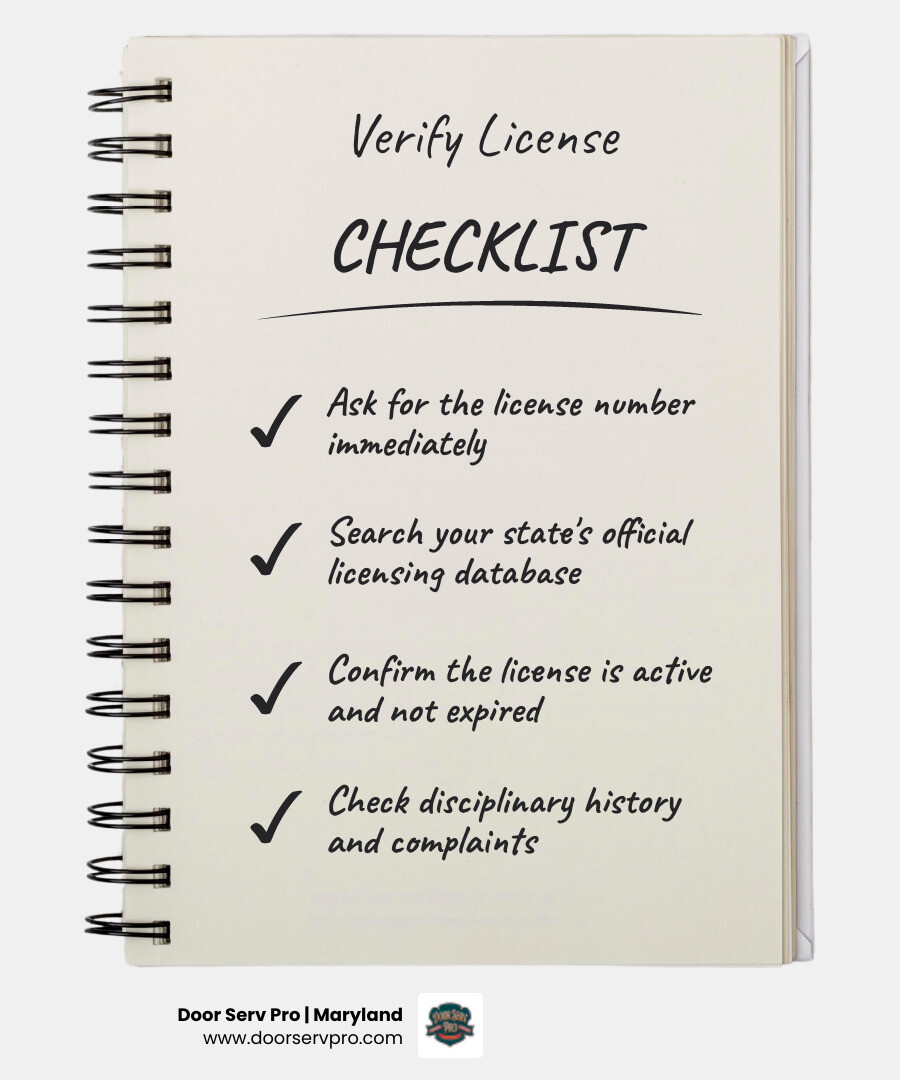
How to verify your garage door company is licensed:
- Ask for the license number — Any legitimate contractor should provide it without hesitation.
- Look up your state's licensing database — For Maryland, use the MHIC database. For Virginia, use the DPOR License Lookup. For Pennsylvania, check the Attorney General's contractor registration portal.
- Confirm the license status is "Active" — Expired or suspended licenses are disqualifying, full stop.
- Match the business name and phone number — Cross-reference what's on the license with what's on the company's website.
- Verify insurance independently — Request a certificate of insurance, then call the carrier directly to confirm coverage is current.
- Check for complaints or disciplinary history — Most state licensing boards display this publicly.
Here's something worth sitting with: according to the Better Business Bureau, 80% of customers who hired licensed contractors reported satisfaction with their experience — compared to just 60% who hired unlicensed ones. That 20-point gap represents real homeowners who dealt with botched repairs, unexpected liability, and little to no legal recourse.
Garage doors aren't a simple fix. They involve high-tension springs, complex opener systems, and structural elements that directly affect your home's safety and security. When something goes wrong — and with an unlicensed contractor, it often does — you may find yourself with no warranty, no legal protection, and no way to recover your losses.
The garage door industry is also, unfortunately, one of the most fraud-prone home services sectors in the country. A 2020 DASMA study found that approximately 70% of all Google Maps garage door repair listings are fake. That means the company showing up at your door tomorrow morning might be exactly who they say they are — or they might be operating with expired credentials and hoping you won't check.
I'm Paul Wiese, founder of Door Serv Pro and a licensed garage door contractor across West Virginia, Virginia, Maryland, Pennsylvania, and California with over 33 years of industry experience — and understanding how to verify your garage door company is licensed is something I've built into the foundation of how we operate. In this guide, I'll walk you through every step to protect yourself before you sign anything or let a single tool touch your garage door.
Why You Must Know How to Verify Your Garage Door Company is Licensed
When we talk about licensing, we aren't just talking about a piece of paper or a fee paid to the state. Licensing is a framework designed for your protection. In our 25 years of experience at Door Serv Pro, we have seen the aftermath of what happens when homeowners skip this crucial step.
The primary reason to verify a license is liability protection. If an unlicensed worker is injured on your property in Hagerstown or Frederick, you—the homeowner—could be held financially responsible for their medical bills. Licensed contractors are required to carry workers' compensation and general liability insurance, which shifts that risk away from you. Furthermore, licensing ensures that the company understands local building codes. Improperly installed doors can fail inspection, complicating future home sales or even resulting in fines from the city.
Hiring a licensed professional also provides access to recourse funds. For example, in Maryland, the MHIC Guaranty Fund exists to compensate homeowners for losses caused by licensed contractors who perform poor work. If you hire an unlicensed "handyman," you lose access to these safety nets. Statistics show that the garage door industry in states with strict licensing grows faster—averaging 5% annually—because consumers feel safer investing in their homes when quality is regulated.
Why You Must Know How to Verify Your Garage Door Company is Licensed
The rise of the "digital scammer" has made verification more urgent than ever. Many fraudulent operations use "bait-and-switch" tactics, advertising a low service fee only to charge hundreds more for unnecessary parts once they have your door taken apart. By learning how to verify your garage door company is licensed, you effectively filter out these fly-by-night operations.
| Feature | Licensed Contractor | Unlicensed "Chuck-in-a-Truck" |
|---|---|---|
| Legal Protection | Access to state guaranty/recovery funds | Zero legal recourse through state boards |
| Insurance | Required Liability & Workers' Comp | Often none; Homeowner assumes risk |
| Permits | Can legally pull required local permits | Cannot pull permits; Work is "off-books" |
| Accountability | Disciplinary history is public record | No oversight or history to track |
| Expertise | Must pass trade exams and experience checks | No verified skill level or training |
Understanding State-Specific Licensing Requirements
Licensing isn't a "one-size-fits-all" deal. Depending on where you live in our service area—whether it's Martinsburg, WV, or Waynesboro, PA—the rules change significantly.
- Maryland (MHIC): The Maryland Home Improvement Commission requires a license for any person or business performing home improvements. This includes garage door repair and installation. Contractors must display their MHIC number on all advertising and vehicles.
- Virginia (DPOR): Virginia requires a state-issued contractor license for projects over $1,000. Most residential garage door work falls under a Class C, B, or A license.
- Pennsylvania: Pennsylvania requires contractors to register with the Attorney General’s office. While this is a registration rather than a trade-tested license, it still requires the company to maintain insurance and follow the Home Improvement Consumer Protection Act.
- West Virginia: Contractors performing work over $2,500 must be licensed by the West Virginia Division of Labor.
Step-by-Step: How to Verify Your Garage Door Company is Licensed Online
You don't have to take a contractor's word for it. You can verify their status in less than five minutes using official state databases. This is the single most effective way to ensure you are hiring a legitimate business.
The first step is to ask the company for their license number. If they hesitate or tell you "we don't need one for this small job," that is an immediate red flag. Once you have the number, you can head to the appropriate state portal.
Using State Databases Like MHIC and DPOR
For our neighbors in Maryland and Virginia, the process is very straightforward:
- Maryland Lookup: Visit the Maryland Department of Labor portal. Select "Home Improvement Commission" and search by either the license number or the business name. When searching by name, try variations (e.g., "Door Serv" instead of "Door Serv Pro") if the first search fails.
- Virginia Portal: Go to the DPOR License Lookup. You can search by "Name" or "License Number." Ensure the "License Type" matches the work being done (Contractor).
- Pennsylvania: Use the PA Attorney General's search tool. Search for the "HIC" (Home Improvement Contractor) number.
Search Tips: Database systems can be finicky. If a business name search doesn't work, try searching by the owner's last name. Avoid using "The" or "Inc." in your search terms to keep the results broad.
How to Verify Your Garage Door Company is Licensed and Active
Finding a listing is only half the battle. You must ensure the status is Active. An "Expired," "Suspended," or "Inactive" license is the same as having no license at all.
Check the Disciplinary History section on the state portal. This will tell you if the board has taken action against the contractor for previous violations. Another pro-tip: match the phone number on the state listing with the one on the company's website. Scammers often steal the license numbers of legitimate, retired, or out-of-area contractors and paste them onto their own fake websites. If the numbers don't match, call the number listed on the official state database to see if you reach the same company.
Verifying Insurance and Professional Credentials
Licensing is the baseline, but insurance is the shield. Even the best technicians can have an accident. If a heavy garage door falls during installation and damages your car or home, the contractor’s insurance is what pays for the repairs—not your wallet.
We recommend looking for three specific types of financial protection:
- General Liability: This covers property damage and bodily injury to third parties. The industry standard is $1,000,000 per occurrence.
- Workers' Compensation: This is non-negotiable if the company has employees. It protects you from being sued if a technician is injured on your property.
- Bonding: A bond is a form of insurance that protects the consumer if the contractor fails to complete the job or follow the contract.
Beyond legal requirements, look for Manufacturer Certifications. At Door Serv Pro, we value our relationships with top brands like Clopay and LiftMaster. When a company is a "Master Authorized Dealer," it means the manufacturer has vetted them and stands behind their installation quality. Membership in the International Door Association (IDA) or training from DASMA (Door & Access Systems Manufacturers Association) further proves that the company is committed to industry best practices and safety standards.
Confirming Insurance Coverage and Financial Protection
Never accept a verbal "Yes, we're insured." Ask for a Certificate of Insurance (COI). A legitimate COI will list the insurance agency, the policy numbers, and the effective dates.
Expert Tip: Don't just look at the paper. Call the insurance carrier listed on the certificate independently. Ask if the policy is currently active and if it covers "Garage Door Installation and Repair." Some unscrupulous operators take out a policy to get the certificate, then stop paying the premiums. A quick phone call ensures the coverage is actually in force on the day they arrive at your home in Boonsboro or Chambersburg.
Common Red Flags of Fraudulent Contractors
Scammers have become sophisticated, but they almost always leave a trail. In April 2026, we are still seeing many of the same patterns that have plagued the industry for years. If you notice these signs, walk away:
- Generic Phone Greetings: If you call and they answer with "Garage Door Services" or "Repair!" instead of a specific company name, they are likely a centralized call center routing leads to unlicensed sub-contractors.
- Unmarked Vehicles: A professional company will have branded trucks and technicians in uniform. If someone pulls up in a beat-up personal SUV with no signage, be extremely cautious.
- Virtual Offices: Many fake listings use addresses that map to a UPS Store, a Regus office, or even a Home Depot parking lot. Use Google Street View to verify that the company has a real, physical location or showroom.
- Bait-and-Switch Pricing: If a quote seems too good to be true, it is. They often lure you in with a "free service call" and then hold your door hostage with high-pressure sales tactics for parts you don't need.
- Review Manipulation: Watch for companies that have hundreds of 5-star reviews all posted within the same week. Real reviews are earned over time and usually mention specific technician names.
Frequently Asked Questions
Does every state require a specific garage door license?
No, and this is where it gets confusing for homeowners. Only a few states (like California, Nevada, and Florida) have a dedicated "Garage Door" specialty license. In most of our service areas—like Maryland and Virginia—garage door work is covered under a broader Home Improvement or General Contractor license. However, 38 states and DC require some form of state-level credential. Always check your local municipality as well, as some cities require their own registration to pull permits.
What should I do if a contractor's license is expired?
If the license is expired, do not hire them. It doesn't matter if they have 30 years of experience or if they are your neighbor’s cousin. An expired license means they are currently operating illegally and likely do not have valid insurance. If a contractor claims they are "in the process of renewing," ask for proof of the submitted application and payment to the state board. You can also report unlicensed activity to your state’s licensing board (like the MHIC or DPOR) to help protect other homeowners.
How do I verify a company's physical business address?
The best way is to use Google Maps. Type in the address provided on their website. If it’s a P.O. Box at a post office or a residential apartment building, they may not have the stability required to honor a long-term warranty. A company with a physical showroom—like many established businesses in Hagerstown and Frederick—is much more likely to be there for you five or ten years down the road if you have an issue.
Conclusion
Your home is your biggest investment, and your garage door is its largest moving part. Entrusting that system to an unlicensed individual isn't just a risk to your property; it’s a risk to your family’s safety. By following this guide and taking the time to learn how to verify your garage door company is licensed, you are choosing peace of mind over a "quick fix."
At Door Serv Pro, we take these standards seriously. With over 25 years of expertise and a family-owned legacy, we are fully licensed, insured, and bonded across West Virginia, Virginia, Pennsylvania, and Maryland. Our team serves communities from Greencastle and Waynesboro to Martinsburg and Charles Town with 24/7 emergency availability and a 100% satisfaction guarantee. We believe in transparency, technical excellence, and the personal touch that only a family-run business can provide.
Don't leave your home's security to chance. Whether you need a simple spring repair or a brand-new custom installation, work with a team that has the credentials to back up their claims. Schedule your professional garage door service with Door Serv Pro today and experience the difference that true professionalism makes.
Need Help?
Contact us today to discuss your needs. Our team is ready to help.
About the author
Door Serv Pro
More articles
View all postsKeep reading
Related articles
Ready to Get Started?
Whether you need a repair, maintenance, or a new installation, our expert team is here to help.