Blog
Modern Garage Doors and How They Prevent Accidents
Door Serv Pro
Reviewed by the Door Serv Pro service team · Trained, professional garage door technicians
Last updated June 24, 2026
Why Garage Door Safety Features Every Homeowner Should Know Can Prevent Serious Injuries
Garage door safety features every homeowner should know include the following essential mechanisms that protect your family every single day:
- Photo-eye sensors - Infrared beams mounted 6 inches above the floor that detect obstructions and stop the door
- Auto-reverse mechanism - Required on all openers since 1993; reverses the door automatically when it contacts an object
- Pinch-resistant panels - Flush-joint panel designs that eliminate dangerous gaps between door sections
- Rolling code technology - Generates a new access code with each use, preventing code theft
- Manual release handle - The red emergency cord that lets you operate the door manually during power outages
- Battery backup system - Keeps your door functioning when the power goes out
- Tamper-resistant brackets - High-tension hardware that requires professional servicing to prevent spring-related injuries
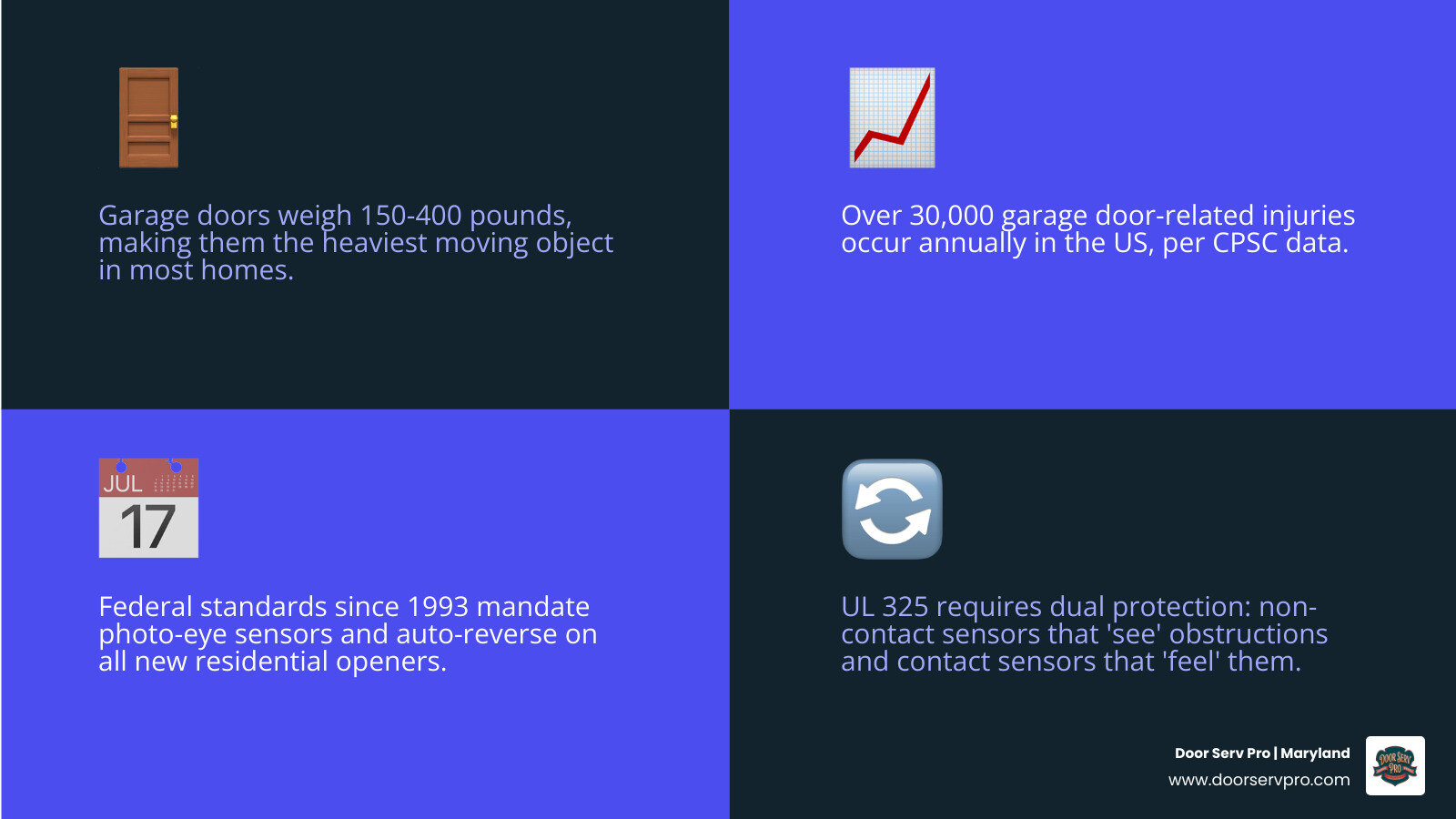
Your garage door is likely the largest and heaviest moving object in your home, weighing anywhere from 150 to 400 pounds and operating hundreds of times each year. According to the U.S. Consumer Product Safety Commission, over 30,000 garage door-related injuries occur annually in the United States alone. Many of these are preventable. Federal safety standards introduced in 1993 made photo-eye sensors and auto-reverse mechanisms mandatory on all new residential openers — yet older systems without these protections are still in operation today, and even modern systems can fail without proper testing and maintenance.
I'm Paul Wiese, founder of Door Serv Pro, and in my 33 years working in the garage door industry across multiple states, I've seen how understanding garage door safety features every homeowner should know can be the difference between a close call and a serious injury. In the sections below, I'll walk you through each critical feature, how to test them, and when to call a professional.
Essential Garage Door Safety Features Every Homeowner Should Know
When we talk about garage door safety, we’re looking at a system that has evolved significantly over the last few decades. If your home in Hagerstown or Martinsburg still uses a garage door opener manufactured before 1993, you might be missing out on life-saving technology.
Before 1993, many garage doors relied solely on mechanical force settings. If the door hit something, it might stop, but often only after exerting significant pressure. Today, the UL 325 safety standards require a "redundant" system—meaning there are two ways the door protects you: one that "sees" an object and one that "feels" it.
| Feature | Pre-1993 Systems | Post-1993 Systems |
|---|---|---|
| Photo-Eye Sensors | Not Required | Mandatory |
| Auto-Reverse | Often Mechanical Only | Mandatory (Contact & Non-Contact) |
| Rolling Code Tech | Rare/Fixed Codes | Standard (Billions of Codes) |
| Pinch Protection | Open Gaps | Flush-Joint Designs |
Beyond these basics, modern doors also feature pinch-resistant panels. Older doors had sections that created a "v" shape as they opened, which were notorious for trapping fingers. Modern designs use tongue-and-groove or flush-joint panels to eliminate these gaps. Understanding the importance of prompt garage door repair to ensure home safety is the first step in protecting your household.
Photo-Eye Sensors and Infrared Beams
The photo-eye sensors are those little "eyes" located at the bottom of your garage door tracks. They send an invisible infrared beam across the opening. If that beam is broken while the door is closing, the motor immediately stops and reverses the door.
For these to work correctly, they must be mounted no higher than 6 inches above the garage floor. This height is specifically chosen based on the average size of an infant’s cranium or a small pet. If they are mounted too high, a child crawling underneath could be missed by the beam. If your sensors are misaligned, you might notice the lights on the sensors flashing or the door refusing to close. This is a common part of garage door opener programming that we handle during our routine safety checks.
Automatic Reversal Force Sensitivity
While photo-eyes catch things before the door touches them, the auto-reverse mechanism is the secondary safety net. It detects physical resistance. If the door's bottom edge makes contact with an object (like a trash can or, heaven forbid, a person), the motor detects the change in torque and reverses the direction within two seconds.
Over time, the force settings on your opener can shift due to weather changes or wear and tear. If the force is set too high, the door might not reverse until it has already caused damage. This is one of the major signs your garage door needs repair and should never be ignored.
I’m worried about my door closing on my kids. How do I test the auto-reverse in Frederick?
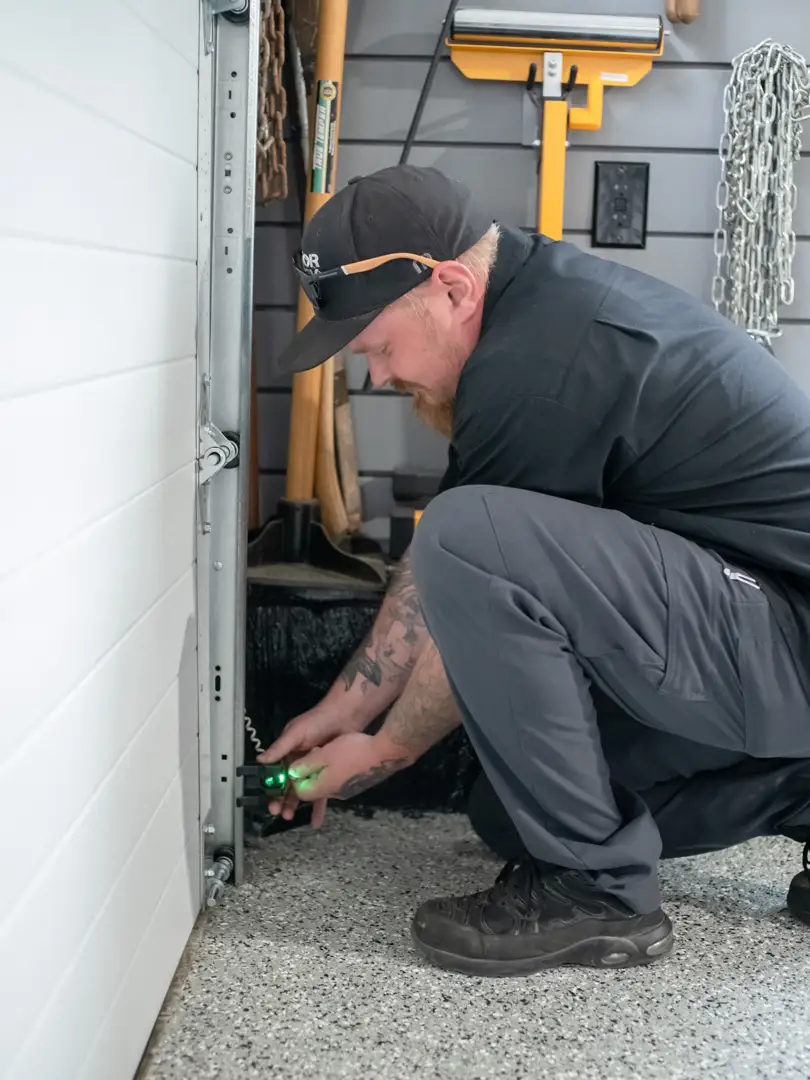
As a family-owned business, we know that nothing is more important than the safety of your children and pets. In Frederick and surrounding areas like Charles Town and Shepherdstown, we recommend that every homeowner performs a simple "2x4 test" once a month. It only takes a minute, but it ensures your garage door safety features every homeowner should know are actually functioning.
Testing Garage Door Safety Features Every Homeowner Should Know
To perform the auto-reverse test:
- Place a full-length 2x4 piece of wood flat on the ground in the center of the garage door opening.
- Press the button to close the door.
- When the door strikes the wood, it should stop and reverse immediately.
If the door tries to "crush" the wood or stops without reversing, your force settings are likely off. Another method is the "paper towel roll" test—place a roll of paper towels under the door. If the door doesn't reverse upon contact, the system needs professional adjustment. We often perform these tests as part of an annual garage door inspection in Cresaptown or Frederick to give parents peace of mind.
Don't forget to test the sensors, too! While the door is closing, simply wave a broomstick through the path of the infrared beam. The door should instantly reverse. If it doesn't, check for dirt on the lenses or misalignment.
Visual Inspection of High-Tension Components
While you are testing the electronics, take a moment to look at the "hardware" of the door. Look at your cables—are they starting to fray? Look at the springs—is there a gap in the coils, or do they look heavily rusted?
These components are under immense tension. A standard torsion spring stores up to 10,000 foot-pounds of energy—that’s enough to lift a small car! If a cable snaps while the door is moving, the door can come crashing down unevenly, bypassing the safety sensors. It is vital to understand garage door springs in Cumberland and other local areas to recognize when they are reaching the end of their 7-to-14-year lifespan.
My garage was broken into recently. What modern security features should I look for in Maryland?
Safety isn't just about preventing accidents; it's also about preventing unauthorized entry. In Maryland, we see a lot of interest in security upgrades, especially for homes in areas like Hagerstown or Falling Waters. Modern garage door safety features every homeowner should know have come a long way in deterring burglars.
Why Modern Garage Door Safety Features Every Homeowner Should Know Matter for Security
Older garage door openers used "fixed codes." This meant a thief with a code-grabbing device could sit in your driveway, record your signal, and open your door later. Modern openers use rolling code technology.
Every time you press your remote, the opener generates a new access code from billions of possible combinations. The remote and the motor "handshake" on a code that will never be used again. This makes it nearly impossible for intruders to duplicate your signal. When we talk about upgrading security modern features in garage door repair, this is usually our top recommendation. Additionally, modern garage door opener programming guide in Inwood WV often includes setting up smartphone alerts so you know exactly when your door is opened or closed.
Battery Backups and Manual Release Handles
Have you ever been stuck in your driveway during a summer thunderstorm in Martinsburg because the power went out? This is where the manual release handle and battery backup systems become essential.
The manual release handle is that red cord hanging from your opener. When pulled, it disconnects the door from the motor, allowing you to lift the 150-400 pound door by hand. However, for many homeowners, lifting that much weight is difficult or dangerous. That’s why we highly recommend openers with battery backup systems. These systems can power your door for several cycles over 24-48 hours during an outage. If you ever find yourself stuck, our 24 7 emergency garage door services are always available to help.
Pro Security Tip: Some burglars use a coat hanger to reach through the top of the garage door and pull the emergency release cord. You can deter this by using a simple zip tie to secure the release lever—it’s enough to stop a coat hanger but can still be broken by a firm, intentional pull from a human in an emergency.
Is it safe to fix a broken spring myself, or should I call a professional in Frederick?
We get this question a lot in Frederick, Hagerstown, and Chambersburg. With so many DIY videos online, it’s tempting to try and save a few dollars. However, when it comes to springs and cables, the answer is a firm "No."
The Dangers of High-Tension Springs and Cables
Garage door springs are not like the small springs in a ballpoint pen. They are heavy-duty steel components wound under thousands of pounds of pressure. Statistics show that attempting DIY repairs on these parts results in hundreds of emergency room visits every year.
If a spring snaps while you are working on it, it can cause severe lacerations, broken bones, or even worse. Professional technicians use specialized winding bars and safety equipment to manage this tension. We also install spring containment cables on extension springs—if the spring breaks, the cable keeps it from flying across the garage like a projectile. Understanding the role of torsion and extension in garage door spring repair is something we take very seriously. Always opt for safe garage door spring repair to protect yourself and your property.
Why Professional Maintenance Outperforms DIY
A garage door is a complex mechanical system with dozens of moving parts. While a homeowner can certainly handle basic lubrication, a professional eye can spot issues before they become emergencies.
During a professional maintenance visit, we check:
- Track Alignment: Ensuring the door isn't binding or rubbing.
- Balance: A perfectly balanced door should stay in place when lifted halfway by hand. If it slams shut or flies open, the springs are improperly tensioned.
- Hardware Tightening: The vibration of the door moving 1,500 times a year can loosen bolts and brackets.
- Lubrication: We use high-quality lithium or silicone-based lubricants that don't attract dust.
In April 2026, the standards for home safety are higher than ever. Investing in professional care is about more than just a working door; it’s about the role of garage door repair in improving system longevity.
Frequently Asked Questions about Garage Door Safety
How often should I test my garage door's safety sensors?
We recommend testing your sensors every month. It only takes a few seconds to wave an object through the beam while the door is closing. You should also take this time to wipe the lenses with a soft, dry cloth to ensure no dust or spiderwebs are blocking the signal. If you find yourself having issues, check out our troubleshooting tips for garage door repair residential service.
Can I add safety sensors to an opener made before 1993?
While some retrofit kits exist, they are often unreliable and may not meet current UL 325 standards. In most cases, if your opener is over 30 years old, it is far safer and more cost-effective to opt for a garage door opener replacement. Modern openers are quieter, more secure, and come with built-in battery backups and smart features.
What should I do if my door reverses for no apparent reason?
This is a common frustration! Usually, it’s caused by one of three things:
- Sensor Misalignment: A small bump from a trash can can knock the sensors out of line.
- Track Debris: A small pebble or buildup of old grease in the tracks can trick the auto-reverse into thinking it hit an object.
- Weather Sensitivity: Extreme cold can cause metal to contract, increasing friction.
Checking your overhead door track alignment in Berryville or Frederick is a good first step to solving this mystery.
Conclusion
At Door Serv Pro, we believe that your garage door should be a source of convenience, not a source of worry. As a family-owned company with over 25 years of expertise, we’ve dedicated ourselves to serving our neighbors in Maryland, West Virginia, Virginia, and Pennsylvania with honesty and craftsmanship. From our base in Frederick to the homes we service in Hagerstown, Martinsburg, and beyond, our NATE-certified team is committed to your safety.
Whether you need a simple safety test, a complex spring replacement, or a brand-new installation, we bring a personal touch and a 100% satisfaction guarantee to every job. Don't wait for a "close call" to check your door. Contact us today for a comprehensive garage door maintenance checkup and let us help you protect what matters most. We are available 24/7 for emergencies, ensuring your home remains the safe haven it’s meant to be.
Need Help?
Contact us today to discuss your needs. Our team is ready to help.
About the author
Door Serv Pro
More articles
View all postsKeep reading
Related articles
Ready to Get Started?
Whether you need a repair, maintenance, or a new installation, our expert team is here to help.