Blog
Warning Signs Your Garage Door Spring is Ready to Snap
Door Serv Pro
Reviewed by the Door Serv Pro service team · Trained, professional garage door technicians
Last updated June 24, 2026
Why Knowing the Signs Your Garage Door Spring Is About to Break Could Save You From a Dangerous Situation
The signs your garage door spring is about to break are easy to miss — until the spring snaps and your 200-pound garage door stops working entirely. For West Virginia homeowners who use the garage as the main entry point into their home, a failed spring is more than an inconvenience. It is a safety hazard that can damage your opener, injure someone, or leave your home unsecured.
Here is a quick look at the most common warning signs:
- Loud bang from the garage — sounds like a gunshot or firecracker; often the spring snapping under tension
- Visible gap in the spring — a 1–2 inch separation in the coil means the spring has broken
- Door feels extremely heavy manually — springs carry 80–90% of the door's weight; without them, lifting is dangerous
- Door moves unevenly or looks crooked — one side dropping lower than the other signals spring imbalance
- Door opens only partway then stops — the opener cannot compensate for a broken spring
- Door slams shut faster than normal — weakened springs can no longer control the door's descent
- Opener strains, jerks, or stops mid-cycle — the motor is working far harder than it should
Garage door springs are rated for roughly 10,000 to 15,000 cycles — about 7 to 10 years for an average household using the door several times per day. Once they near the end of that lifespan, failure can happen suddenly and without much warning.
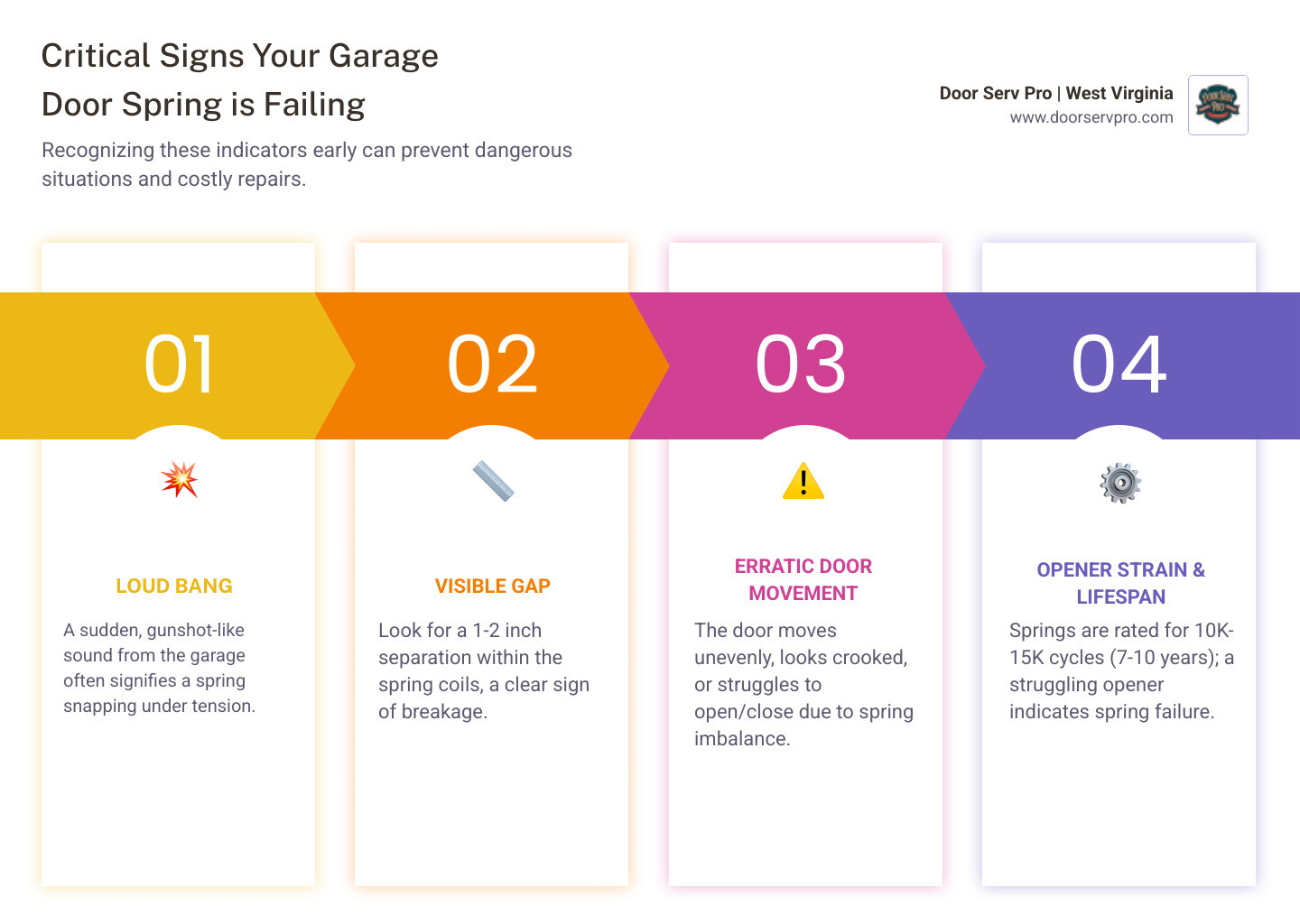
7 Critical Signs Your Garage Door Spring is About to Break
In our 30+ years of serving West Virginia communities from Martinsburg to Charles Town, we have seen it all. Garage door springs are the literal "muscle" of your door system. While the opener acts as the brain, the springs do the heavy lifting. When they begin to fail due to metal fatigue or reaching their cycle limit, the symptoms are often progressive.
Recognizing these signs your garage door spring is about to break early can prevent a total system collapse. To understand the "why" behind these failures, you can explore Garage Door Spring Repair Insights to see how these components wear down over time.
The Unmistakable Loud Bang
One of the most dramatic signs of a spring failure is a sound you won’t soon forget. Because torsion springs are wound under extreme tension (storing up to 200 pounds of force), when they snap, they release all that energy in a millisecond.
Homeowners in Hedgesville and Inwood often tell us they thought a heavy object fell in the garage or even that a firearm was discharged nearby. This "gunshot" or "firecracker" sound is the metal coil fracturing and spinning rapidly on the shaft. If you hear this, do not attempt to operate the door, as the counterbalance system is now compromised.
Visual Gaps and Signs Your Garage Door Spring is About to Break
If you suspect something is wrong, the first thing you should do is look up. Most modern homes in the Falling Waters and Shepherdstown areas use torsion springs, which are mounted horizontally on a bar above the door.
When a torsion spring breaks, it doesn't just disappear. Instead, it unwinds and creates a visible gap, usually about two inches wide. This separation occurs because the spring can no longer hold its tension. If you see a gap in the coils, the spring is officially broken. For residents dealing with specific issues in the Eastern Panhandle, checking out Garage Door Spring Issues Stephens City can provide more localized context on common failure patterns.
Erratic Movement and Signs Your Garage Door Spring is About to Break
Does your door seem to have a "hiccup" when it opens? Or perhaps it looks like it’s leaning to one side as it travels up the tracks? This lopsided or jerky motion is a major red flag.
When one spring fails (or is significantly weaker than the other), the door loses its equilibrium. This puts immense strain on the rollers and tracks, often causing the door to bind or even jump out of the track entirely. Operating an unbalanced door is a recipe for disaster. We always emphasize the importance of Safe Garage Door Spring Repair because a jerky door can suddenly fall without warning, posing a risk to anyone standing beneath it.
Understanding Torsion vs. Extension Spring Failure
Not all springs are created equal. Depending on the age of your home in Ranson or Harpers Ferry, you likely have one of two types: torsion springs or extension springs. Understanding which one you have helps you identify the specific signs your garage door spring is about to break.
| Feature | Torsion Springs | Extension Springs |
|---|---|---|
| Mounting Location | Above the door opening | Along the horizontal tracks |
| Movement | Twisting/Torque | Stretching/Expanding |
| Average Lifespan | 10,000 – 20,000 cycles | 5,000 – 10,000 cycles |
| Safety Level | Higher (contained on a bar) | Lower (can fly off if safety cable fails) |
| Common Failure Sign | Visible gap in coil | Stretching or gaps between coils |
Torsion Spring Lifespan
Torsion springs are the modern industry standard for a reason. They are generally more durable and provide a smoother operation. In 2026, many high-quality torsion springs are rated for 15,000 to 20,000 cycles. However, even these "long-distance runners" eventually succumb to metal fatigue.
Since they are mounted horizontally, they stay contained on the metal shaft even when they break. This makes them safer than the older extension style, but no less urgent to repair. If your door is used as the primary entrance for your family, those cycles add up faster than you might think—roughly 1,500 times per year for the average household. For a deeper dive into these systems, see Navigating Torsion: Your Complete Guide to Garage Door Spring Repair.
Extension Spring Vulnerabilities
Extension springs are more common on older doors or in garages with low headroom. These springs stretch out along the sides of the upper tracks. Because they act like giant rubber bands, they are under incredible tension when the door is closed.
The most common signs your garage door spring is about to break with extension systems include:
- Gaps in the coils when the door is closed.
- Excessive elongation, where the spring looks "stretched out" and doesn't return to its original shape.
- Frayed safety cables. Since these springs can fly across the garage if they snap, they should always have a safety cable running through the center.
If you notice your extension springs are looking a bit tired, our Garage Door Spring Service can help ensure they are replaced before they become a projectile risk.
Why Ignoring Failing Springs is a Major Safety Risk
We get it—life is busy in Berkeley Springs and Martinsburg. It’s tempting to ignore a squeaky door or a motor that sounds a little tired. But ignoring the signs your garage door spring is about to break is a gamble you don't want to take.
Opener Motor Strain
Many homeowners assume that if the door is moving slowly, the opener is the problem. In reality, the opener is only designed to lift about 15 to 20 pounds of the door's weight; the springs handle the rest.
When a spring is weak or broken, the opener motor has to lift the full weight of the door (which can be 150 to 400 pounds!). This leads to:
- Stripped gears inside the opener.
- Motor burnout, which turns a simple spring replacement into a much more expensive opener replacement.
- Inconsistent operation, where the door starts to open and then reverses because the safety sensors detect too much resistance.
By addressing spring issues now, you can learn How Garage Door Spring Repairs Can Prevent Future Door Malfunctions and save yourself a lot of money in the long run.
The Danger of Manual Operation
If your spring breaks while the door is closed, you might be tempted to pull the red emergency release cord and lift the door yourself. We strongly advise against this.
Without the counterbalance of the springs, a garage door is a "dead weight." Attempting to lift a 300-pound door manually can lead to severe back injuries or smashed fingers. Furthermore, if you manage to get the door up, there is nothing holding it there. It could come crashing down like a guillotine at any moment.
Maintenance Tips to Extend Spring Lifespan
While you can't stop time, you can certainly slow down the wear and tear on your garage door system. Proactive care is the best way to avoid the sudden shock of a broken spring.
The Balance Test
This is the easiest way for a homeowner to check the health of their springs.
- Close the garage door.
- Pull the emergency release cord to disconnect the opener.
- Manually lift the door to about waist height and let go.
A well-balanced door with healthy springs should stay in place or move only slightly. If the door slams shut, your springs have lost their tension and are likely about to fail. If the door shoots upward, the springs are under too much tension. Either way, it’s time to call in the pros.
Professional Inspections
We recommend an annual "tune-up" for every garage door in West Virginia. During these visits, we don't just look at the springs. We tighten hardware, inspect the cables for fraying, and ensure the tracks are aligned.
Lubrication is also key. Using a high-quality silicone-based lubricant on the springs a few times a year prevents rust and reduces the friction that leads to metal fatigue. For more details on what a professional looks for, read about The Importance of Regular Inspections for Garage Door Spring Repair.
Frequently Asked Questions about Garage Door Springs
If one garage door spring breaks, should both be replaced?
Yes, absolutely. Most garage doors are installed with a pair of springs that were manufactured at the same time and have gone through the exact same number of cycles. If one has snapped, the other is usually just days or weeks away from doing the same. Replacing them as a pair ensures the door remains balanced and saves you the cost of a second service call a month later.
What is the typical lifespan of a garage door spring in 2026?
In 2026, the standard lifespan remains 7 to 10 years for most residential doors. However, environmental factors in West Virginia—like high humidity in the summer and freezing temperatures in the winter—can cause rust and metal contraction, which may shorten that lifespan to 5 or 6 years if the springs aren't properly lubricated.
What should I NOT do if I suspect a broken spring?
- Do NOT attempt to wind or adjust a torsion spring yourself. They require specialized winding bars and can cause catastrophic injury if they slip.
- Do NOT keep using the automatic opener. You will likely burn out the motor.
- Do NOT stand under the door or leave your car parked halfway in the garage.
- Do NOT ignore the gap. A broken spring makes the door unstable and dangerous.
Trust the West Virginia Experts at Door Serv Pro
At Door Serv Pro, we aren't just technicians; we are your neighbors. As a family-owned business with over 30 years of craftsmanship, we take pride in keeping the families of Martinsburg, Charles Town, and the surrounding areas safe. Our community focus goes beyond repairs—we are proud to support veterans and cancer charities through our philanthropic campaigns.
When you notice the signs your garage door spring is about to break, don't wait for the "loud bang" to leave you stranded. Whether you're in Paw Paw, Great Cacapon, or Ranson, our team is ready to provide fast, expert service to get your door back in perfect balance.
Don't let a broken spring ruin your day. Contact us for expert Garage Door Spring Repair and experience the peace of mind that comes with 30+ years of excellence.
Need Help?
Contact us today to discuss your needs. Our team is ready to help.
About the author
Door Serv Pro
More articles
View all postsKeep reading
Related articles
Ready to Get Started?
Whether you need a repair, maintenance, or a new installation, our expert team is here to help.