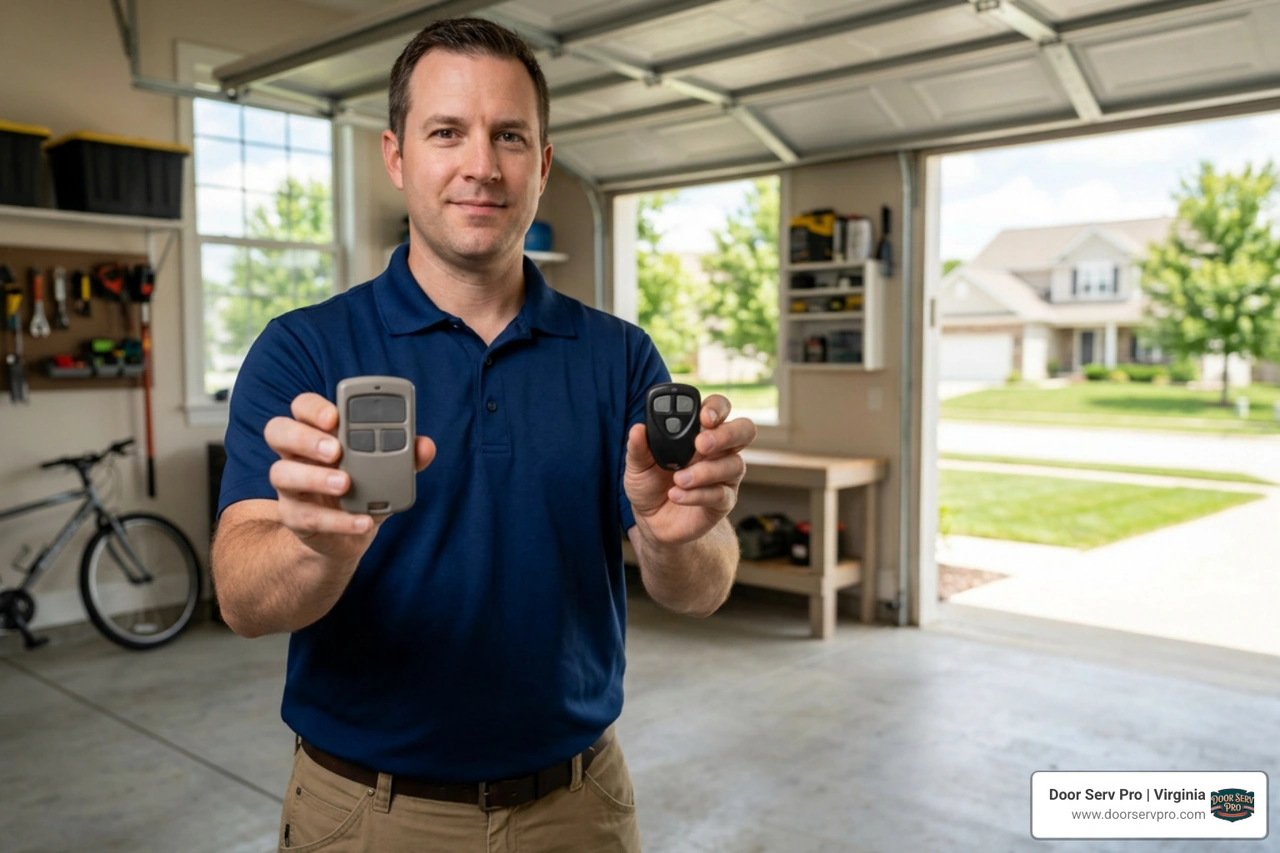
Universal Garage Door Remote vs Brand Specific: Which One Do You Actually Need?
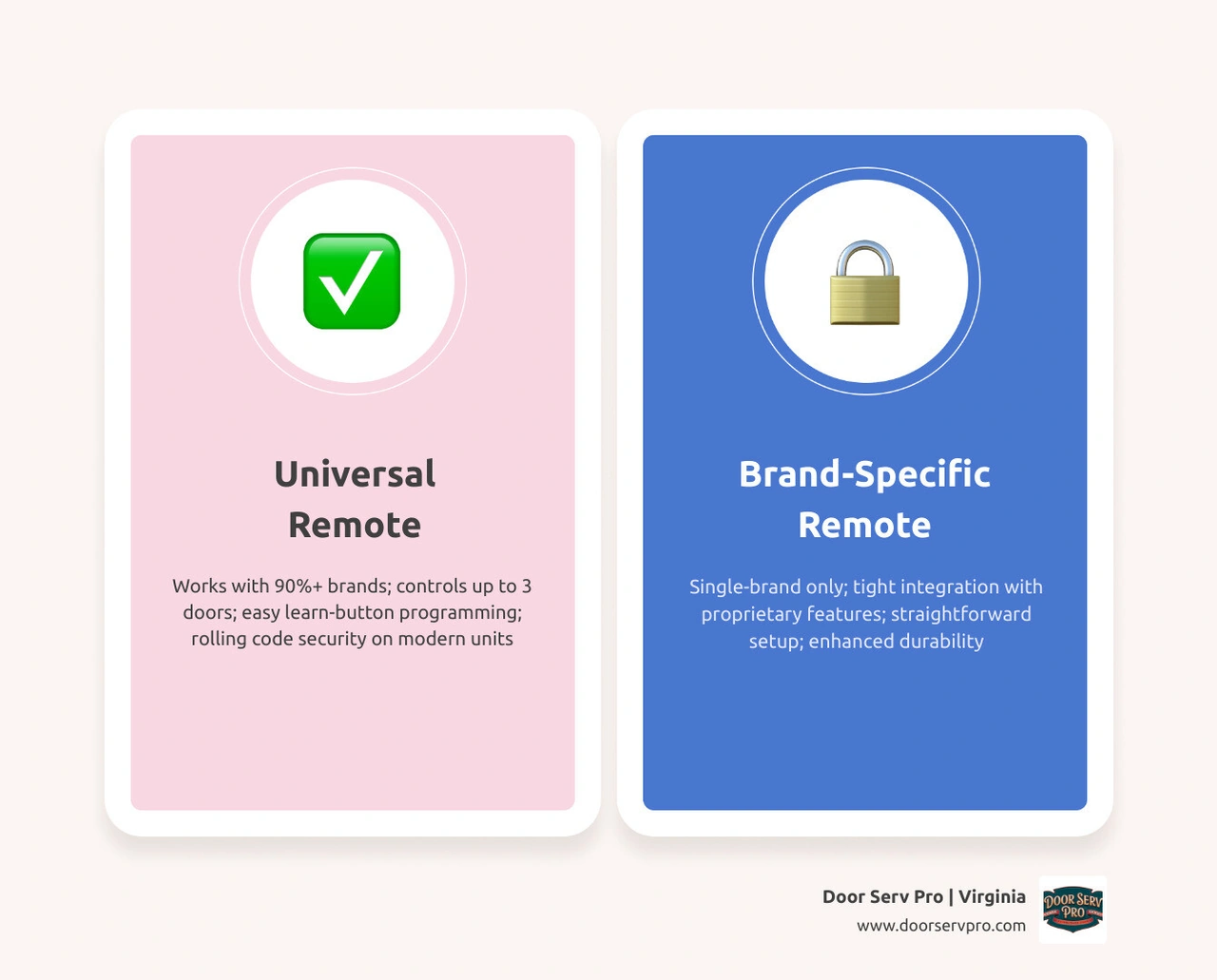
When deciding between a universal garage door remote vs brand specific remote, the short answer is this: universal remotes work with most openers and offer more flexibility, while brand-specific remotes offer tighter integration and slightly more reliability within a single system.
Here's a quick side-by-side to help you decide fast:
| Feature | Universal Remote | Brand-Specific Remote |
|---|---|---|
| Compatibility | Works with 90%+ of major brands | Works with one brand/model family only |
| Programming | Few steps via Learn button; 1-2 minutes | Straightforward; minimal guesswork |
| Multi-door control | Yes, typically up to 3 doors | Usually limited to one brand's ecosystem |
| Security | Rolling code on modern models | Rolling code, often with proprietary encryption |
| Best for | Mixed-brand garages, replacements | Single-brand setups, maximum integration |
For most Virginia homeowners, the choice comes down to one simple question: do you have more than one garage door opener brand, or have you lost your original remote and can't find a replacement?
If yes to either — a universal remote is likely your best starting point. If you're running a single-brand system and want zero hassle, stick with the brand-specific option.
But there's more to it than that. The frequency your opener uses, whether it supports rolling code technology, and even how old your opener is can all affect which remote actually works for your home.
Know your universal garage door remote vs brand specific terms:
- how to program a garage door remote
- troubleshooting garage door remote and opener issues
- garage door remote replacement when you need it
Understanding Garage Door Remote Technologies
To make an informed decision between a universal garage door remote vs brand specific model, we first need to look under the hood. Garage door remotes are essentially miniature radio transmitters. When you press the button, the remote sends a specific radio signal through the air, which is captured by the receiver inside your garage door opener motor.
Most garage door openers operate on a handful of widely used radio frequencies globally, specifically 300 MHz, 310 MHz, 315 MHz, and 390 MHz.
Historically, older systems manufactured before the mid-1990s relied on physical "dip switches." These are small toggle switches inside both the remote and the opener motor that must be manually set to match each other. If the switches match, the door opens. While simple, this technology is highly vulnerable to security breaches.
Modern systems use sophisticated digital communication methods. Understanding these technical elements helps you keep your system running smoothly. For instance, maintaining fresh power in your transmitter is vital; you can learn more in our Garage Door Remote Battery Guide to keep your system responsive.
How Radio Frequencies and Rolling Codes Work
Modern garage door remotes rely on rolling code technology. Instead of transmitting the exact same code every time you press the button, rolling code systems use an encrypted algorithm to change the code with every single use.
When you click your remote, it sends the current code to the opener. The receiver validates this code, opens the door, and then both the remote and the receiver instantly roll over to the next code out of billions of possible combinations. This prevents a security risk known as "code grabbing," where an intruder intercepts your radio signal and attempts to replay it later to gain unauthorized access.
Because these frequencies and encryption protocols must sync up perfectly, selecting the right remote requires careful attention to your opener's specifications. Keeping your remote powered is crucial for maintaining this encrypted connection, as detailed in our Garage Door Remote Batteries Complete Guide.
Universal Garage Door Remote vs Brand Specific: Key Differences
The primary difference between a universal garage door remote vs brand specific remote lies in how they handle compatibility and signal transmission.
A brand-specific remote (often called an OEM, or Original Equipment Manufacturer remote) is built by the same company that manufactured your garage door opener (such as Chamberlain, LiftMaster, Genie, or Craftsman). It is hardwired to transmit on that brand's specific proprietary frequency and encryption protocol. There is absolutely no guesswork; if you buy a LiftMaster remote for a LiftMaster opener, they will communicate seamlessly.
A universal remote, on the other hand, is designed to be a multi-brand translator. It features internal circuitry capable of emulating different frequencies (300 MHz to 390 MHz) and various brand-specific encryption protocols. This allows a single universal remote to operate a Genie opener on your left garage door and a LiftMaster opener on your right garage door.
Universal garage door remotes are highly versatile, compatible with over 90% of all garage door openers in North America. To understand the full scope of replacing a lost or broken remote, you can check out our Garage Door Remote Replacement Complete Guide.
| Feature | Universal Remote | Brand-Specific Remote |
|---|---|---|
| Primary Advantage | Consolidates multiple brands into one device | Guaranteed out-of-the-box compatibility |
| Frequencies Supported | Multi-frequency (300, 310, 315, 390 MHz) | Single, fixed proprietary frequency |
| Battery Lifespan | Typically 12–18 months | Up to 2 years due to optimized power usage |
| Security Standards | Emulates rolling codes; legacy DIP switches | Native high-grade proprietary encryption |
| Clutter Reduction | Excellent (one remote controls up to 3-4 doors) | Low (requires separate remotes for different brands) |
Programming a Universal Garage Door Remote vs Brand Specific Model
Programming a brand-specific remote is usually incredibly simple. Because the remote already speaks the opener's language, you typically just have to press the "Learn" button on your garage door opener motor unit, press the button on your remote, and wait for the opener's light bulb to flash. The entire process takes less than 30 seconds.
Programming a universal remote requires an extra step: you must first tell the remote which brand and frequency it needs to emulate. This is often done by putting the remote into "programming mode" (sometimes using a small pin or a specific button sequence), pressing the remote button a set number of times corresponding to your brand, and then syncing it with the opener's "Learn" button.
While it requires a little more attention to detail, programming a universal garage door remote typically takes just a minute or two. If you encounter any hiccups during this process, our guide on Fixing Garage Door Remote Issues can help you troubleshoot signal blocks and synchronization errors.
Security Features: Universal Garage Door Remote vs Brand Specific Encryption
A common concern among homeowners in Northern Virginia is whether universal remotes are as secure as brand-specific ones.
The short answer is yes—provided you purchase a high-quality, reputable universal remote. Modern universal remotes from trusted brands are fully capable of emulating rolling code technology. They will generate a brand-new, encrypted code with every button press, matching the high security standards of OEM remotes.
However, there are a few security caveats to keep in mind:
- Legacy Systems: If you use a universal remote to operate an older pre-1993 opener, the remote must fallback to a weaker, fixed-code signal (using DIP switches). This is a limitation of the old opener, not the remote itself, but it does leave your home vulnerable to code-grabbing devices.
- Generic Third-Party Remotes: Extremely cheap, unbranded universal remotes purchased online may use outdated cloning chips that bypass rolling code security. These devices copy the static signal of your existing remote rather than generating dynamic rolling codes, which significantly lowers your home's security. Always stick to recognized, high-quality universal brands.
Pros and Cons of Universal and Brand-Specific Remotes
Choosing the best remote for your home in Ashburn, Leesburg, or Winchester requires weighing the pros and cons of each option based on your daily routine.
Advantages of Universal Remotes
- Unmatched Versatility: If you live in a multi-car household where the left bay uses a newer LiftMaster belt-drive opener and the right bay uses an older Genie screw-drive system, a single universal remote can control both. You can program button A for door one, button B for door two, and even button C for a community gate.
- Consolidation and Less Clutter: Instead of lining your car visor with three different plastic clickers, you can consolidate everything into one sleek, modern visor clip or keychain remote.
- Emergency Readiness and Availability: If your original remote breaks, finding an exact brand-specific replacement for an older or discontinued opener model can be difficult. Universal remotes are widely available and can act as an instant backup.
- Long-Lasting Keypad Options: If you opt for an exterior wall-mounted keypad, a well-maintained universal keypad can last for many years, often exceeding 5 to 7 years of reliable service.
Disadvantages of Universal Remotes
- Slightly Shorter Battery Life: Because universal remotes contain multi-frequency chips that require more processing power to search for and transmit multiple signals, their batteries typically last 12 to 18 months, compared to the 2-year lifespan of brand-specific options.
- Ambiguous Setup Guides: If the printed instructions are poorly translated or confusing, matching your opener's "Learn" button color to the correct number of button presses on the remote can feel like solving a puzzle.
Advantages of Brand-Specific Remotes
- Guaranteed Out-of-the-Box Compatibility: There is zero guesswork. If you buy an OEM remote designed for your specific opener model, it will program on the first try.
- Access to Advanced Proprietary Features: Some brand-specific remotes offer unique features, such as controlling the opener's work lights independently or integrating directly with smart home systems like MyQ without requiring external bridges.
- Superior Durability and Weather Resistance: OEM remotes are often manufactured with higher-grade plastics and tighter seals, making them slightly more resilient to extreme winter cold and summer humidity in Virginia.
- Optimized Power Consumption: Because the remote is finely tuned to transmit on only one frequency, it maximizes battery efficiency.
If you decide that a brand-specific replacement is the best path for your home, you can read our Garage Door Remote Replacement Guide for steps on identifying your model and securing a genuine OEM replacement.
Disadvantages of Brand-Specific Remotes
- Zero Cross-Brand Flexibility: If you upgrade one of your garage door openers to a different brand in the future, your existing brand-specific remote will become completely useless for that door.
- Visor Clutter: If you have multiple garage doors from different manufacturers, you will be forced to carry multiple distinct remotes in your vehicle.
Key Factors to Consider Before Choosing Your Remote
Before making your final purchase, we recommend checking these five critical factors on your garage door system:
- The Age of Your Garage Door Opener: If your opener was manufactured before 1993, it likely does not have safety photoelectric sensors at the base of the tracks. These older systems use obsolete frequencies and lack rolling code security. In many cases, modern universal remotes will not pair with them, and for safety and security reasons, it is highly recommended to replace the entire opener unit.
- The Color of the "Learn" Button: On Chamberlain, LiftMaster, and Craftsman openers, the color of the physical "Learn" button on the motor head (typically yellow, purple, red/orange, or green) indicates the exact radio frequency and security protocol the system uses. Universal remotes will have a compatibility chart matching these colors to specific programming steps.
- Radio Frequency (RF) Interference: If your garage door remote suddenly experiences a drop in range—requiring you to pull all the way up to the door before it opens—check your light bulbs. Standard LED bulbs installed inside the garage door opener housing can emit electromagnetic interference that blocks the remote's radio signal. Swapping them out for specialized, shielded garage door LED bulbs or traditional incandescents often solves the problem.
- Car Electrical Interference: In rare cases, a vehicle's electrical system, alternator, or onboard computer can emit RF interference that prevents a garage remote from working while the engine is running. If your remote works perfectly while the car is off but fails when the engine is idling, testing a different remote frequency or repositioning the opener's antenna wire can help.
- Smart Home Integration: If you want to control your garage door using a smartphone app or integrate it with home automation platforms, ensure your remote choice aligns with your smart hub. While brand-specific remotes integrate seamlessly with their native smart ecosystems, some universal remotes may require additional smart receivers to bridge the gap.
Frequently Asked Questions
Can a universal remote control multiple garage doors from different brands?
Yes! This is one of the greatest benefits of a universal remote. A single universal remote control typically features two, three, or four buttons. You can program button one to operate a LiftMaster opener, button two to operate a Genie opener, and button three to operate a Craftsman opener. Each button acts independently, storing its own distinct frequency and encryption protocol.
Are universal remotes as secure as brand-specific remotes?
Yes, as long as you purchase a high-quality remote from a reputable manufacturer. Reputable universal remotes fully support modern rolling code technology, meaning they generate a brand-new, encrypted code with every single button press. This provides the exact same level of protection against digital code grabbing as an original, brand-specific remote.
What should I do if my universal remote fails to program?
If your universal remote refuses to sync with your opener, try these troubleshooting steps:
- Check the Battery: Low battery voltage is the number one cause of failed programming sequences. Install a fresh lithium battery before trying again.
- Identify the Learn Button Color: Ensure you are following the exact programming steps designated for your opener's specific "Learn" button color or manufacturing year.
- Clear the Opener's Memory: If your opener has reached its maximum limit of programmed remotes (usually between 5 and 8 devices), it will reject new ones. Hold down the opener's "Learn" button for about 6 seconds until the indicator light goes out to clear the memory, then reprogram your devices.
- Eliminate LED Interference: Temporarily unscrew any LED light bulbs from the opener motor housing and try programming the remote again.
Conclusion
Whether you choose a universal remote to simplify a multi-brand garage or a brand-specific remote for seamless, single-system integration, having a reliable wireless entry system is essential for your daily convenience and home security.
At Door Serv Pro, we have spent over 30 years providing top-rated garage door repair, maintenance, and installation services across Northern Virginia. As a family-owned business, we are proud to serve homeowners and businesses in Winchester, Ashburn, Berryville, Front Royal, Leesburg, McLean, Middletown, Reston, Stephens City, and Vienna.
If you are struggling with a stubborn garage remote, experiencing range issues, or looking to upgrade your entire garage door system to a modern, secure setup, we are here to help. Schedule professional garage door maintenance with Door Serv Pro today, or reach out to our friendly local team to find the perfect remote access solution for your home!