Blog
How to Stop Your Garage Door from Shaking and Rattling
Door Serv Pro
Reviewed by the Door Serv Pro service team · Trained, professional garage door technicians
Last updated June 24, 2026
Why a Garage Door Shaking or Vibrating During Operation Is a Warning You Shouldn't Ignore
Garage door shaking or vibrating during operation is one of the most common signs that something in your door system needs attention. It might still open and close just fine — but that rattling, trembling, or wobbling as it moves along the tracks is your door telling you something is off.
The causes range from minor issues like loose bolts or dry hinges, to more serious problems like worn rollers, misaligned tracks, failing pulleys, or an unbalanced door system. Left alone, small vibrations tend to get worse over time. That's because vibration loosens hardware, and loose hardware creates more vibration — a cycle that accelerates wear across the entire system.
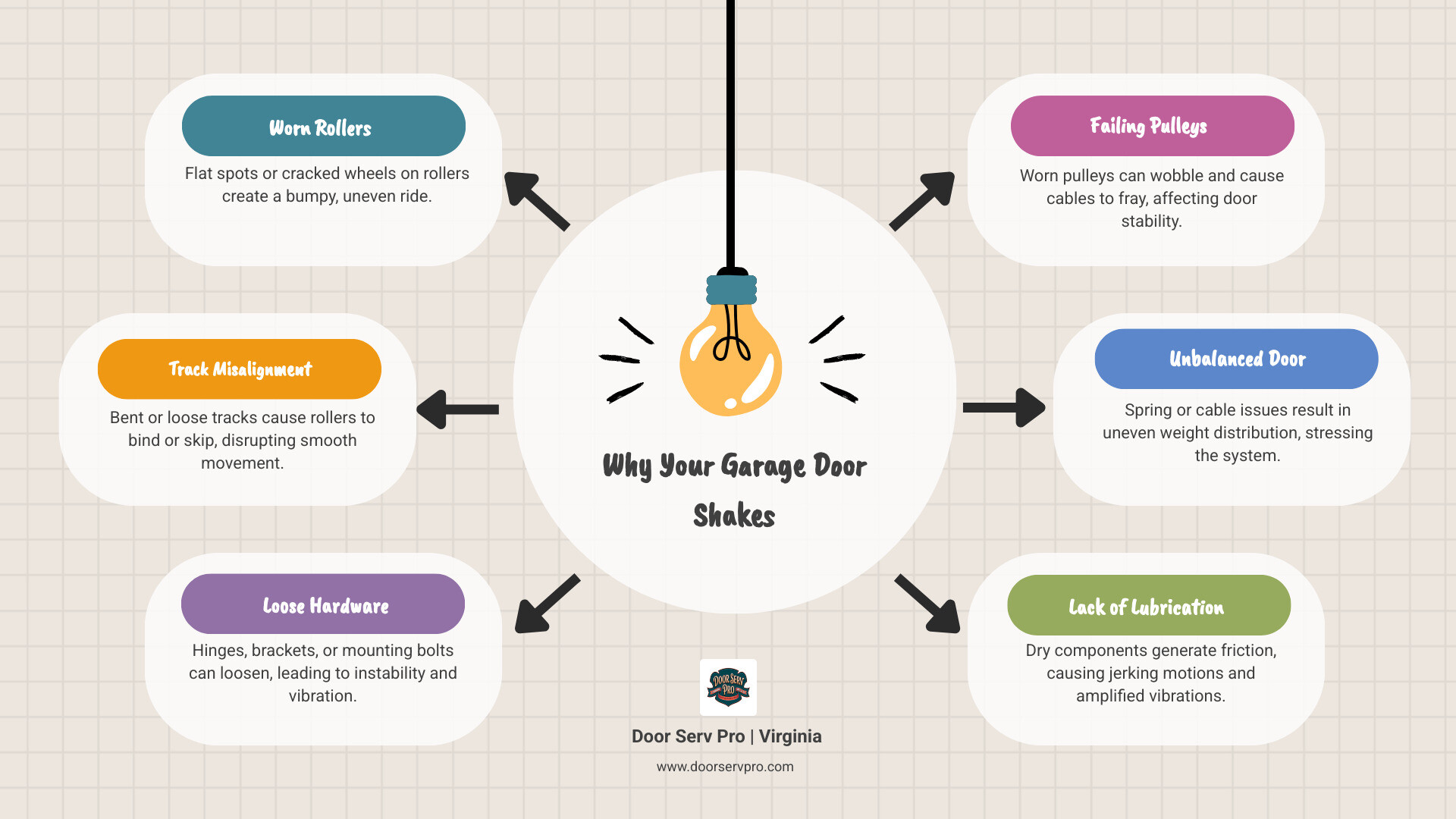
Here are the most common reasons a garage door shakes or vibrates during operation:
- Worn or damaged rollers – flat spots and cracked wheels cause a bumpy, uneven ride
- Misaligned or loose tracks – rollers bind or skip when tracks shift out of position
- Loose hinges, brackets, or mounting hardware – natural use gradually loosens fasteners
- Failing pulleys – worn press fit pulleys wobble and cause cables to fray
- Unbalanced door – spring or cable issues create uneven weight distribution
- Opener strain – the opener amplifies existing instability rather than causing it directly
- Lack of lubrication – dry components create friction, jerking, and uneven movement
If your garage door is shaking in Virginia, Door Serv Pro is available 24/7 to diagnose and fix the problem before it becomes a costly repair.
Mechanical Reasons for a Garage Door Shaking or Vibrating During Operation
When we talk about a garage door system, we are looking at a heavy machine designed to move as a single, stable unit. When it begins to tremble, it’s usually because the "guidance" system—the tracks and rollers—is failing to maintain a smooth path. Mechanical instability is rarely a localized issue; because every part is interconnected, a vibration in the rollers can eventually rattle the hinges loose, which in turn stresses the opener.
Understanding the importance of timely garage door repair to prevent bigger problems is the first step toward a quiet home. If you ignore the shaking, you aren't just dealing with noise; you're allowing the door to slowly shake itself apart.
Identifying a Garage Door Shaking or Vibrating During Operation Due to Worn Rollers
Rollers are the "tires" of your garage door. Just like a car with a flat spot on its tire will vibrate at high speeds, a roller with a flat spot will cause the door to hop and jitter.
In our service areas like Ashburn and Leesburg, we see a wide variety of roller wear. Older steel rollers without sealed bearings are particularly susceptible to the humidity we experience in Virginia. These rollers tend to rust and seize, forcing the wheel to slide rather than roll, which creates intense vibration.
We often recommend upgrading to sealed nylon rollers. Unlike standard steel, nylon provides a much quieter ride and the sealed ball bearings prevent dust and grit from entering the race. This is especially important in Virginia's climate, where seasonal temperature swings can cause metal components to expand and contract, leading to cracked rollers and uneven movement.
Track Misalignment and Binding
The tracks act as the highway for your door. If the highway is bent or shifting, the ride gets bumpy. Garage door shaking or vibrating during operation is frequently caused by tracks that have moved out of vertical alignment.
Over time, the vibration from daily use can loosen the mounting bolts and brackets that hold the tracks to your garage walls. If a track becomes slightly crooked, the rollers will "bind" or get squeezed against the metal. This resistance causes the door to jerk and shake as the opener tries to force it through the tight spot. You might notice the shaking is most aggressive at a specific point—usually where the vertical track curves into the horizontal ceiling track.
The Impact of Worn Pulleys and Hardware
While rollers and tracks are the most visible parts, the hardware holding everything together is just as vital. When hinges crack or pulleys wobble, the door loses its structural integrity. This creates a "vibration cycle": the door shakes because it's loose, and the shaking makes it even looser.
In many cases, quick garage door repair involving the tightening of hardware can solve minor rattles, but deeper mechanical failures require part replacement.
Why a Garage Door Shaking or Vibrating During Operation Often Points to Pulley Failure
If your door sounds like it’s about to fall off the tracks, the culprit is often the pulleys. Most standard garage doors are installed with Press Fit Pulleys. These are made of two separate pieces of metal riveted together.
| Feature | Press Fit Pulleys | Cast Iron Pulleys |
|---|---|---|
| Construction | Two-piece (riveted) | One-piece solid casting |
| Lifespan | 3–5 years | 10–15+ years |
| Bearing Type | Open (prone to dust) | Sealed ball bearings |
| Failure Mode | Splitting/Wobbling | Slow wear (rarely splits) |
When the ball bearings in a press fit pulley wear out—usually after just 3 to 5 years—they begin to crush each other. This causes the pulley to wobble on its axis. As it wobbles, it pulls the cables unevenly, leading to a violent shaking motion. Furthermore, a splitting pulley can allow the cable to rub against sharp edges, causing dangerous fraying.
Loose Hinges and Mounting Brackets
Every time your door opens, the hinges allow the panels to bend around the track curve. If the screws in these hinges are loose, the panels will shift independently of one another. This "panel play" creates a resonance that sounds like a loud rattling or banging.
We often find that the mounting brackets for the garage door opener rail are also culprits. If the rail isn't securely fastened to the header or the ceiling, the entire motor unit can swing slightly during operation, amplifying the vibration throughout the garage.
Safety Risks of Unbalanced Systems
A garage door is a heavy object balanced by high-tension springs. When the system is out of balance, the weight isn't distributed evenly. This causes the door to "cock" or tilt, putting immense strain on one side.
Maintaining a balanced system is one of the preventive maintenance: key steps to avoid costly garage door repair. An unbalanced door doesn't just shake; it's a safety hazard that could lead to a sudden drop.
How an Unbalanced Garage Door Shaking or Vibrating During Operation Risks Safety
If your springs are weak or one has more tension than the other, the door will struggle to rise evenly. This manifests as a "jerking" motion. The opener has to work twice as hard to pull the heavy side of the door, which can lead to the motor burning out prematurely.
More importantly, an aggressively shaking door can vibrate itself right out of the tracks. If a cable snaps or a roller pops out while the door is under tension, the results can be catastrophic. If you see your door bouncing or if it feels heavy when you try to lift it manually, stop using it immediately.
Cable Tension and Drum Issues
Cables work in tandem with the springs to lift the door. If the cables have "slack" or are frayed, they won't wrap around the drums correctly. This causes the door to lift in "fits and starts," creating a vibrating sensation. We recommend a professional inspection if you notice any "bird-nesting" (tangled strands) on your cables, as these are under high tension and are not safe for DIY repair.
Maintenance Steps for Virginia Homeowners
While major repairs like spring replacement or track realignment should be left to the pros at Door Serv Pro, there are several things you can do to keep your door quiet in towns like Vienna and Berryville.
- Clean the Tracks: Use a damp cloth to wipe out the inside of the tracks. Never use grease or oil inside the tracks, as this actually attracts dirt and creates a "grinding paste" that increases vibration.
- Lubricate Moving Parts: Use a high-quality silicone-based lubricant. Focus on the roller stems (not the wheels themselves), the hinges, and the springs. This reduces friction and prevents the "jerking" motion associated with dry parts.
- Tighten Hardware: Grab a wrench and check the bolts on the hinges and track brackets. A quarter-turn is often all it takes to stop a rattle.
- Check the Balance: Disconnect your opener and lift the door halfway. If it stays in place, it’s balanced. If it slams shut or shoots upward, your springs need professional adjustment.
Understanding the role of maintenance in preventing garage door opener repairs will save you significant stress in the long run.
Professional Inspection and Tune-Ups
Sometimes, a shaking door needs more than a shot of lubricant. A professional technician will perform a full-system audit, checking the safety sensors, verifying the auto-reverse function, and ensuring the vertical and horizontal tracks are perfectly plumb. You can find more info about professional garage door service on our blog to see exactly what a 20-point inspection entails.
Frequently Asked Questions
Can a garage door opener cause the shaking?
The opener usually doesn't create the vibration, but it certainly amplifies it. If the door is already unstable due to worn rollers or bad balance, the opener pulls against that resistance with uneven force. This makes the existing vibration much more noticeable. However, if the drive chain is too loose, it can slap against the rail, creating its own unique rattling sound.
How often should I lubricate my garage door to stop rattling?
For homeowners in Northern Virginia and the Shenandoah Valley, we recommend lubricating your door at least twice a year. The best times are in the spring and fall, preparing the metal components for the extreme temperature shifts of summer and winter. Always use a silicone or lithium-based spray rather than WD-40, which is a degreaser, not a long-term lubricant.
Is it safe to use a garage door that is aggressively shaking?
No. Aggressive shaking is a sign of mechanical distress. It indicates that a component is on the verge of failure. Continued use can lead to track derailment, where the door falls out of the overhead tracks entirely. If your door is jerking violently, stop operation and call for an emergency repair.
Conclusion
A quiet, smooth-running garage door is a sign of a healthy home. If you are experiencing garage door shaking or vibrating during operation, don't wait for the system to fail completely. Whether you are in Reston, Front Royal, or Stephens City, our family-owned team is ready to help.
With over 30 years of craftsmanship and a deep commitment to our Virginia community, Door Serv Pro provides the expert touch needed to turn that clamor back into calm. Addressing vibration early prevents further damage and ensures your home's safety—give us a call today for a professional tune-up!
Need Help?
Contact us today to discuss your needs. Our team is ready to help.
About the author
Door Serv Pro
More articles
View all postsKeep reading
Related articles
Ready to Get Started?
Whether you need a repair, maintenance, or a new installation, our expert team is here to help.