Blog
Stuck in the Driveway? What to Check When Your Garage Door Fails
Door Serv Pro
Reviewed by the Door Serv Pro service team · Trained, professional garage door technicians
Last updated June 24, 2026
When Your Garage Door Stops Working: What's Actually Going On
If you're wondering why is my garage door not opening or closing, you're not alone — and the answer is usually one of a handful of common problems you can check in minutes.
Here are the most likely reasons your garage door has stopped working:
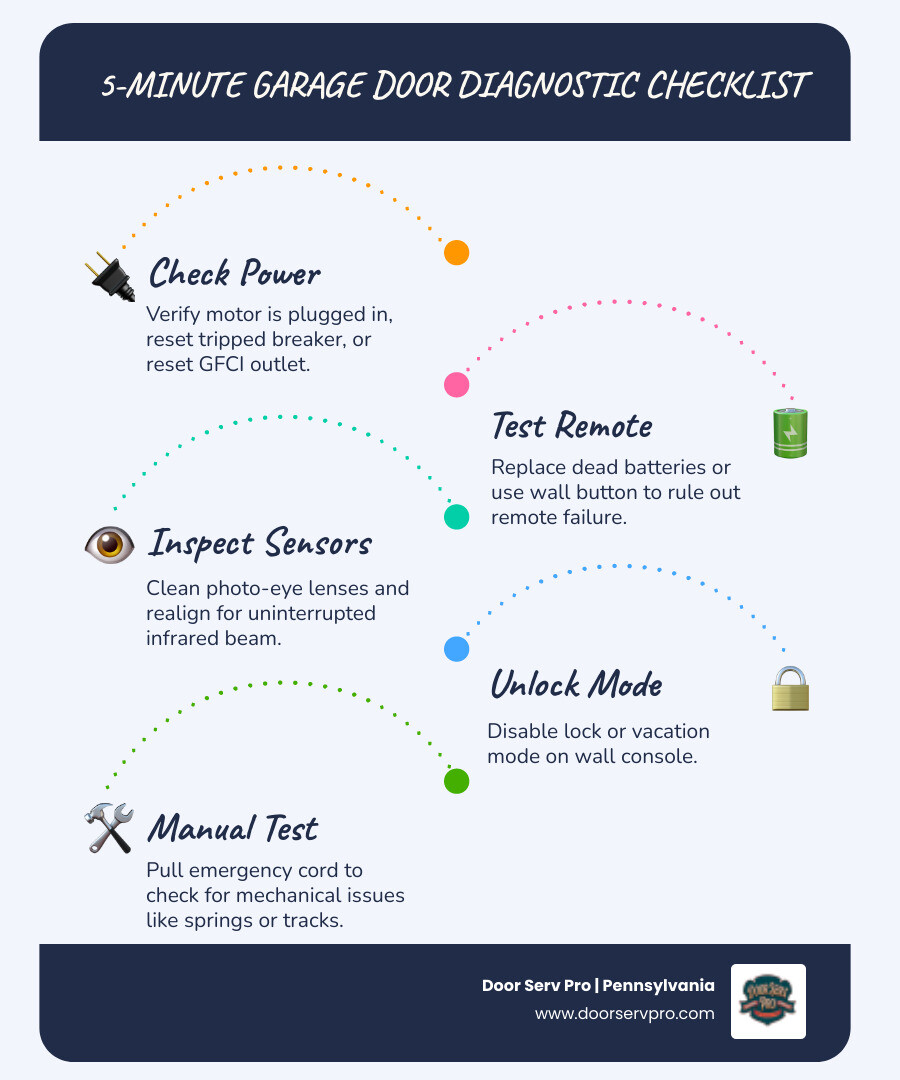
- No power - The opener is unplugged, the circuit breaker has tripped, or a GFCI outlet has cut power to the unit
- Dead remote batteries - The most common single cause; try the wall button to confirm
- Misaligned or dirty safety sensors - The photo-eye sensors near the floor are blocked, dirty, or out of alignment
- Lock mode is on - The wall panel's lock or vacation button was accidentally activated
- Broken spring or cable - The door is too heavy for the opener to move without spring assistance
- Opener is disconnected - The emergency release cord was pulled and the trolley hasn't re-engaged
- Track obstruction or damage - Debris, a bent track, or a worn roller is blocking movement
- Limit or force settings are off - The opener doesn't know where "open" or "closed" actually is
- Weather or rust - Cold temperatures, ice buildup, or corroded parts are creating resistance
- Internal opener failure - Stripped gears, a bad logic board, or a failed capacitor inside the motor unit
According to industry data, dead remote batteries, a tripped circuit breaker, misaligned safety sensors, and an accidentally engaged lock mode account for roughly 80% of all garage door opener failures — and every one of those can be fixed in under five minutes at no cost.
That said, problems like broken springs, snapped cables, and internal motor failures are a different story. Those require a trained technician.
At Door Serv Pro, we've seen every one of these issues across homes throughout Pennsylvania — and we know how stressful it is when your garage door fails unexpectedly, whether your car is stuck inside or you simply can't secure your home. This guide walks you through each cause clearly, so you can diagnose what's wrong and decide whether it's a quick DIY fix or time to call for help.
Why Is My Garage Door Not Opening or Closing? Start with the Basics
Before we dive into the complex mechanical components, we always recommend starting with the simplest explanation: power. It sounds obvious, but you would be surprised how often a "broken" door is just a "disconnected" one.
First, look up at the motor unit hanging from your ceiling. Is it plugged in? Over time, the vibrations from the door opening and closing can actually wiggle the plug right out of the socket. If it’s plugged in but still dark, check your electrical panel for a tripped circuit breaker. In many Pennsylvania garages, the opener is on the same circuit as a refrigerator or deep freezer; when those appliances kick on, they can occasionally pull enough juice to trip the breaker.
Another common culprit is the GFCI outlet. These are the outlets with "Test" and "Reset" buttons. If the GFCI has tripped due to a moisture spike or a minor surge, it will cut power to everything downstream, including your opener. Simply pressing the "Reset" button can often bring your door back to life. If you've checked these and the motor still won't hum, you might be facing one of the most common garage door problems that require a deeper look. If the motor runs but the door stays still, read our guide on what to do when your garage door won't open.
Troubleshooting Why Is My Garage Door Not Opening or Closing Due to Remote Issues
If your wall button works but your remote is ignored, the problem is likely in your hand, not on the ceiling. Dead batteries are the #1 reason remotes fail. Most remotes use a CR2032 coin cell battery, and we recommend replacing them at least every five years—even if they seem to be working—to avoid being locked out in the cold. You can find more details in our garage door opener remote battery replacement guide.
However, if you've swapped the batteries and it still won't budge, consider these "hidden" remote issues:
- Signal Interference: Believe it or not, certain LED light bulbs in the opener itself can emit radio frequency interference that "jams" your remote's signal. If you recently changed a light bulb and the remote stopped working, try removing the bulb.
- Reprogramming Needs: Occasionally, a power surge or a long period with a dead battery can cause the remote to lose its "handshake" with the motor. You may need to press the "Learn" button on the motor unit to resync them.
- Keypad Desync: If your exterior keypad is the issue, it may need a factory reset or new wiring. Check out our tips on garage door keypad repair for more help.
Checking the Wall Console and Lock Mode
Have you ever pressed your remote only to see the light on the motor flash, but the door refuses to move? You might have accidentally engaged "Lock Mode" or "Vacation Mode" on your wall console. This feature is designed to prevent unauthorized remote access while you're away, but it's very easy for a child or a stray elbow to bump the button.
Look at your wall-mounted control panel. If the light is blinking rapidly, hold the "Lock" button down for about five seconds to disengage it. If the wall button itself is unresponsive, we may need to inspect the low-voltage wiring running from the button to the motor. Loose staples or a wire chewed by a rodent can easily break the connection. For residents in the Keedysville area, we offer specialized garage door opener repair to handle these electrical gremlins.
Safety Sensor Malfunctions and Alignment Issues
If your garage door starts to close, gets about halfway down (or just a few inches), and then suddenly reverses while the opener lights flash, your safety sensors are likely the cause. Since 1993, federal law has required these "photo-eyes" to prevent doors from closing on people, pets, or vehicles.
These sensors sit about six inches off the ground on either side of the door. They project an invisible infrared beam across the opening. If that beam is broken, the door will not close. Check the small LED lights on both sensors; they should both be glowing steadily. If one is flickering or off, the sensors are either misaligned or blocked.
Identifying Why Is My Garage Door Not Opening or Closing Because of Sensor Obstructions
You don't always need a technician to fix a sensor issue. Before calling us, try these quick steps:
- Clean the Lenses: Dust, dirt, and even spider webs can block the "eye." Wipe them gently with a soft, dry cloth.
- Check for Obstructions: Is there a leaf, a trash can, or a stray garden tool breaking the beam? Even a tiny cobweb hanging in front of the lens can be enough to trigger a reversal.
- Realignment: Vibrations can loosen the wingnuts holding the sensors. Gently wiggle the sensor until the light stays solid.
- Sunlight Interference: In certain parts of Pennsylvania, the morning or evening sun can hit the receiving lens at just the right angle to "blind" it. If your door only fails to close at a specific time of day, you may need to build a small sun shield for the sensor.
For more advanced troubleshooting, see our top garage door opener repair tips. If the lights are solid but the door still won't close, it might be time to consult a professional.
Mechanical Failures: Springs, Cables, and Tracks
When the problem is mechanical, you’ll usually hear it before you see it. A loud "bang" from the garage often signals a broken spring. Most garage door springs are rated for about 10,000 cycles. If you use your door four times a day, you can expect your springs to last roughly seven years.
| Symptom | Likely Cause | Severity |
|---|---|---|
| Loud "shotgun" bang; door won't lift | Broken Torsion Spring | High (Dangerous) |
| Door hanging crookedly; loose wire | Snapped Cable | High (Dangerous) |
| Grinding noise; door jerky | Track Obstruction/Dirt | Medium |
| Motor hums; door doesn't move | Stripped Gears | Medium |
A properly balanced torsion spring does 90% of the heavy lifting. When it breaks, your door becomes "dead weight"—often 200 to 400 pounds of it. Trying to force the opener to lift a door with a broken spring can quickly burn out the motor. If you suspect a spring issue, read our guide to garage door spring repair and avoid attempting a DIY fix, as these parts are under extreme tension. Similarly, if a cable has frayed or snapped, refer to our snapped garage door cable guide.
Off-Track Doors and Obstructed Rollers
Sometimes the door is physically stuck because it has jumped its tracks. This often happens if the door hits an object while closing or if a cable snaps. A door that is "off-track" is extremely unstable and can fall unexpectedly.
If you see the rollers popping out of the metal rails or the tracks themselves look bent, do not attempt to move the door. You can pull the red emergency release cord to disconnect the motor, but be extremely careful—if the springs are also broken, the door could crash down. For those in the Cresaptown area, we specialize in helping homeowners fix off-track garage doors safely.
Opener Motor and Internal Component Troubleshooting
If the springs are intact and the power is on, but the motor just hums or makes a grinding noise, the problem is likely internal. Most modern openers use nylon drive gears. These are actually designed to be the "weak point" in the system; if the door is too heavy or hits an obstruction, the plastic gear will strip out to prevent the more expensive motor from burning out. If you see white plastic "snow" inside your opener housing, you have a stripped gear.
Other internal issues include:
- Logic Board Failure: Think of this as the "brain" of the opener. Lightning strikes or power surges can fry the board, leading to erratic behavior or total silence.
- Capacitor Issues: If the motor hums for a second and then clicks off, the start capacitor (which gives the motor a "kick" to get moving) may have failed.
- Limit and Force Settings: These settings tell the motor how far to travel. If they are misadjusted, the door might think it hit something when it’s actually just reaching the floor, causing it to reverse.
When internal components fail on an older unit, we often discuss whether it's more cost-effective to repair or move forward with a new garage door installation.
Environmental Factors and Rust Buildup
In Pennsylvania, our weather plays a huge role in why is my garage door not opening or closing. During our freezing winters, the metal tracks and springs contract, which can make the door feel "tighter" and more difficult to move. The bottom rubber seal can also freeze to the driveway; if you try to open the door while it's iced shut, you risk stripping the gears or tearing the seal.
Rust is another silent killer. High humidity or road salt brought in by your car can corrode the rollers and hinges, causing them to seize up. We recommend using a silicone-based lubricant—never WD-40, which actually attracts dirt—on all moving parts twice a year. For more localized advice, check out our tips for garage door maintenance in New Market, MD.
Preventive Maintenance and Professional Solutions
The best way to ensure you never ask "why is my garage door not opening or closing" is to stay ahead of the wear and tear. We recommend an annual "tune-up" where we tighten all hardware, lubricate moving parts, and—most importantly—perform a balance test.
To check your door's balance yourself:
- Close the door and pull the emergency release cord.
- Lift the door manually to the halfway point and let go.
- A well-balanced door should stay in place. If it slams shut or shoots upward, your springs need professional adjustment.
Regular care not only extends the life of your opener but also keeps your family safe. Our team has documented how routine maintenance prevents emergency door repairs. Understanding the importance of balance is the first step toward a worry-free garage.
Frequently Asked Questions about Garage Door Malfunctions
Why does my garage door hum but not move?
This usually means the motor is trying to work but is physically blocked. The most common reasons are a broken spring (making the door too heavy to lift), a stripped nylon drive gear, or the door being manually locked. Check the slide lock on the side of the door first!
Can I manually open my door if the spring is broken?
We strongly advise against this. Without the spring's counterbalance, a garage door can weigh over 200 pounds. Attempting to lift it manually can cause serious back injury, and if you lose your grip, the door can crash down like a guillotine. If you must get your car out, call for professional assistance.
Why does my door reverse before hitting the floor?
This is typically a "close-limit" or "force" setting issue. The opener thinks the door has reached the bottom before it actually has, or it's detecting a tiny bit of resistance (like ice or a thick rug) and reversing for safety. A quick adjustment to the limit screws on the motor unit usually fixes this.
Conclusion
A malfunctioning garage door is more than just a nuisance; it’s a security risk and a major disruption to your day. Whether it’s a simple sensor alignment or a complex spring replacement, identifying the root cause is the first step toward getting back on track.
At Door Serv Pro, we take pride in being Pennsylvania’s trusted garage door experts. As a family-owned business with over 30 years of craftsmanship, we’ve built our reputation on reliability and community focus. Whether you need a quick garage door repair in Libertytown, MD or emergency service in Chambersburg, we’re here 24/7 to help.
Don't let a stuck door ruin your schedule. Contact Us today for expert service you can count on!
Need Help?
Contact us today to discuss your needs. Our team is ready to help.
About the author
Door Serv Pro
More articles
View all postsKeep reading
Related articles
Ready to Get Started?
Whether you need a repair, maintenance, or a new installation, our expert team is here to help.