Blog
The Heavy Lifters: Ranking Garage Openers by Reliability
Door Serv Pro
Reviewed by the Door Serv Pro service team · Trained, professional garage door technicians
Last updated June 24, 2026
The Most Reliable Garage Door Opener Types, Ranked for Maryland Homeowners
Which garage door opener type is most reliable comes down to how many moving parts the system has, how well it handles your climate, and how often it needs maintenance. Here is a quick answer before we dig into the details:
Reliability Ranking at a Glance:
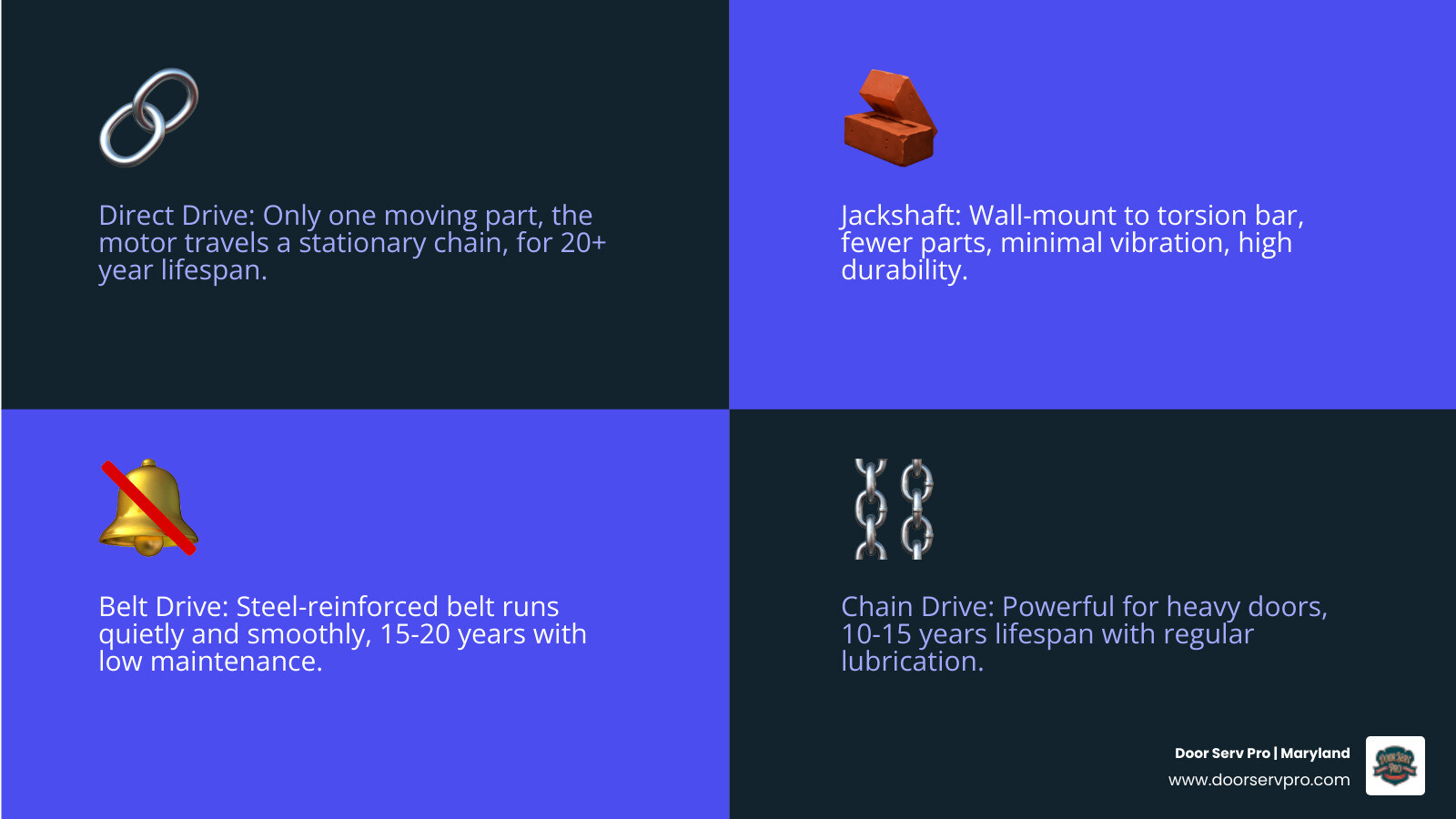
- Direct Drive - Only one moving part; the motor travels along a stationary chain. Lifespan of 20+ years. Often backed by lifetime warranties.
- Jackshaft (Wall-Mount) - Mounts to the torsion bar beside the door. Fewer moving parts, less vibration, excellent durability.
- Belt Drive - Steel-reinforced rubber belt; quiet, smooth, and low-maintenance. Lifespan of 15-20 years.
- Chain Drive - The most common type. Durable and powerful, especially for heavy doors. Lifespan of 10-15 years with regular lubrication.
- Screw Drive - Fewer components than chain or belt, but sensitive to temperature swings and requires frequent lubrication.
Your garage door is the largest moving object in your home. It lifts and lowers multiple times every single day, in heat, cold, humidity, and everything in between. Choosing the wrong opener type does not just mean inconvenience — it means premature breakdowns, costly repairs, and mornings where you are stuck in the driveway.
The right choice depends on your door weight, whether your garage is attached or detached, how sensitive you are to noise, and yes — your Maryland climate, where temperature swings and humidity can quietly wear down the wrong system over time.
I'm Paul Wiese, founder of Door Serv Pro, and with over 33 years in the garage door industry — and hands-on experience across hundreds of opener installations in Maryland and beyond — I've seen which opener types hold up and which ones don't when it comes to which garage door opener type is most reliable. In the sections ahead, I'll break down exactly what separates a reliable opener from one that leaves you stranded.
Comparing Drive Mechanisms for Long-Term Performance
When we talk about reliability, we are really talking about physics. Every moving part in a garage door opener is a potential point of failure. By understanding how these mechanisms work, you can predict how they will behave five or ten years down the road.
| Drive Type | Mechanism | Noise Level | Maintenance | Typical Lifespan |
|---|---|---|---|---|
| Direct Drive | Motor moves on track | Lowest | Minimal | 20+ Years |
| Jackshaft | Side-mount to torsion bar | Low | Low | 15-20 Years |
| Belt Drive | Rubber/Kevlar belt | Low | Low | 15-20 Years |
| Chain Drive | Metal bicycle-style chain | High | Moderate | 10-15 Years |
| Screw Drive | Threaded steel rod | Moderate | High | 10-12 Years |
Chain Drive Strength
Chain drives have been the industry standard for decades. They use a heavy-duty metal chain to pull the trolley. Their primary strength is durability under load; they are less likely to slip or stretch when lifting heavy carriage-house doors or solid wood models. However, they are noisy, making them better suited for detached garages.
Belt Drive Silence
Belt drives replace the metal chain with a steel-reinforced rubber or fiberglass belt. They offer a "gold standard" experience for modern suburban homes. Because there is no metal-on-metal contact, they are incredibly quiet and smooth. In terms of which garage door opener type is most reliable, the belt drive is a top contender because it requires virtually no lubrication and resists the "jerking" motion that wears out other components.
Screw Drive Speed and Simplicity
Screw drive openers use a threaded steel rod to move the trolley. They have fewer moving parts than chain or belt drives, which theoretically makes them simpler. They are often faster than other models. However, they struggle with heavy doors and are notoriously sensitive to Maryland’s winter temperatures, where the metal rod can contract and cause friction issues.
Direct Drive and Jackshaft Innovation
Direct drive systems are unique because the motor itself acts as the trolley, moving along a stationary chain. With only one moving part, there is very little that can go wrong. Jackshaft (wall-mount) openers are equally impressive; they mount on the wall beside the door, connecting directly to the torsion bar. This eliminates the overhead rail entirely, reducing vibration and freeing up ceiling space.
Before you make a final decision, it helps to walk through a Choosing the Right Garage Door Opener: A Buyer's Checklist to ensure the model fits your specific garage layout.
Which garage door opener type is most reliable for Maryland homes?
In our experience serving areas from Hagerstown to Frederick, the crown for absolute reliability goes to the Direct Drive and Jackshaft systems.
The Power of Stationary Chains
Traditional openers use a stationary motor to pull a moving chain. Direct drive flips this: the chain stays still, and the motor moves. This design eliminates the long "trolley" arm and the tensioning issues that plague older chain models. Because there is less friction and fewer gears to grind, these units often come with lifetime warranties.
Torsion Bar Integration
Jackshaft openers are the rising stars of residential reliability. By mounting directly to the torsion bar, the opener doesn't have to "fight" the door via a long rail. This direct connection means less strain on the motor. We often recommend these for homeowners in places like Charles Town or Martinsburg who have high ceilings or want to use their overhead space for storage.
Reliability isn't just about the machine; it's about the setup. Ensuring a Garage Door Opener Installation Ensuring Smooth Operation is critical, as even the most reliable direct drive unit will fail if the door isn't balanced correctly.
Mechanical Components and Motor Efficiency
The "heart" of the opener is the motor, and the "muscles" are the drive components. In April 2026, the technology inside these units has reached a point where efficiency directly translates to longevity.
AC vs. DC Motors
Older openers typically used AC (Alternating Current) motors. These are simple "on or off" machines that start and stop with a jolt. Modern, high-reliability openers use DC (Direct Current) motors. DC motors allow for "Soft Start/Stop" technology, which slows the door down as it reaches the floor or the top of the track. This prevents the jarring impact that causes screws to loosen and tracks to misalign over time.
Steel-Reinforced Belts and Forged Rails
If you choose a belt drive, look for steel-reinforced belts. These won't stretch or snap like cheaper rubber versions. Additionally, look for "one-piece" forged rails. Many retail models come with "three-piece" rails that bolt together; these are prone to flexing and rattling, which reduces the overall reliability of the system. We always emphasize these Factors to Consider Before Garage Door Opener Installation to ensure our clients get a "pro-grade" build.
Why DC motors determine which garage door opener type is most reliable
DC motors aren't just quieter; they are smarter. They are more energy-efficient and, most importantly, they allow for battery backup integration. In Maryland, where summer storms or winter ice can knock out power, a battery backup ensures you aren't locked out of your own home. Furthermore, DC motors are often rated in "HPc" (Horsepower Comparable), and because they are more efficient, they run cooler, extending the life of the internal electronics. For many, a Smart Garage Door Opener Upgrade provides both this motor efficiency and the convenience of remote monitoring.
Environmental Factors and Maintenance Schedules
Maryland’s climate is a "stress test" for garage hardware. Between the humidity of a Chesapeake summer and the freezing nights in the Blue Ridge Mountains, your opener is under constant environmental pressure.
Humidity and Thermal Expansion
High humidity can cause wooden doors to swell, increasing the weight the opener must lift. It can also cause metal components to rust if they aren't properly coated. Screw drive openers are particularly susceptible to thermal expansion; the long steel rod can expand or contract just enough to cause the trolley to bind or the motor to strain.
Rolling Code Security and Sensors
Reliability isn't just mechanical; it's about the safety and security of the system. Modern openers use "Rolling Code" technology, which changes the access code every time you press the button. This prevents "code grabbing" by thieves. Additionally, photo-eye sensors must be kept aligned. If your door starts reversing for no reason, it’s often a sensor issue rather than a motor failure. If you find yourself constantly resetting your unit, it might be time for a Garage Door Opener Repair When to Call a Professional.
Maintenance tips for which garage door opener type is most reliable
Even the best machine needs a little love. Here is our "reliability checklist" for Maryland homeowners:
- Lubricate Twice a Year: Use a silicone-based spray on the tracks, rollers, and hinges. Never use grease on the tracks, as it attracts dirt and creates a "grinding paste."
- Check the Balance: Disconnect the opener and lift the door halfway by hand. If it stays put, it’s balanced. If it slams down or flies up, your springs are strained, which will eventually kill your opener motor.
- Clean the Photo-Eyes: Dust and cobwebs on the safety sensors are the #1 cause of "ghost" malfunctions.
- Test the Manual Release: Ensure you can pull the red cord and move the door manually in case of an emergency.
- Tighten the Hardware: Vibration from daily use can loosen the bolts on the tracks and the motor mount. A quick turn of a wrench once a year goes a long way.
Following these Safety Tips for Garage Door Opener Installation and maintenance will ensure your warranty remains valid and your family stays safe.
Frequently Asked Questions about Garage Opener Reliability
How long should a high-quality garage door opener last?
With proper maintenance, a high-quality opener should last between 10 and 20 years. Chain drives usually hit the 10-15 year mark, while belt and direct drive models frequently reach 20 years. The biggest factor in lifespan is the "door balance"—if the opener is constantly fighting an unbalanced door, it will burn out in half the time.
Are wall-mount openers more reliable than overhead models?
In many cases, yes. Because they eliminate the long rail and the trolley mechanism, there are fewer parts to vibrate loose or get caught. They also use a direct-drive connection to the torsion bar, which is a very efficient way to transfer power. They are particularly reliable for garages with high or sloped ceilings where a traditional rail might flex.
Does higher horsepower always mean better reliability?
Not necessarily, but you should never "under-power" a door. A 1/2 HP motor is the standard for single-car aluminum doors. However, for double-car doors or insulated steel doors, a 3/4 HP or 1 HP (or equivalent DC motor) is preferred. A more powerful motor doesn't have to work as hard, which means it runs cooler and lasts longer.
Conclusion
Choosing which garage door opener type is most reliable is a decision that affects your home's security and your daily peace of mind. While chain drives offer rugged strength for detached garages, the quiet, low-maintenance performance of belt drives and the near-indestructible nature of direct drive and jackshaft systems make them the preferred choice for modern Maryland living.
At Door Serv Pro, we have spent over 25 years helping homeowners across Greencastle, Hagerstown, Frederick, and Winchester find the perfect balance of power and reliability. As a family-owned business, we treat every installation like it’s for our own home. Whether you need a 24/7 emergency repair or a brand-new, high-tech installation with a 100% satisfaction guarantee, our NATE-certified team is ready to help.
Don’t wait for your old, noisy opener to give up on a rainy Monday morning. If you are in the Winchester area, check out our Garage Door Opener Repair Winchester VA services, or contact us today for a free estimate on a new, reliable system that will serve your family for decades to come.
Need Help?
Contact us today to discuss your needs. Our team is ready to help.
About the author
Door Serv Pro
More articles
View all postsKeep reading
Related articles
Ready to Get Started?
Whether you need a repair, maintenance, or a new installation, our expert team is here to help.